2. Rotations and Dilations
Sign In
An error ocurred, try again later!
Chapter 11
2.
Rotations and Dilations
This lesson covers geometric transformations like rotation and dilation. It explains how to rotate a point around another and how triangles can be rotated. Additionally, it introduces the concept of dilations, focusing on how to apply coordinate rules for dilation in geometry. Understanding these transformations is crucial in solving problems involving shapes, symmetry, and scaling in various mathematical contexts.
Show less Show more expand_more 


Lesson Settings & Tools
| | 16 Theory slides |
| | 13 Exercises - Grade E - A |
| | Each lesson is meant to take 1-2 classroom sessions |
Rotations and Dilations
Slide of 16
This lesson explores two new transformations, rotations and dilations. Rotations move shapes around a central point, while dilations either enlarge or shrink geometric figures without changing their shape.
Catch-Up and Review
Here are a few recommended readings before getting started with this lesson.
Explore
Share
Report error
Rotating Points About a Fixed Point
In the following applet, points A, B, C, and D, are movable. Arrange them as desired, then use the slider bar to rotate the points around the central point P.
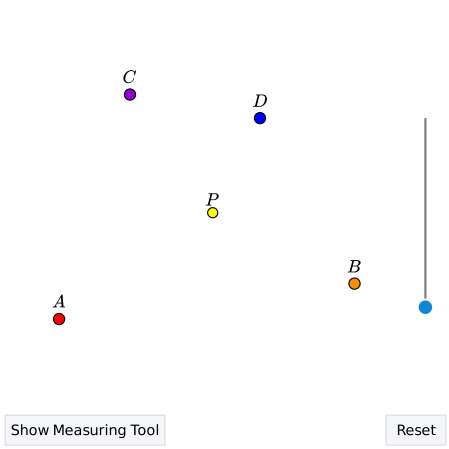 Use the measuring tool to fill in the following table with the distances between P and the image and preimage of each point.
What conclusions can be drawn from the table? Repeat the process with different arrangements of points as needed to see a pattern.
| PA | PA' | ||
|---|---|---|---|
| PB | PB' | ||
| PC | PC' | ||
| PD | PD' |
Explore
Share
Report error
Rotating a Triangle About a Fixed Point
This time, use the slider bar to rotate triangle ABC about point P.
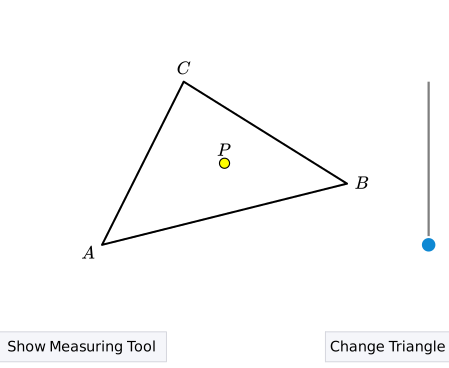 Then, use the measuring tool to determine the angle measures of ∠ APA', ∠ BPB', and ∠ CPC'.
Change the triangle and perform the same procedure. What can be said about rotations? Does the conclusion depend on the position of P relative to the triangle?
| m ∠ APA' | |
|---|---|
| m ∠ BPB' | |
| m ∠ CPC' |
Discussion
Share
Report error
Rotation
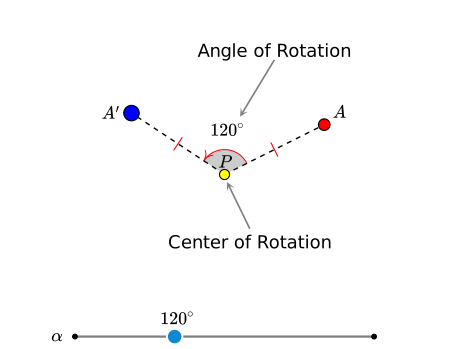
A rotation is a transformation in which a figure is turned about a fixed point P. The number of degrees the figure rotates α ^(∘) is the angle of rotation. The fixed point P is called the center of rotation. Rotations map every point A in the plane to its image A' such that one of the following statements is satisfied.
- If A is the center of rotation, then A and A' are the same point.
- If A is not the center of rotation, then A and A' are equidistant from P, with ∠ APA' measuring α ^(∘).
Discussion
Share
Report error
Rotation of a Point Around Another Point
Rotations can be performed by hand with the help of a straightedge, a compass, and a protractor.

To rotate point A about point P by an angle of 130^(∘) measured counterclockwise, follow these five steps.
1
Draw PA
expand_more 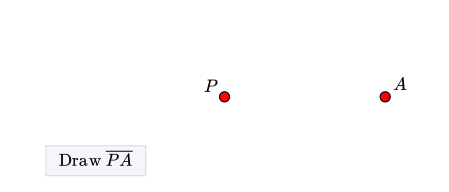
2
Place the Protractor
expand_more Place the center of the protractor on P and align it with PA.
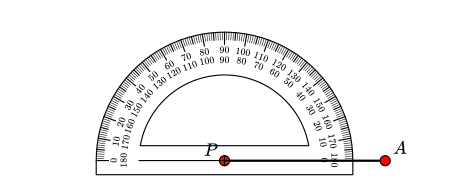
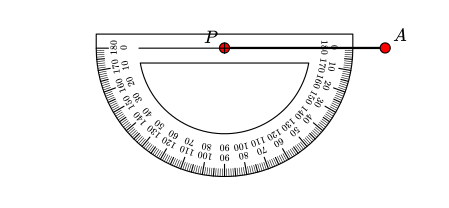
The protractor is placed as illustrated above when the rotation is counterclockwise. If the rotation has to be done clockwise, the protractor needs to be placed as follows.
3
Mark the Desired Angle
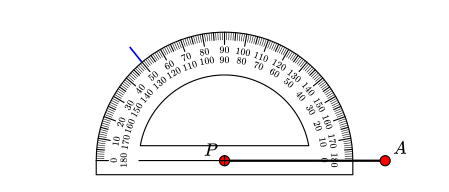
expand_more Locate the corresponding measure on the protractor and make a small mark. In this case, the mark will be made at 130^(∘).
4
Draw a Ray
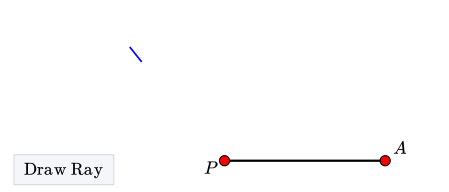
expand_more Using the straightedge, draw a ray with starting point P that passes through the mark made in the previous step.
5
Draw Point A'
expand_more Place the compass tip on P and open it to the distance between P and A. Without changing this setting and keeping the point of the compass at P, draw a small arc centered at P that intersects the ray drawn before.
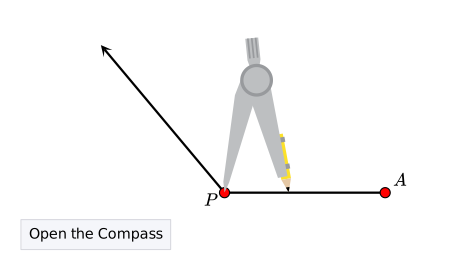 The intersection of the ray and the arc is the image A' after the give rotation.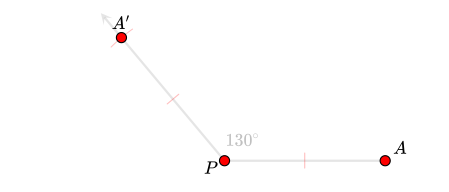
Notice that this method of construction has also confirmed that PA is congruent to PA'.
Example
Share
Report error
Cyrptawheel
Vincenzo and Zosia are two friends who love exploring the world of puzzles. Within the pages of a book discussing transformations, they find a circular disk with letters on it. They decide to call the disk a Cyrptawheel. The Cryptawheel has a movable triangle with one vertex fixed at the center of the circular disk. To reveal its secrets, the friends need to rotate the triangle.
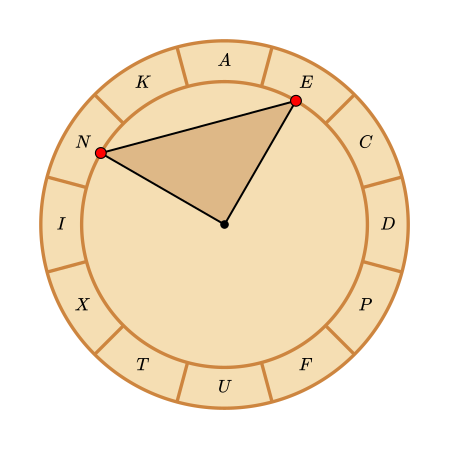 Two vertices of the triangle show the letters N and E. These are the first two letters of a clue. Rotate the triangle 180^(∘) clockwise around its fixed vertex to find the other two letters. Zosia wants to perform this rotation using a protractor to be mathematically sure. Help her in this task.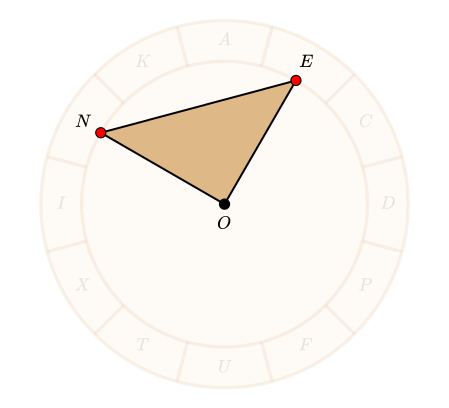
{"type":"multichoice","form":{"alts":["N","P","F","U","T","X"],"noSort":false},"formTextBefore":"","formTextAfter":"","answer":[1,4]}
Hint
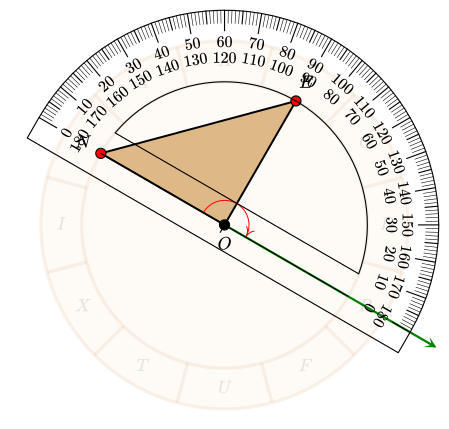
Start by rotating the vertices of the triangle. To do so, use a protractor to draw a 180^(∘) angle.
Solution
Zosia's goal is to find the image of the triangle after a 180^(∘) clockwise rotation about its fixed vertex. Labeling the vertices of the triangle will make this rotation process simpler.
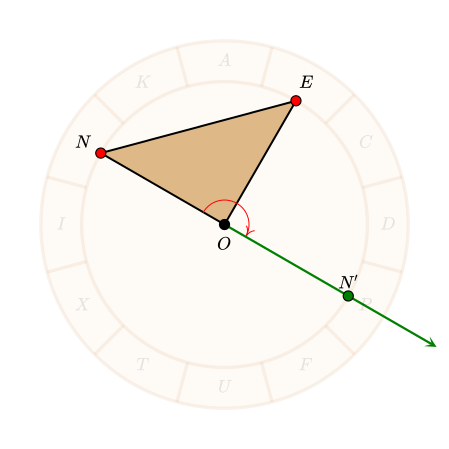
The center of rotation is O and the angle of rotation is 180^(∘). Perform the rotation by rotating one point at a time. To rotate N, place the center of the protractor on O and align it with NO. Use the protractor to draw a ray that starts from O and makes a 180^(∘) angle with NO.
Then, mark a point N' on this ray so that ON' is the same length as ON. This is the image of N after the rotation. Since ON is the radius of the inner circle, N' should also be on that circle.
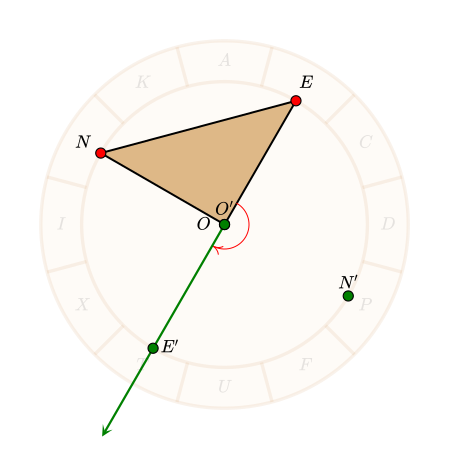
Repeat the same process for the vertex E to find E'. Since O is the center of rotation, O' will be in the same position as O.
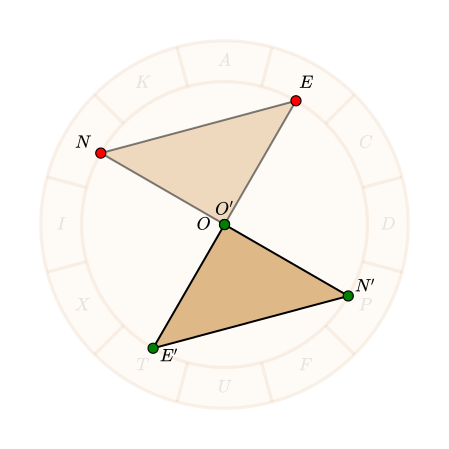
Finally connect N', E', and O' to draw the image of NEO after the 180^(∘) rotation.
As shown, the image N' corresponds to P and E' corresponds to T. Therefore, the clue Vincenzo and Zosia is looking for is NEPT.
Extra
Visualizing the RotationVincenzo, on the other hand, completes this rotation task by solely relying on his eyes, without the use of any extra tools. The applet shows how he rotated the triangle 180^(∘) about its fixed vertex.
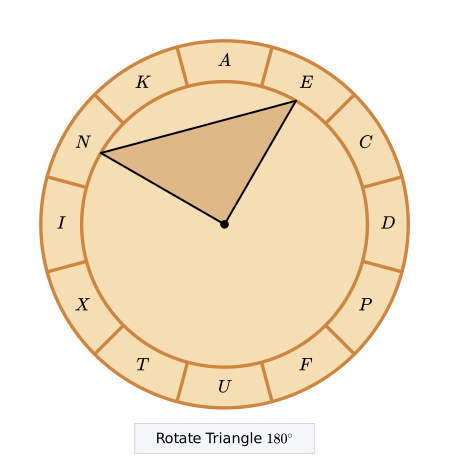 Notice that a 180^(∘) clockwise rotation and a 180^(∘) counterclockwise rotation produce the same image. Therefore, there is no need to specify direction when rotating a figure by 180^(∘).
Pop Quiz
Share
Report error
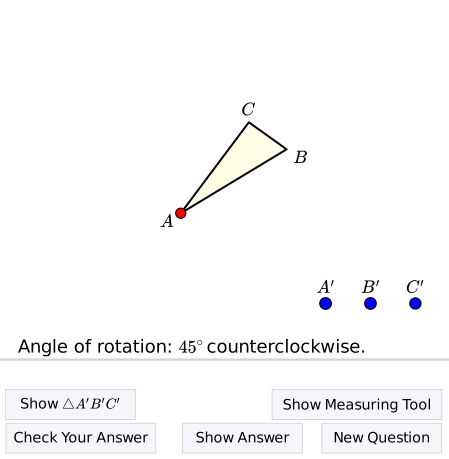
Practice Rotating Triangles
Discussion
Share
Report error
Rotating a Point Around the Origin at 90^(∘), 180^(∘), and 270^(∘)
In the coordinate plane, when a point is rotated counterclockwise around the origin at certain angles, its coordinates change in a specific way. This occurs when the angle of rotation is 90^(∘), 180^(∘), or 270^(∘). Try to figure these patterns out using the following applet.
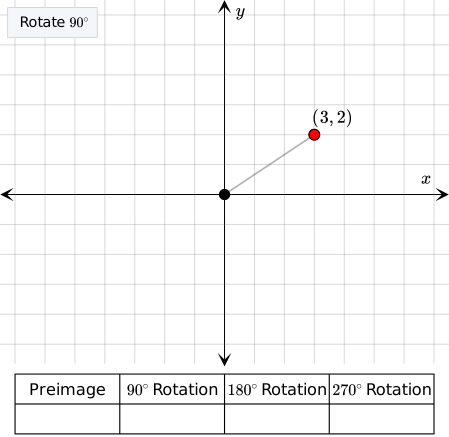 From the diagram, the following rules can be set.
| Counterclockwise Rotations Around the Origin | |
|---|---|
| Angle of Rotation | Rule |
| 90^(∘) | (x,y) → (- y,x) |
| 180^(∘) | (x,y) → (- x,- y) |
| 270^(∘) | (x,y) → (y,- x) |
Example
Share
Report error
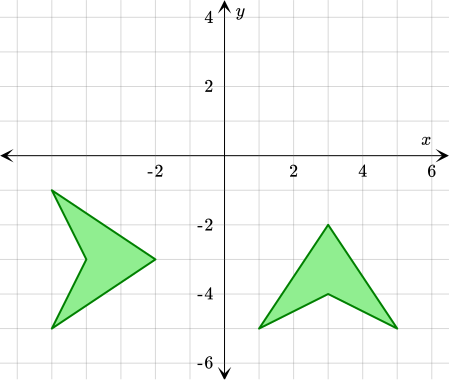
A Gateway to a New Realm
The clue Vincenzo and Zosia found reminded them of the word Neptune.

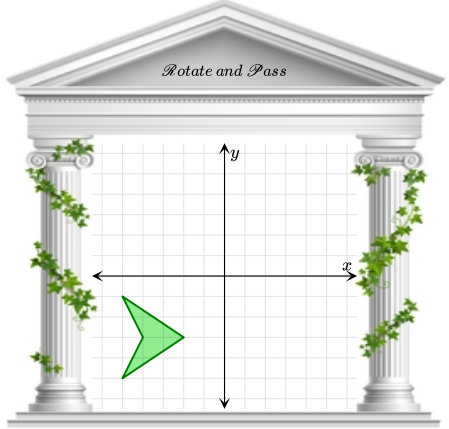
Vincenzo had previously heard stories about this magical place. He had even heard about three ordinary students who had found a door into a mystical library. Could this be another doorway to that place? As they got closer, a puzzle appeared between the columns of the gate.
External credits: macrovector
Answer
Hint
When a point with coordinates (x,y) is rotated 90^(∘) counterclockwise about the origin, its image becomes (- y,x).
Solution
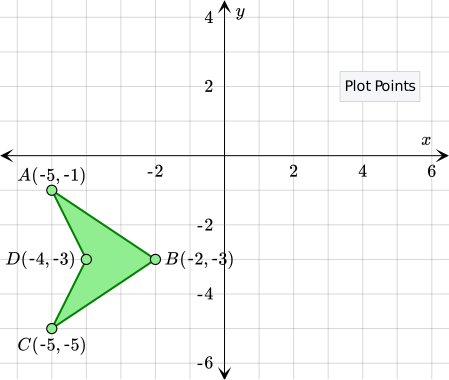
Zosia and Vincenzo want to rotate the figure 90^(∘) counterclockwise around the origin. This can be achieved by rotating each point of the original figure. In this case, four points will be sufficient to determine the position of the image.
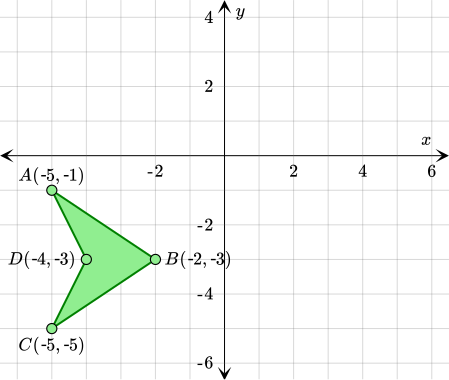
When a counterclockwise rotation is performed about the origin, the coordinates of the image can be written in relation to the coordinates of the preimage.
| Counterclockwise Rotations About the Origin | ||
|---|---|---|
| 90^(∘) Rotation | 180^(∘) Rotation | 270^(∘) Rotation |
|
ccc Preimage & & Image [0.5em] (x,y) & → & (- y,x) |
ccc Preimage & & Image [0.5em] (x,y) & → & (- x,- y) |
ccc Preimage & & Image [0.5em] (x,y) & → & (y,- x) |
Extra
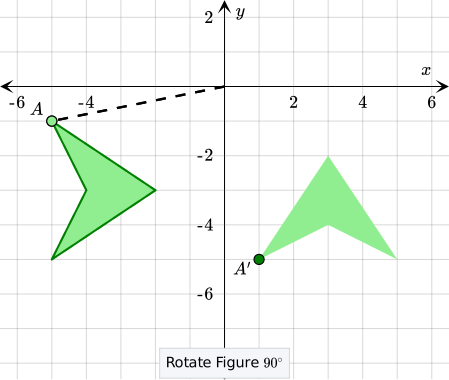
Visualizing the RotationThe applet shows how the figure is rotated 90^(∘) counterclockwise about the origin. Notice that this rotation maps quadrilateral ABCD onto quadrilateral A'B'C'D'.
Explore
Share
Report error
Exploring Dilations
The gate swings open as the figure rotates into place. Zosia takes the first step through the gate, while Vincenzo hesitantly waits to see what happens. Use the sliders to see how Zosia's size changes as she passes through the gate and down the hall.
 As he watches Zosia's size change with amazement, Vincenzo notices that her image changes relative to a fixed point. How can this point be identified?
Illustration
Share
Report error
Dilating a Drawing
Feeling braver, Vincenzo steps through the gate as well. Inside, her and Zosia find an old notebook with a big red dot on one page. Zosia draws a figure on the page and watches as it changes size. 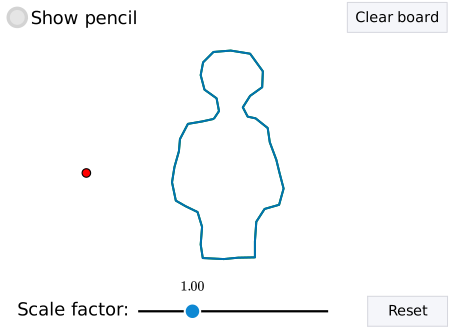 The friends are excited about the magical discovery and eager to comprehend the logic behind it. What other surprises lie ahead?
Discussion
Share
Report error
How to Dilate?
As they explore the magical realm, Vincenzo and Zosia come across Dilatius the Dimension Shifter, a wizard who can change the size of objects using dilations. They realize that the notebook they found belongs to the wizard and excitedly ask him to teach them about dilation. Dilatius thrilled to share his knowledge with them.
Concept
Share
Report error
Dilation
A dilation is a transformation that changes the size of a figure while keeping its shape the same. This transformation involves enlarging or reducing the figure by a certain length scale factor k from a fixed point O called the center of dilation. For example, the image of every point on a leaf lies on the ray that starts at the center of the dilation and passes through its preimage.
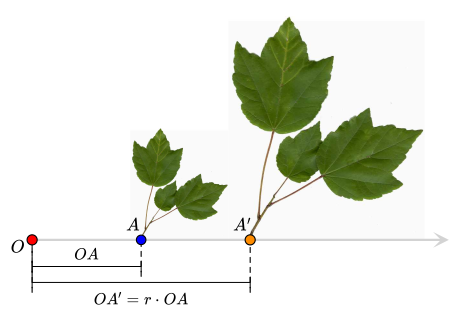 As shown in the diagram, O is the center of the dilation, k is the scale factor, A is the preimage, and A' is the image point. By definition, the scale factor k can also be defined as the ratio of a length in the image to the corresponding length in the preimage.
When the scale factor is greater than 1, the dilation is called an enlargement because the image is larger than the preimage. When the scale factor is between 0 and 1, the dilation is called a reduction because the image is smaller than the preimage.
As shown in the diagram, O is the center of the dilation, k is the scale factor, A is the preimage, and A' is the image point. By definition, the scale factor k can also be defined as the ratio of a length in the image to the corresponding length in the preimage.
When the scale factor is greater than 1, the dilation is called an enlargement because the image is larger than the preimage. When the scale factor is between 0 and 1, the dilation is called a reduction because the image is smaller than the preimage.
OA'=k * OA ⇔ k = OA'/OA
Discussion
Share
Report error
Coordinate Rule for Dilations
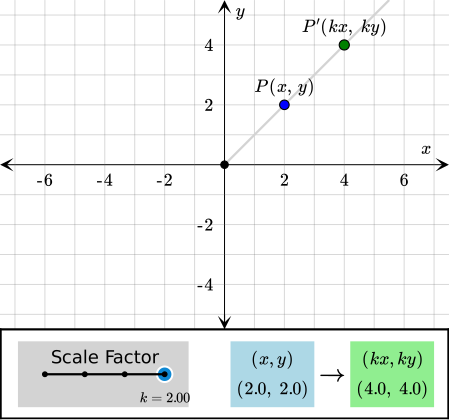
When a point is dilated using a scale factor of k and a center of dilation at the origin, the coordinates of its image are found by multiplying the coordinates of the preimage by k.
(x,y) → ( kx, ky)
The diagram shows how the image changes as the preimage and the scale factor change.
Example
Share
Report error
Practicing Dilatius's Teachings
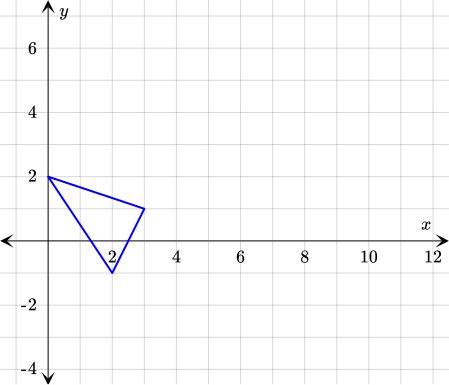
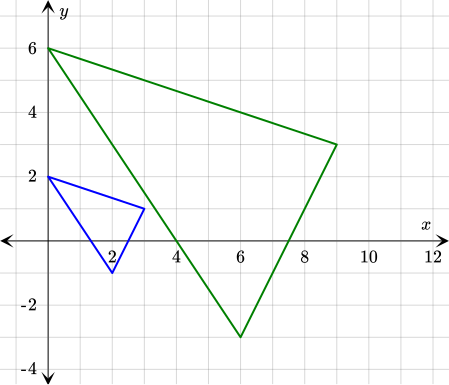
Dilatius is impressed by Vincenzo and Zosia's eagerness to learn. They seem to have picked up the dilation spell using the coordinate rule quickly, so he challenges them to dilate the following triangle.
Answer
Hint
To find the image of a vertex after a dilation with scale factor k, multiply its coordinates by k.
Solution
Zosia and Vincenzo need to dilate the triangle using a scale factor of 3 with respect to the origin. Start by identifying the vertices of the triangle.
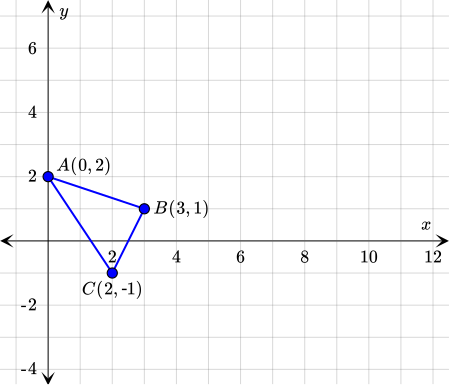
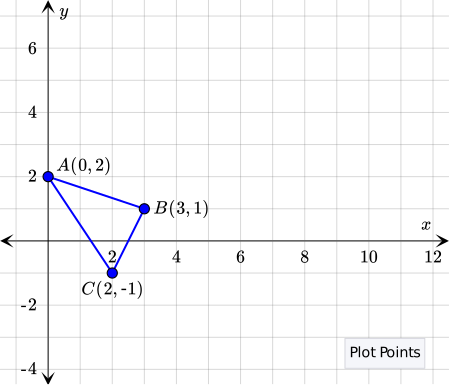
When the center of dilation is the origin, each coordinate of the preimage is multiplied by the scale factor k to find the coordinates of the image. ccc Preimage & & Image [0.5em] (x,y)& ⇒ & ( kx, ky) Find the coordinates of the vertices of △ A'B'C' after a dilation with a scale factor k= 3.
| Dilation With Scale Factor k=3 | ||
|---|---|---|
| Preimage | Multiply by k | Image |
| A(0,2) | ( 3* 0, 3 * 2 ) | A'(0,6) |
| B(3,1) | ( 3* 3, 3 * 1 ) | B'(9,3) |
| C(2,- 1) | ( 3* 2, 3 * (- 1) ) | C'(6,- 3) |
Checking Our Answer
Visualizing the DilationTo check the answer, draw rays from the origin through the vertices of the original figure. The vertices of the dilation should lie on those rays. 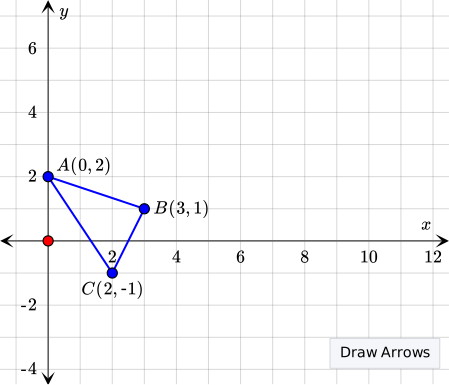 Notice that OA' is 3 times as long as OA since 3 is the scale factor. This also applies to other side lengths.
OA' = 3 * OA OB' = 3 * OB OC' = 3 * OC
Notice that OA' is 3 times as long as OA since 3 is the scale factor. This also applies to other side lengths.
OA' = 3 * OA OB' = 3 * OB OC' = 3 * OC
Example
Share
Report error
Dilatius's Final Lesson
Dilatius teaches Vincenzo and Zosia to use reducio
to make things smaller and enlargio
to make them bigger. These phrases produce a reduction and an enlargement, respectively. He then quizzes them about the magic behind the drawings in his notebook.
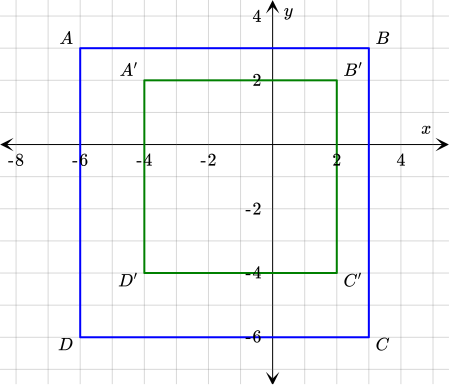
{"type":"choice","form":{"alts":["A","B","C","D"],"noSort":true},"formTextBefore":"","formTextAfter":"","answer":2}
Hint
The scale factor is the ratio of the sides lengths of the image to the corresponding side lengths of the original figure.
Solution
There are two types of dilations.
- Enlargement: The image is larger than the original figure. An enlargement is the product of a scale factor greater than 1.
- Reduction: The image is smaller than the original figure. A reduction is the product of a scale factor between 0 and 1.
In the given coordinate plane, it can be seen that the green square is smaller than the blue square. This means that the dilation is a reduction.
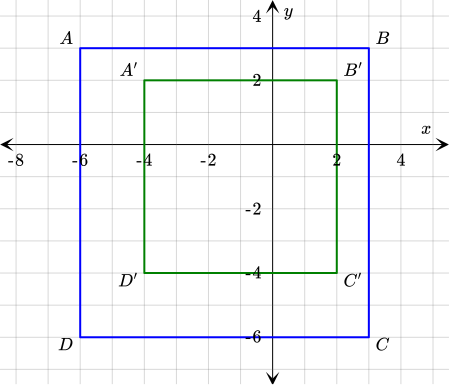
Next, remember that the scale factor is the ratio of the sides lengths of the image to the corresponding side lengths of the preimage. Scale Factor= Image Side Length/Preimage Side Length In the graph, AB is 9 units long and the corresponding side A'B' is 6 units long.
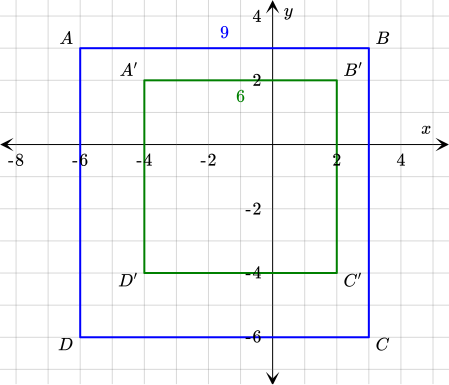
Substitute these values into the formula to find the scale factor. Scale Factor= 6/9 = 2/3 The scale factor is equal to 23. Therefore, the green square is a reduction of the blue square with a scale factor of 23. The answer is C.
Checking Our Answer
Visualizing the DilationTo check the answer, draw rays from the origin through the vertices of the original figure. The vertices of the dilation should lie on those rays. 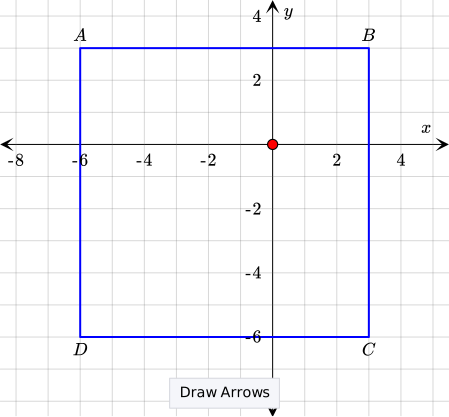 The square ABCD has a side length of 9 units, while the square A'B'C'D' has a side length of 6 units. Therefore, the scale factor is 69, or 23.
Closure
Share
Report error
Comparing Rotations and Dilations
Reflecting on their journey, Vincenzo and Zosia realized that both rotations and dilations preserve the original shape of an object. Consider, for example, a triangle. No matter how much it is rotated or dilated, its image is still a triangle. 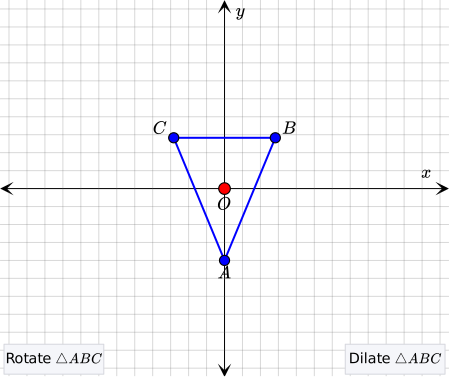 However, these transformations do still transform the preimage, almost like a magic trick. Rotations can change the orientation of a figure. Dilations reduce or enlarge a figure while preserving its original shape and angle measures. Since dilations do not preserve side lengths, they are called non-rigid transformations.
Rotations and Dilations
Exercise 1.1
The vertices of quadrilateral ABCD are A(- 3,2), B(3,2), C(2,5), and D(- 1,4). Which is the image of the quadrilateral after a 90^(∘) counterclockwise rotation about vertex B?

{"type":"choice","form":{"alts":["A","B","C","D"],"noSort":true},"formTextBefore":"","formTextAfter":"","answer":1}
security
report
code
security
report
code
Let's start by plotting the given vertices A(- 3,2), B(3,2), C(2,5), and D(- 1,4). Then we can connect them with line segments to draw the quadrilateral.
We will now draw the image of ABCD after a 90^(∘) counterclockwise rotation about vertex B. For simplicity, we start by rotating only one point. Let's start with vertex A. To rotate it, we will use a protractor to draw a ray that makes a 90^(∘) angle with BA at B.
Now we mark a point A' on this ray such that BA' is the same length as BA. This point is the image of A after the rotation. We can see that BA is 6 units long, so BA' must also be 6 units long.
Next, we repeat the same process for vertices C and D to plot C' and D'. Since B is the center of rotation, B' will be in the same position as B.
The coordinates of the images of the vertices are A'(3,- 4), B'(3,2), C'(0,1), and D'(1,- 2). Finally, we will connect A', B', C', and D' to draw the image of ABCD.
This corresponds to B.
Let's rotate ABCD 90^(∘) counterclockwise about B so that we can see how it is mapped onto A'B'C'D'.
security
report
code
Triangle JKL has vertices J(- 4,1), K(- 6,- 5), and L(-2,- 3). Which graph shows the image of the triangle after a 180^(∘) counterclockwise rotation about the origin?
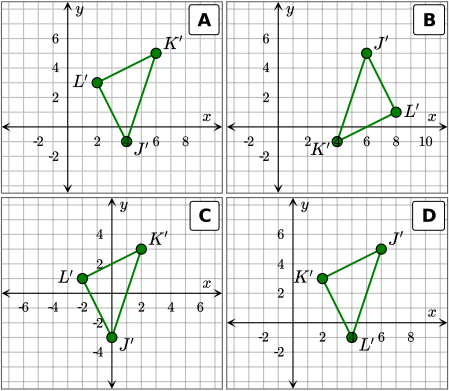
{"type":"choice","form":{"alts":["A","B","C","D"],"noSort":true},"formTextBefore":"","formTextAfter":"","answer":0}
security
report
code
security
report
code
We want to rotate a triangle 180^(∘) counterclockwise about the origin. Vertices of Triangle J(- 4,1), K(- 6,- 5),andL(-2,- 3) The center of rotation is the origin. When a counterclockwise rotation is performed about the origin, the coordinates of the image can be written in relation to the coordinates of the preimage.
| Counterclockwise Rotations About the Origin | ||
|---|---|---|
| 90^(∘) Rotation | 180^(∘) Rotation | 270^(∘) Rotation |
|
ccc Preimage & & Image [0.5em] (x,y) & → & (- y,x) |
ccc Preimage & & Image [0.5em] (x,y) & → & (- x,- y) |
ccc Preimage & & Image [0.5em] (x,y) & → & (y,- x) |
We can use the rule shown in the table that corresponds to a 180^(∘) counterclockwise rotation to determine the coordinates of the image of each vertex. ccc Preimage & & Image [0.3em] (x,y) & → & (- x,- y) [0.5em] [-0.5em] J(- 4,1) & & J'(4,- 1) [0.5em] K(- 6,- 5) & & K'(6,5) [0.5em] L(- 2,- 3) & & L'(2,3) Let's draw triangle JKL first. Then, we will plot the points we found and connect them to see the image of the triangle after rotation.
This corresponds to A.
Let's rotate JKL 180^(∘) counterclockwise about the origin so that we can see how it is mapped onto J'K'L'.
security
report
code
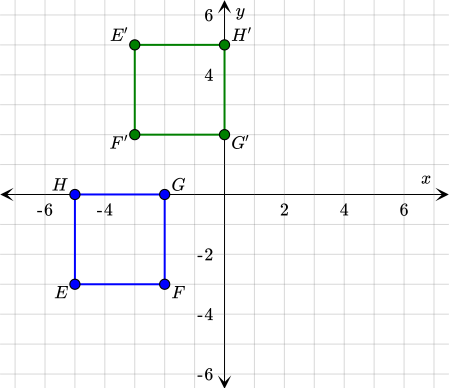
Square EFGH is rotated about the origin.
{"type":"choice","form":{"alts":["90^(∘) clockwise","90^(∘) counterclockwise","180^(∘) clockwise","270^(∘) clockwise"],"noSort":false},"formTextBefore":"","formTextAfter":"","answer":0}
security
report
code
security
report
code
We know that square EFGH is rotated about the origin. We want to identify the angle of rotation.
Let's consider point G and its image G'. First, we will draw a segment that connects G and the origin. We will then connect the origin with G' and measure the angle between the segments.
We can see that the segments create a 90^(∘) angle. Therefore, square EFGH is rotated either 90^(∘) clockwise or 270^(∘) counterclockwise. Of these, only 90^(∘) clockwise is an available option, so the graph describes a 90^(∘) clockwise rotation.
Let's rotate EFGH 270^(∘) counterclockwise about the origin so that we can see how it is mapped onto E'F'G'H'. Then we will rotate it 90^(∘) clockwise to see it mapped onto E'F'G'H' to see it mapped that way.
security
report
code
The vertices of a trapezoid are P(2,- 4), Q(4,- 4), R(6,- 8), and S(- 2,- 8). Which is the image of the trapezoid after a dilation with center (0,0) and a scale factor of 12?
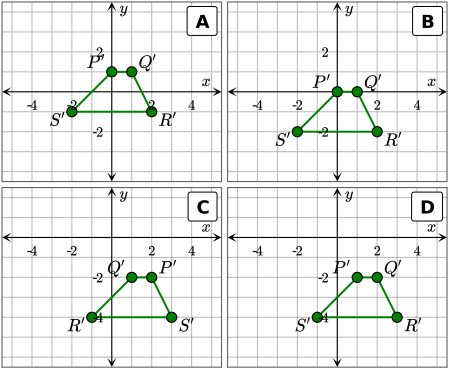
{"type":"choice","form":{"alts":["A","B","C","D"],"noSort":true},"formTextBefore":"","formTextAfter":"","answer":3}
security
report
code
security
report
code
When the center of dilation is the origin, each coordinate of the preimage is multiplied by the scale factor k to find the coordinates of the image. ccc Preimage & & Image [0.5em] (x,y)& ⇒ & ( kx, ky) Let's find the coordinates of the vertices of the trapezoid after a dilation with a scale factor k= 12.
| Dilation With Scale Factor k= 12 | ||
|---|---|---|
| Preimage | Multiply by k | Image |
| P(2,- 4) | ( 1/2 (2), 1/2(- 4)) | P'(1,- 2) |
| Q(4,- 4) | ( 1/2 (4), 1/2(- 4)) | Q'(2,- 2) |
| R(6,- 8) | ( 1/2 (- 6), 1/2(- 8)) | A'(- 3,- 4) |
| S(- 2,- 8) | ( 1/2 (- 2), 1/2(- 8)) | S'(- 1,- 4) |
Let's draw the preimage trapezoid first. Then we will plot the points we found and connect them to see its image after dilation.
The answer is D.
security
report
code
The green figure PQR is a dilation of the blue figure P'Q'R'.
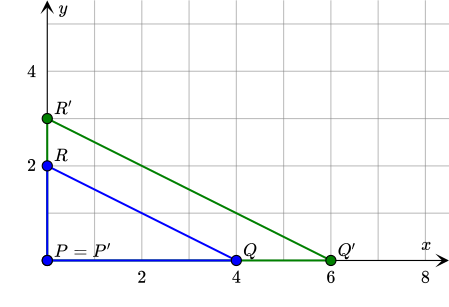
{"type":"choice","form":{"alts":["An enlargement, because the image is smaller than the preimage","An enlargement, because the image is larger than the preimage","A reduction, because the image is smaller than the preimage","A reduction, because the image is larger than the preimage"],"noSort":false},"formTextBefore":"","formTextAfter":"","answer":1}
security
report
code
security
report
code
We have a graph showing triangles PQR and P'Q'R'. We know that △ P'Q'R' is the image of △ PQR after a dilation. We want to decide if the dilation is an enlargement or a reduction.
To decide, recall that there are two types of dilation.
- Enlargement: The image is larger than the preimage and is produced by a scale factor greater than 1.
- Reduction: The image is smaller than the preimage and is produced by a scale factor between 0 and 1.
In the graph we see that the image, triangle P'Q'R', is larger than the preimage, △ PQR. This tells us that the dilation is an enlargement.
security
report
code
The green triangle K'L'M' is a dilation of the blue triangle KLM.
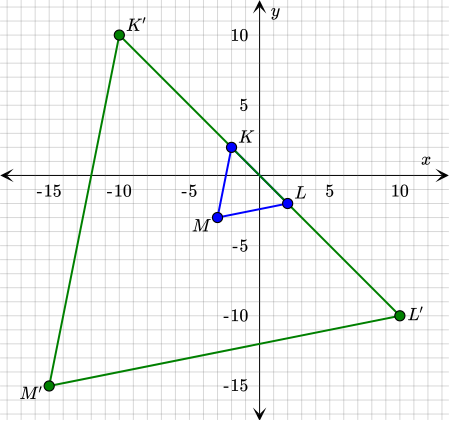
{"type":"choice","form":{"alts":["A","B","C","D"],"noSort":true},"formTextBefore":"","formTextAfter":"","answer":3}
security
report
code
security
report
code
We want to identify the type of dilation and the scale factor of the given triangles.
We know that there are two types of dilation.
- Enlargement: The image is larger than the preimage and is produced by a scale factor greater than 1.
- Reduction: The image is smaller than the preimage and is produced by a scale factor between 0 and 1.
In the given coordinate plane, we can see that the green triangle is larger than the blue triangle. This means that the dilation is an enlargement. We can find the ratio of the sides lengths of the image to the corresponding side lengths of the original figure to determine the scale factor. Scale Factor= Image Side Length/Preimage Side Length In the graph we can see that KL and K'L' are bounded by lattice points. Since the length of a diagonal of a unit square is sqrt(2) by the Pythagorean Theorem, we have KL=4sqrt(2) and K'L' = 20sqrt(2).
Let's substitute these values into the formula to find the scale factor. Scale Factor = 20sqrt(2)/4sqrt(2) = 5 The scale factor is 5, so the green triangle is the image of the blue triangle after a dilation with scale factor 5. The answer is D.
Recall that when a dilation by a scale factor of k is applied to a point, both of its coordinates are multiplied by the scale factor, k. Preimage & & Image (x,y) & → & ( kx, ky) Let's find the coordinates of all the vertices and check if there is a scale factor k.
We will divide the x- and y-coordinate of each preimage point by its corresponding coordinate in the image. Then we can check if the scale factors from each coordinate are equal. Let's do it!
| Scale Factor | ||
|---|---|---|
| Ratio of x-coordinates | Ratio of y-coordinates | |
| K(- 2,2) and K'(- 10,10) | -10/-2=5 | 10/2=5 |
| L(2,- 2) and L'(10,- 10) | 10/2=5 | - 10/- 2=5 |
| M(- 3,- 3) and M'(- 15,- 15) | -15/-3=5 | - 15/- 3=5 |
The scale factor is the same for every coordinate in the points, which means that the scale factor is 5. Since it is greater than 1, the dilation is an enlargement.
security
report
code
Rotations and Dilations
Recommended exercises
To get personalized recommended exercises, please login first.
Loading content
≤
>
■2
■▢
e▢
7
8
9
×
÷■1
=
=
√▢
▢√
∫▢▢
4
5
6
+
−
≤
<
log
ln
log▢
1
2
3
()
∣
sin
cos
tan
0
.
π
x
y
Loading content