{{ tocSubheader }}
{{ 'ml-label-loading-course' | message }}
An error ocurred, try again later!
Chapter {{ article.chapter.number }}
{{ article.number }}.
{{ article.displayTitle }}
{{ article.intro.summary }}
Show less Show more expand_more Lesson Settings & Tools
| | {{ 'ml-lesson-number-slides' | message : article.intro.bblockCount }} |
| | {{ 'ml-lesson-number-exercises' | message : article.intro.exerciseCount }} |
| | {{ 'ml-lesson-time-estimation' | message }} |
When collecting real-life data, there are many cases where most of the data values cluster close to the mean of the set. Consider, for example, men's shoe sizes.
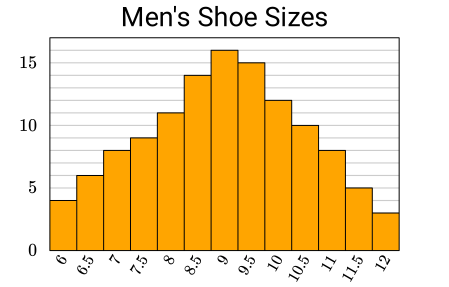
Most of the data is grouped next to the mean value, which is 9. Therefore, a man who wears a size 9.5 shoe is more likely to be randomly selected than a man who wears a size 11.5 shoe. When a data set is distributed this way and the domain of the distribution is continuous — not discrete — it is said that the data is normally distributed. This lesson explores this distribution.
Catch-Up and Review
Here are a few recommended readings before getting started with this lesson.
Challenge
Finding Probabilities of Data Normally Distributed
Kevin has a summer internship at a tech company in his town. The daily number of calls that the company receives is normally distributed with a mean of 2240 calls and a standard deviation of 150 calls. The graph represents the distribution of the data.
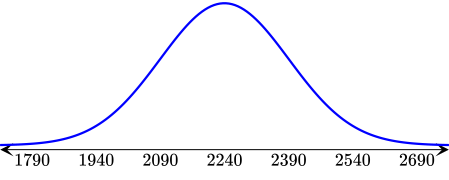
Looking to make improvements in the company, Kevin's boss is interested in knowing the answers to the next couple of questions.
a What is the probability that more than 2540 calls are received on a random day?
{"type":"text","form":{"type":"math","options":{"comparison":"1","nofractofloat":false,"keypad":{"simple":true,"useShortLog":false,"variables":[],"constants":[]},"rendered":false},"text":"<span class=\"katex\"><span class=\"katex-html\" aria-hidden=\"true\"><\/span><\/span>"},"formTextBefore":null,"formTextAfter":null,"answer":{"text":["0.025"]}}
b What is the probability that between 2300 and 2420 calls are received on a random day? Round the answer to two decimal places.
{"type":"text","form":{"type":"math","options":{"comparison":"1","nofractofloat":false,"keypad":{"simple":true,"useShortLog":false,"variables":[],"constants":[]},"rendered":false},"text":"<span class=\"katex\"><span class=\"katex-html\" aria-hidden=\"true\"><\/span><\/span>"},"formTextBefore":"<span class=\"katex\"><span class=\"katex-html\" aria-hidden=\"true\"><span class=\"base\"><span class=\"strut\" style=\"height:0.48312em;vertical-align:0em;\"><\/span><span class=\"mrel\">\u2248<\/span><\/span><\/span><\/span>","formTextAfter":null,"answer":{"text":["0.23"]}}
Discussion
Normal Distributions and the Empirical Rule
When dealing with probability distributions, there is one type that stands out above the rest because it is very common in different real-life scenarios like people's heights, shoe sizes, birth weights, average grades, IQ levels, and many qualities. Because of this regularity, this type of distribution is called the normal distribution.
Concept
Normal Distribution
A normal distribution is a type of probability distribution where the mean, the median, and the mode are all equal to each other. The graph that represents a normal distribution is called a normal curve and it is a continuous, bell-shaped curve that is symmetric with respect to the mean μ of the data set.
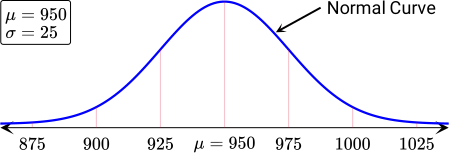
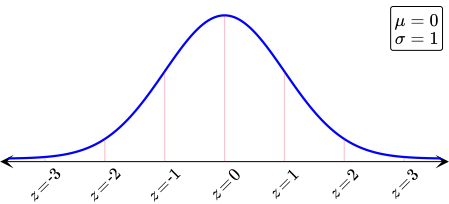
This type of distribution is the most common continuous probability distribution that can be observed in real life. When a normal distribution has a mean of 0 and standard deviation of 1, it is called a standard normal distribution.
Concept
Empirical Rule
In statistics, the Empirical Rule, also known as the 68–95–99.7 rule, is a shorthand used to remember the percentage of values that lie within certain intervals in a normal distribution. The rule states the following three facts.
- About 68% of the values lie within one standard deviation of the mean.
- About 95% of the values lie within two standard deviations of the mean.
- About 99.7% of the values lie within three standard deviations of the mean.
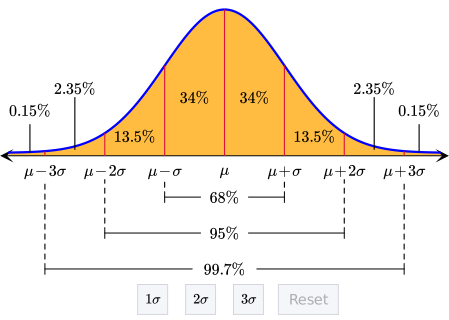
Empirical Rule.
Example
Distribution of Heights
In his spare time, Kevin works with the Less Chat, More Talk campaign to encourage people to share with their loved ones in person instead of through screens. He wants to give away T-shirts with a cool logo outside a shopping mall to help spread this message.

Kevin is in charge of preparing the men's T-shirts, but he does not know how many of each size he should order. To figure it out, he searched the City Hall website and he found that the heights of the men in the city are normally distributed with a mean of 183 centimeters and a standard deviation of 5 centimeters. Along with this information, there was also a graph.
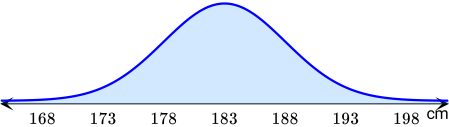
a What is the range of the heights that represent the middle 68% of the distribution? Write the answer as a strict compound inequality.
{"type":"text","form":{"type":"math","options":{"comparison":"1","nofractofloat":false,"keypad":{"simple":false,"useShortLog":false,"variables":["X"],"constants":[]},"rendered":false},"text":"<span class=\"katex\"><span class=\"katex-html\" aria-hidden=\"true\"><\/span><\/span>"},"formTextBefore":"Range:","formTextAfter":null,"answer":{"text":["178 < X < 188"]}}
b What percent of the surveyed men are shorter than 173 centimeters?
{"type":"text","form":{"type":"math","options":{"comparison":"1","nofractofloat":false,"keypad":{"simple":true,"useShortLog":false,"variables":[],"constants":[]},"rendered":false},"text":"<span class=\"katex\"><span class=\"katex-html\" aria-hidden=\"true\"><\/span><\/span>"},"formTextBefore":null,"formTextAfter":"<span class=\"katex\"><span class=\"katex-html\" aria-hidden=\"true\"><span class=\"base\"><span class=\"strut\" style=\"height:0.80556em;vertical-align:-0.05556em;\"><\/span><span class=\"mspace\" style=\"margin-right:0.16666666666666666em;\"><\/span><span class=\"mord\">%<\/span><\/span><\/span><\/span>","answer":{"text":["2.5"]}}
c If 3000 men participated in the survey, how many of them are between 188 and 193 centimeters tall?
{"type":"text","form":{"type":"math","options":{"comparison":"1","nofractofloat":false,"keypad":{"simple":true,"useShortLog":false,"variables":[],"constants":[]},"rendered":false},"text":"<span class=\"katex\"><span class=\"katex-html\" aria-hidden=\"true\"><\/span><\/span>"},"formTextBefore":null,"formTextAfter":"adults","answer":{"text":["405"]}}
Hint
a Use the Empirical Rule to determine the corresponding percentage.
b Use the Empirical Rule.
c Use the Empirical Rule to find the percent. Then, multiply it by the total number of men surveyed.
Solution
a According to the Empirical Rule, the middle 68% of the data in a normal distribution
falls in the range that starts one standard deviation to the left of the mean and ends one standard deviation to the right of the mean.
Middle 68%μ−σ<X<μ+σ
According to the website, the mean is 183 and the standard deviation is 5. Therefore, μ=183 and σ=5.
Middle 68%183−5<X<183+5⇕178<X<188
Consequently, the middle 68% of the distribution represents the range of heights from 178 to 188 centimeters. 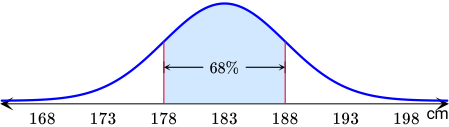
b Start by highlighting the corresponding interval in the graph.
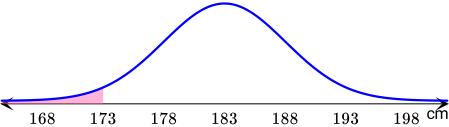
μ−2σμ−2σ=183−2(5)⇕=173
According to the Empirical Rule, 95% of the data fall between μ−2σ and μ+2σ. It is known that the value of μ−2σ is 173. Calculate the value of μ+2σ.
μ+2σμ+2σ=183+2(5)⇕=193
Therefore, 95% of the data fall between 173 and 193. This implies that 5% of the data fall outside this range. 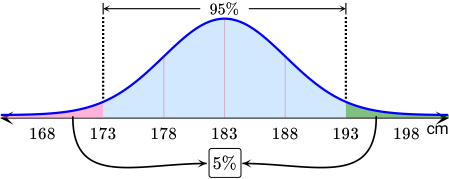
Due to the symmetry of the normal curve, 2.5% of the data fall to the left of 173 and 2.5% of the data fall to the right of 193. Consequently, 2.5% of the men surveyed are shorter than 173 centimeters.
c The graph below shows the percentages represented by each interval according to the Empirical Rule.
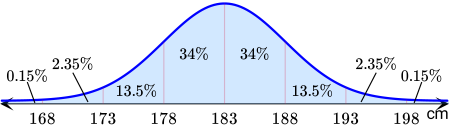
According to the graph, 13.5% of the surveyed men are between 188 and 193 centimeters tall.
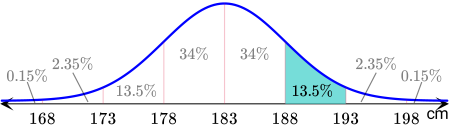
13.5%(3000)
▼
Multiply
PercentToFrac
a%=100a
10013.5(3000)
MoveRightFacToNum
ca⋅b=ca⋅b
10040500
CalcQuot
Calculate quotient
405
Discussion
Drawing a Normal Curve
Given a normal distribution, it can be drawn by hand. For example, consider a normally distributed data set with a mean μ=10 and standard deviation σ=2.


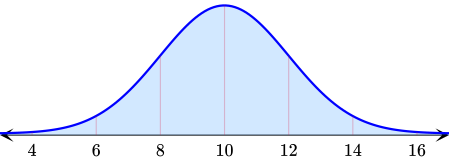
μ=10andσ=2
Such distribution can be drawn following the next three steps.
1
Place the Mean on a Horizontal Axis
expand_more First, draw a horizontal axis and mark the mean of the data in the middle. In this case, the mean is 10.
2
Find and Add More Labels
expand_more Find more labels to write on the axis such that each interval is one standard deviation long. In this case, the intervals must be 2 units long. To accomplish this, add and subtract multiples of the standard deviation to and from the mean.
| Labels to the Left of the Mean | Labels to the Right of the Mean |
|---|---|
| 10−1⋅2=8 | 10+1⋅2=12 |
| 10−2⋅2=6 | 10+2⋅2=14 |
| 10−3⋅2=4 | 10+3⋅2=16 |
Adding three labels to each side of the mean is enough.
3
Draw the Normal Curve
expand_more Lastly, draw a bell-shaped curve with its peak at the mean. Remember, the curve is symmetric with respect to the mean. In this case, the peak occurs at 10.
Example
Graphing a Normal Distribution
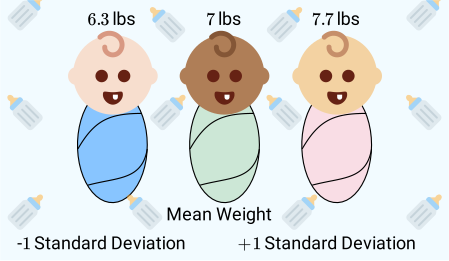
While reading some statistics about the people in the city, Kevin was surprised to learn that the weights of newborns are also normally distributed. He found the following information given by the local hospital.
a Graph the normal distribution labeling all the intervals and percentages.
b What percent of the newborn babies weigh 6.3 pounds or more?
Answer
a
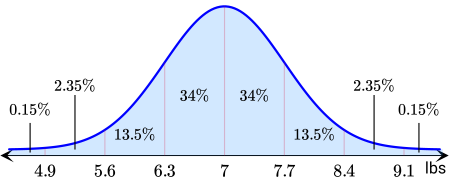
b 84%
Hint
a Start by drawing the axis and placing the mean in the middle. Determine the standard deviation. Write labels so that the length of each interval is 1 standard deviation. Then, draw the normal curve and use the Empirical Rule to label the percents.
b Identify 6.3 in the graph from Part A. Shade the region to the right of 6.3 pounds and add the corresponding percentages.
Solution
a To graph a normal distribution, draw a horizontal axis and place the mean of the data in the middle. According to the given information, the mean weight is μ=7 pounds.

7−σσ=6.3⇕=0.7and7+σσ=7.7⇕=0.7
The standard deviation of the weights of the babies is 0.7 pounds, so on the axis, write labels to the left and right of the mean such that each interval is 0.7 units long. 
Next, draw the normal curve — a bell-shaped curve that is symmetric with respect to the mean, where it has its peak.
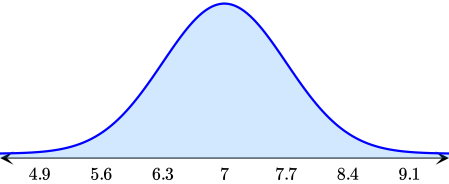
According to the Empirical Rule, the percentages below the curve are distributed as follows.
- About 68% of the data fall between 6.3 and 7.7 pounds.
- About 95% of the data fall between 5.6 and 8.4 pounds.
- About 99.7% of the data fall between 4.9 and 9.1 pounds.
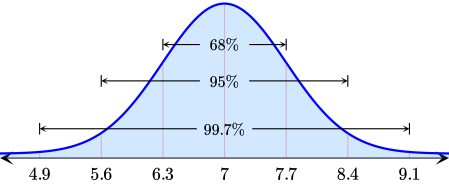
The percentages in every interval can be labeled by using the symmetry of the curve. This will complete the diagram of the distribution.
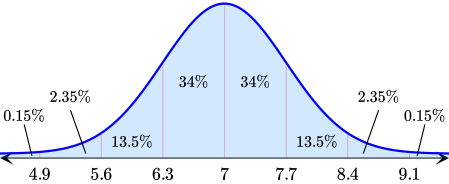
b The percent of newborn babies that weigh 6.3 pounds or more corresponds to the region below the normal curve that is to the right of 6.3. Therefore, to calculate the percent of newborns that weigh 6.3 pounds or more, highlight this part of the graph.
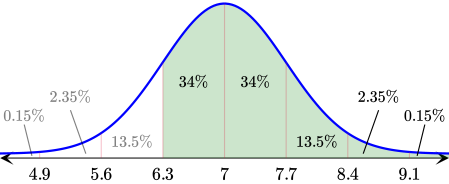
34+34+13.5+2.35+0.15=84
Consequently, 84% of the newborn babies weigh 6.3 pounds or more.
Discussion
The Standard Normal Table and z-Scores
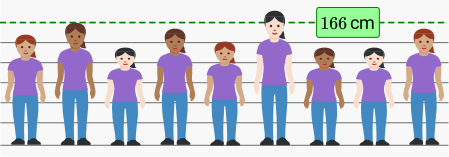
The height of people is usually normally distributed. For example, the average height of a woman in the United States is about 162.5 centimeters. Assuming a standard deviation of 2.5 centimeters, the graph of this distribution looks as follows.
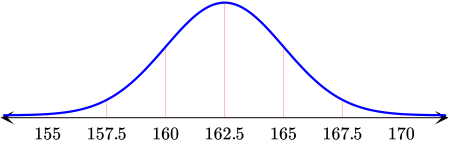
The Empirical Rule is used to determine the percentage of data that falls between any two labels on the axis. However, what about if the endpoints of the interval are different from the labels? For example, what is the percentage of women that are shorter than 166 centimeters?
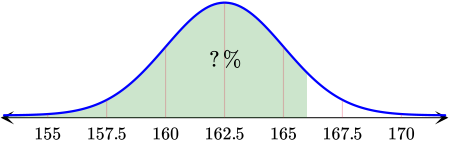
To find such a percentage, the first step is converting the data value into its corresponding z-score.
Concept
z-Score
The z-score, also known as the z-value, represents the number of standard deviations that a given value x is from the mean of a data set. The following formula can be used to convert any x-value into its corresponding z-score.
z=σx−μ
z=2.5166−162.5⇔z=1.4
This means that the value 166 is 1.4 standard deviations to the right of 162.5. Once the corresponding z-score is known, the area below the curve that is to the left of this value can be found using a standard normal table. Method
Finding the Area to the Left of a z-Score
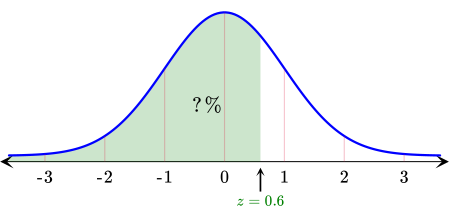
Consider a standard normal distribution and a randomly chosen z-score. The area below the normal curve that is to the left of this z-score can be calculated using a standard normal table. For example, consider z=0.6.
1
Locate the Whole Part of the z-Score
expand_more In the left column of the standard normal table, locate the whole part of the z-score. Since z=0.6 is positive, look at the four bottom rows. Because the whole part of z is 0, shade the fifth row.
| .0 | .1 | .2 | .3 | .4 | .5 | .6 | .7 | .8 | .9 | |
|---|---|---|---|---|---|---|---|---|---|---|
| -3 | .00135 | .00097 | .00069 | .00048 | .00034 | .00023 | .00016 | .00011 | .00007 | .00005 |
| -2 | .02275 | .01786 | .01390 | .01072 | .00820 | .00621 | .00466 | .00347 | .00256 | .00187 |
| -1 | .15866 | .13567 | .11507 | .09680 | .08076 | .06681 | .05480 | .04457 | .03593 | .02872 |
| -0 | .50000 | .46017 | .42074 | .38209 | .34458 | .30854 | .27425 | .24196 | .21186 | .18406 |
| 0 | .50000 | .53983 | .57926 | .61791 | .65542 | .69146 | .72575 | .75804 | .78814 | .81594 |
| 1 | .84134 | .86433 | .88493 | .90320 | .91924 | .93319 | .94520 | .95543 | .96407 | .97128 |
| 2 | .97725 | .98214 | .98610 | .98928 | .99180 | .99379 | .99534 | .99653 | .99744 | .99813 |
| 3 | .99865 | .99903 | .99931 | .99952 | .99966 | .99977 | .99984 | .99989 | .99993 | .99995 |
The probability that corresponds to a z-score for which the integer part is 0 appears in the shaded row.
2
Locate the Decimal Part of the z-Score
expand_more In the top row of the standard normal table, locate the decimal part of the z-score. Here, the decimal part is 6. Consequently, shade the seventh column.
| .0 | .1 | .2 | .3 | .4 | .5 | .6 | .7 | .8 | .9 | |
|---|---|---|---|---|---|---|---|---|---|---|
| -3 | .00135 | .00097 | .00069 | .00048 | .00034 | .00023 | .00016 | .00011 | .00007 | .00005 |
| -2 | .02275 | .01786 | .01390 | .01072 | .00820 | .00621 | .00466 | .00347 | .00256 | .00187 |
| -1 | .15866 | .13567 | .11507 | .09680 | .08076 | .06681 | .05480 | .04457 | .03593 | .02872 |
| -0 | .50000 | .46017 | .42074 | .38209 | .34458 | .30854 | .27425 | .24196 | .21186 | .18406 |
| 0 | .50000 | .53983 | .57926 | .61791 | .65542 | .69146 | .72575 | .75804 | .78814 | .81594 |
| 1 | .84134 | .86433 | .88493 | .90320 | .91924 | .93319 | .94520 | .95543 | .96407 | .97128 |
| 2 | .97725 | .98214 | .98610 | .98928 | .99180 | .99379 | .99534 | .99653 | .99744 | .99813 |
| 3 | .99865 | .99903 | .99931 | .99952 | .99966 | .99977 | .99984 | .99989 | .99993 | .99995 |
3
Identify the Intersecting Cell
expand_more The shaded row and column intersect at 0.72575. Therefore, the percentage of data that is less than or equal to 0.6 is 72.575%. This means that the probability that a value chosen at random is less than or equal to 0.6 is 0.72575.
P(z≤0.6)=0.72575
Extra
Finding Other AreasOther areas can also be found using the same standard normal table.
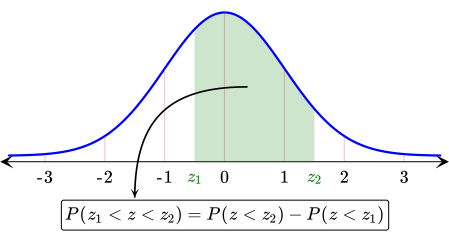
Area Between Two z-Scores
To find the area below the normal curve and between two z-scores, subtract the area to the left of the smaller z-score from the area to the left of the greater z-score.
Area to the Right of a z-Score
The area to the right of a z-score is the complement of the area to the left of the same z-score.
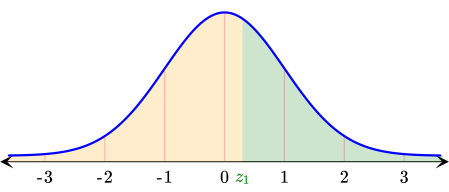
P(z>z1)+P(z≤z1)=1
Therefore, the area to the right of a z-score is the difference of 1 and the area to the left of the z-score.
P(z>z1)=1−P(z≤z1)
According to the standard normal table, the probability that a randomly selected value is less than or equal to 1.4 is 0.91924. Therefore, about 91.92% of women are shorter than or equal to 166 centimeters.
Example
Commuting Times
Kevin has become a stats fan. He has recorded the time it takes him to commute to his internship over the past few days. He observes that the times are normally distributed with a mean of 17 minutes and a standard deviation of 2.5 minutes.

Find the following probabilities and write them in decimal form rounded to two decimal places.
a What is the probability that Kevin's commute tomorrow will take less than 14 minutes?
{"type":"text","form":{"type":"math","options":{"comparison":"1","nofractofloat":false,"keypad":{"simple":true,"useShortLog":false,"variables":[],"constants":[]},"rendered":false},"text":"<span class=\"katex\"><span class=\"katex-html\" aria-hidden=\"true\"><\/span><\/span>"},"formTextBefore":"<span class=\"katex\"><span class=\"katex-html\" aria-hidden=\"true\"><span class=\"base\"><span class=\"strut\" style=\"height:0.48312em;vertical-align:0em;\"><\/span><span class=\"mrel\">\u2248<\/span><\/span><\/span><\/span>","formTextAfter":null,"answer":{"text":["0.12"]}}
b What is the probability that Kevin's commute will take between 16 and 19 minutes next Monday?
{"type":"text","form":{"type":"math","options":{"comparison":"1","nofractofloat":false,"keypad":{"simple":true,"useShortLog":false,"variables":[],"constants":[]},"rendered":false},"text":"<span class=\"katex\"><span class=\"katex-html\" aria-hidden=\"true\"><\/span><\/span>"},"formTextBefore":"<span class=\"katex\"><span class=\"katex-html\" aria-hidden=\"true\"><span class=\"base\"><span class=\"strut\" style=\"height:0.48312em;vertical-align:0em;\"><\/span><span class=\"mrel\">\u2248<\/span><\/span><\/span><\/span>","formTextAfter":null,"answer":{"text":["0.44"]}}
c Kevin starts work every day at 8:00 AM. One day he leaves his house at 7:41 AM. What is the probability that Kevin will be late for work this day?
{"type":"text","form":{"type":"math","options":{"comparison":"1","nofractofloat":false,"keypad":{"simple":true,"useShortLog":false,"variables":[],"constants":[]},"rendered":false},"text":"<span class=\"katex\"><span class=\"katex-html\" aria-hidden=\"true\"><\/span><\/span>"},"formTextBefore":"<span class=\"katex\"><span class=\"katex-html\" aria-hidden=\"true\"><span class=\"base\"><span class=\"strut\" style=\"height:0.48312em;vertical-align:0em;\"><\/span><span class=\"mrel\">\u2248<\/span><\/span><\/span><\/span>","formTextAfter":null,"answer":{"text":["0.22"]}}
Hint
a Draw the normal distribution curve. If 14 is not one of the labels in the axis, then convert it into a z-score. Use a standard normal table to find the probability that a random value is less than the corresponding z-score.
b Convert each value to its corresponding z-score. To find the desired probability, subtract the probability that a random value is less than the smallest z-score from the probability that a random value is less than the largest z-score.
c How much time does Kevin have on this day to get from his house to work on time? Convert that time into a z-score. The probability of Kevin being late is equal to the probability a random value being greater than that z-score.
Solution
a Start by drawing the normal distribution curve. According to Kevin, the mean time it takes him to get to work is 17 minutes, so this value should be located in the middle of the axis. The standard deviation is 2.5 minutes. The labels of the axis are found by adding and subtracting integer multiples of the standard deviation to and from the mean.
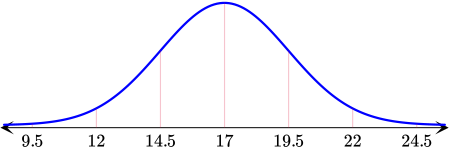
The probability that Kevin spends less than 14 minutes getting to work tomorrow is represented by the area below the curve that is to the left of 14.
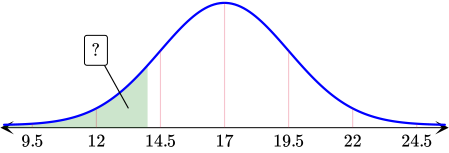
z=σx−μ
SubstituteValues
Substitute values
z=2.514−17
▼
Evaluate right-hand side
SubTerm
Subtract term
z=2.5-3
MoveNegNumToFrac
Put minus sign in front of fraction
z=-2.53
CalcQuot
Calculate quotient
z=-1.2
| .0 | .1 | .2 | .3 | .4 | .5 | .6 | .7 | .8 | .9 | |
|---|---|---|---|---|---|---|---|---|---|---|
| -3 | .00135 | .00097 | .00069 | .00048 | .00034 | .00023 | .00016 | .00011 | .00007 | .00005 |
| -2 | .02275 | .01786 | .01390 | .01072 | .00820 | .00621 | .00466 | .00347 | .00256 | .00187 |
| -1 | .15866 | .13567 | .11507 | .09680 | .08076 | .06681 | .05480 | .04457 | .03593 | .02872 |
| -0 | .50000 | .46017 | .42074 | .38209 | .34458 | .30854 | .27425 | .24196 | .21186 | .18406 |
| 0 | .50000 | .53983 | .57926 | .61791 | .65542 | .69146 | .72575 | .75804 | .78814 | .81594 |
| 1 | .84134 | .86433 | .88493 | .90320 | .91924 | .93319 | .94520 | .95543 | .96407 | .97128 |
| 2 | .97725 | .98214 | .98610 | .98928 | .99180 | .99379 | .99534 | .99653 | .99744 | .99813 |
| 3 | .99865 | .99903 | .99931 | .99952 | .99966 | .99977 | .99984 | .99989 | .99993 | .99995 |
According to the table, the probability that tomorrow Kevin will spend less than 14 minutes traveling to work is about 0.12.
b In the graph from Part A it can be seen that neither 16 nor 19 are labels on the axis.
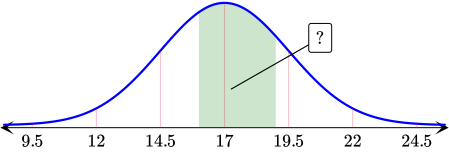
Therefore, both values will need to be converted into their corresponding z-scores first. Recall that μ=17 and σ=2.5!
| z=σx−μ | ||
|---|---|---|
| x-value | Substitute | Simplify |
| 16 | z=2.516−17 | z=-0.4 |
| 19 | z=2.519−17 | z=0.8 |
P(-0.4<z<0.8)=P(z<0.8)−P(z<-0.4)
Each of these probabilities can be found using the standard normal table. | .0 | .1 | .2 | .3 | .4 | .5 | .6 | .7 | .8 | .9 | |
|---|---|---|---|---|---|---|---|---|---|---|
| -3 | .00135 | .00097 | .00069 | .00048 | .00034 | .00023 | .00016 | .00011 | .00007 | .00005 |
| -2 | .02275 | .01786 | .01390 | .01072 | .00820 | .00621 | .00466 | .00347 | .00256 | .00187 |
| -1 | .15866 | .13567 | .11507 | .09680 | .08076 | .06681 | .05480 | .04457 | .03593 | .02872 |
| -0 | .50000 | .46017 | .42074 | .38209 | .34458 | .30854 | .27425 | .24196 | .21186 | .18406 |
| 0 | .50000 | .53983 | .57926 | .61791 | .65542 | .69146 | .72575 | .75804 | .78814 | .81594 |
| 1 | .84134 | .86433 | .88493 | .90320 | .91924 | .93319 | .94520 | .95543 | .96407 | .97128 |
| 2 | .97725 | .98214 | .98610 | .98928 | .99180 | .99379 | .99534 | .99653 | .99744 | .99813 |
| 3 | .99865 | .99903 | .99931 | .99952 | .99966 | .99977 | .99984 | .99989 | .99993 | .99995 |
P(-0.4<z<0.8)=P(z<0.8)−P(z<-0.4)
SubstituteII
P(z<0.8)=0.78814, P(z<-0.4)=0.34458
P(-0.4<z<0.8)=0.78814−0.34458
SubTerm
Subtract term
P(-0.4<z<0.8)=0.44356
RoundDec
Round to 2 decimal place(s)
P(-0.4<z<0.8)≈0.44
c In order for Kevin to be on time, his commute cannot take more than 19 minutes. In other words, he will be late for work if it takes more than 19 minutes. This means that the probability that Kevin will be late for work that day is represented by the area below the normal curve that is to the right of 19.
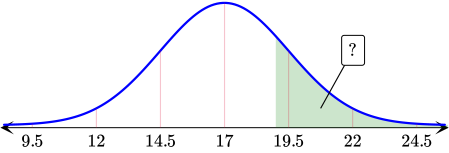
Since 19 is not a label on the axis, the Empirical Rule cannot be used. Therefore, z-scores must be used to find the area. In Part B it was determined the z-score that corresponds to 19 is 0.8.
| Probability of Kevin Being Late | Probability of Kevin Being on Time |
|---|---|
| P(z>0.8) | P(z≤0.8) |
P(z>0.8)+P(z≤0.8)=1
It was also determined in Part B that P(z≤0.8) is 0.78814. Substitute this value into the equation above and solve for P(z>0.8).
P(z>0.8)+P(z≤0.8)=1
Substitute
P(z≤0.8)=0.78814
P(z>0.8)+0.78814=1
SubEqn
LHS−0.78814=RHS−0.78814
P(z>0.8)=0.22186
RoundDec
Round to 2 decimal place(s)
P(z>0.8)≈0.22
Example
Testing a Prototype
The company Kevin is interning with plans to release a new smartphone. He goes with the research team to a stadium with a prototype to let different people use the phone in order to determine what features and design people like.

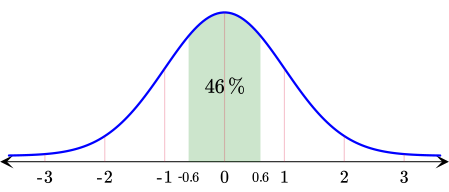
After comparing and contrasting size preference with the ages of the participants, Kevin realizes that the data is normally distributed. Additionally, he notices that the middle 46% of participants prefer a larger phone.
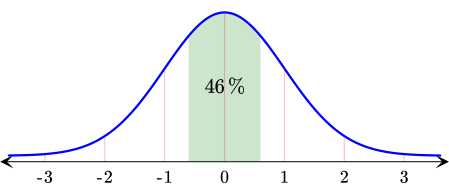
a Find the z-scores that correspond to the limits of the ages of the middle 46% of people, those that prefer a larger phone. Write the limits from least to greatest, rounded to one decimal place.
{"type":"text","form":{"type":"list","options":{"comparison":"1","nofractofloat":false,"keypad":{"simple":true,"useShortLog":false,"variables":[],"constants":[]},"rendered":false,"ordermatters":true,"numinput":2,"listEditable":false,"hideNoSolution":true},"text":"<span class=\"katex\"><span class=\"katex-html\" aria-hidden=\"true\"><\/span><\/span>"},"formTextBefore":"<span class=\"katex\"><span class=\"katex-html\" aria-hidden=\"true\"><span class=\"base\"><span class=\"strut\" style=\"height:0.43056em;vertical-align:0em;\"><\/span><span class=\"mord mathdefault\" style=\"margin-right:0.04398em;\">z<\/span><span class=\"mspace\" style=\"margin-right:0.2777777777777778em;\"><\/span><span class=\"mrel\">=<\/span><\/span><\/span><\/span>","formTextAfter":null,"answer":{"text":["-0.6","0.6"]}}
b The mean age of the participants was 19 years old and the standard deviation 5. With this information, determine the range of the ages that represent the middle 46% of the distribution. Write the answer as a strict compound inequality.
{"type":"text","form":{"type":"math","options":{"comparison":"1","nofractofloat":false,"keypad":{"simple":false,"useShortLog":false,"variables":["X"],"constants":[]},"rendered":false},"text":"<span class=\"katex\"><span class=\"katex-html\" aria-hidden=\"true\"><\/span><\/span>"},"formTextBefore":"Age Range:","formTextAfter":null,"answer":{"text":["16<X<22"]}}
Hint
a Find the area that is to the left of the middle 46%. Use a standard normal table to find the z-score that produces that area. Because a normal distribution is symmetrical, the upper bound is the opposite of the lower bound.
b Convert the z-scores found in Part A into their original values.
Solution
a Let z1 and z2 be the lower and upper limits of the middle 46% of the data. To find the corresponding values, start by finding the percentage of data outside the middle area. To do so, subtract 46% from 100%.
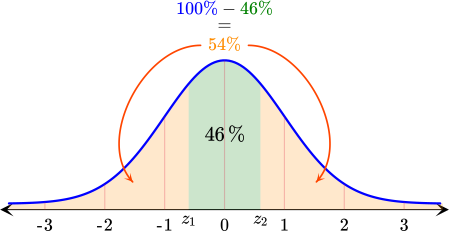
Due to the symmetry of the normal curve, the area to the left of z1 is equal to the area to the right of z2. Therefore, each portion corresponds to 54÷2=27% of the data. For the moment, focus on the area to the left of z1.
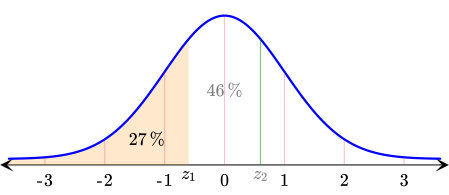
According to the last graph, the probability that a randomly chosen value is less than z1 is 0.27. In other words, P(z<z1)=0.27. Now, look for the z-value that produces a probability of 0.27 on a standard normal table.
| .0 | .1 | .2 | .3 | .4 | .5 | .6 | .7 | .8 | .9 | |
|---|---|---|---|---|---|---|---|---|---|---|
| -3 | .00135 | .00097 | .00069 | .00048 | .00034 | .00023 | .00016 | .00011 | .00007 | .00005 |
| -2 | .02275 | .01786 | .01390 | .01072 | .00820 | .00621 | .00466 | .00347 | .00256 | .00187 |
| -1 | .15866 | .13567 | .11507 | .09680 | .08076 | .06681 | .05480 | .04457 | .03593 | .02872 |
| -0 | .50000 | .46017 | .42074 | .38209 | .34458 | .30854 | .27425 | .24196 | .21186 | .18406 |
| 0 | .50000 | .53983 | .57926 | .61791 | .65542 | .69146 | .72575 | .75804 | .78814 | .81594 |
| 1 | .84134 | .86433 | .88493 | .90320 | .91924 | .93319 | .94520 | .95543 | .96407 | .97128 |
| 2 | .97725 | .98214 | .98610 | .98928 | .99180 | .99379 | .99534 | .99653 | .99744 | .99813 |
| 3 | .99865 | .99903 | .99931 | .99952 | .99966 | .99977 | .99984 | .99989 | .99993 | .99995 |
It is seen in the table that z1=-0.6. Again, due to symmetry, z2 is the opposite of z1. Therefore, z2=0.6.
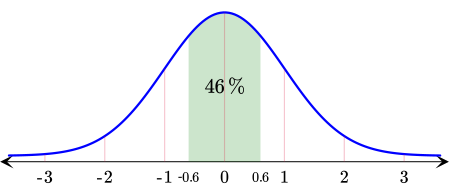
Therefore, the limits of the middle 46% of the data are z=-0.6 and z=0.6.
b In Part A it was determined that the limits of the middle 46% of the data are -0.6 and 0.6.
z=σx−μ
▼
Solve for x
x=μ+z⋅σ
x=μ+z⋅σ
▼
Substitute values and evaluate
SubstituteValues
Substitute values
x=19+(-0.6)(5)
MultNegPos
(-a)b=-ab
x=19+(-3)
AddNeg
a+(-b)=a−b
x=19−3
SubTerm
Subtract term
x=16
x=μ+z⋅σ
▼
Substitute values and evaluate
x=22
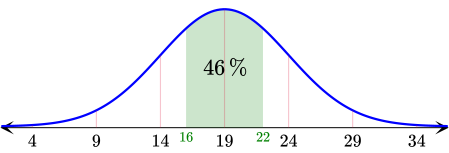
16<X<22
Discussion
Standardizing a Normal Distribution
One interesting property of a normal distribution is that it can take any value as its mean and any non-negative value as its standard deviation. Because of this, comparing two normally distributed data sets has to be done carefully. Otherwise, erroneous conclusions can be made.
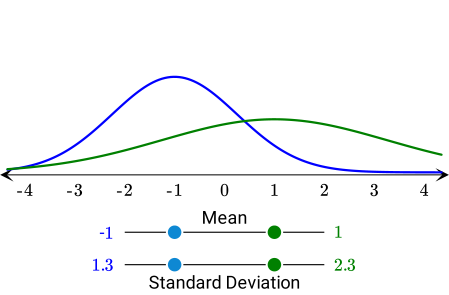 Additionally, the probability of an event happening is the area below the curve. Since there are infinitely many possible curves, the process for finding a certain probability changes between different normal distributions. However, through the use of z-scores, any normal distribution can be standardized, allowing the use of a standard normal table to find any probability.
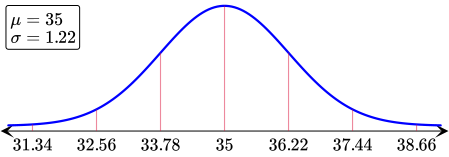 Since the domain is continuous, the conversion cannot be manually done for all the values. However, for illustrative purposes, it will be performed for the data set {33, 34, 34, 35, 35, 35, 36, 36, 37}. Two steps will be followed.
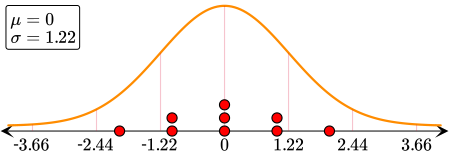
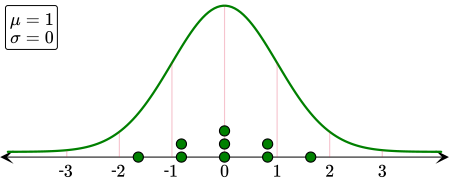 This process is called standardization and allows objective comparison of data sets that are normally distributed but have different means and standard deviations. Furthermore, it makes it possible to use the same table — the Standard Normal Table — to calculate the probability of any normal distribution.
Method
Standardization of Normal Distribution
Any normal distribution with mean μ and standard deviation σ can be converted into a standard normal distribution. For example, consider a normal distribution with μ=35 and σ=1.22. To standardize the distribution, all its values have to be converted into their corresponding z-scores.
1
Subtract the Mean From Each Data Value
expand_more First, shift all the values so that the mean of the new set is 0. To do this, subtract the mean 35 from each data value.
| x | x−μ |
|---|---|
| 33 | 33−35 |
| 34 | 34−35 |
| 34 | 34−35 |
| 35 | 35−35 |
| 35 | 35−35 |
| 35 | 35−35 |
| 36 | 36−35 |
| 36 | 36−35 |
| 37 | 37−35 |
Notice that translating the values will not changed the standard deviation. The standard deviation of the new data set is still 1.22.
The initial data set has been converted into {-2, -1, -1, 0, 0, 0, 1, 1, 2}.
2
Divide the Results by the Standard Deviation
expand_more To obtain a data set with a standard deviation of 1, divide the values obtained in the previous step by the standard deviation of the set.
| x | σx−μ | z-Score |
|---|---|---|
| 33 | 1.2233−35 | -1.64 |
| 34 | 1.2234−35 | -0.82 |
| 34 | 1.2234−35 | -0.82 |
| 35 | 1.2235−35 | 0 |
| 35 | 1.2235−35 | 0 |
| 35 | 1.2235−35 | 0 |
| 36 | 1.2236−35 | 0.82 |
| 36 | 1.2236−35 | 0.82 |
| 37 | 1.2237−35 | 1.64 |
After the standardization, the new data set is {-1.64, -0.82, -0.82, 0, 0, 0, 0.82, 0.82, 1.64}. Here, the mean is 0 and the standard deviation 1.
Notice that the resulting curve has a similar shape and distribution of data values as the original.
Extra
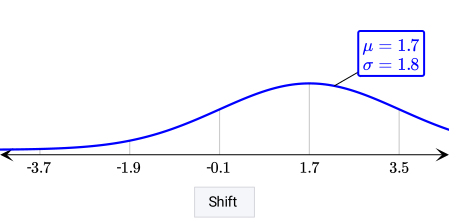
Graphic IllustrationThe applet shows the changes of a normal distribution as it is standardized.
Example
Comparing Performances
Kevin's friend LaShay took the SAT and scored 640 points on the math section. Kevin took the ACT and scored 28.32 points in the math section.
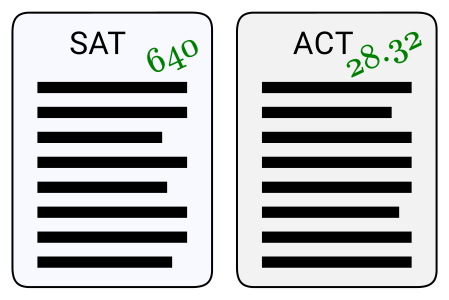
Since these tests use different scales — the math section of the SAT scores 800 points while the math section of the ACT scores 36 points — they wonder who did better. They looked at the stats for each test to find out.
- LaShay's class scores are normally distributed with a mean of 523 and a standard deviation of 90.
- Kevin's class scores are also normally distributed with a mean of 21 and a standard deviation of 6.1.
a Compared to their corresponding classmates, who stood out more, Kevin or LaShay?
{"type":"choice","form":{"alts":["Kevin","LaShay"],"noSort":false},"formTextBefore":"","formTextAfter":"","answer":1}
b Kevin took the ACT with 2000 people, including himself. How many people scored higher than Kevin?
{"type":"text","form":{"type":"math","options":{"comparison":"1","nofractofloat":false,"keypad":{"simple":true,"useShortLog":false,"variables":[],"constants":[]},"rendered":false},"text":"<span class=\"katex\"><span class=\"katex-html\" aria-hidden=\"true\"><\/span><\/span>"},"formTextBefore":null,"formTextAfter":"people","answer":{"text":["230"]}}
c What is the probability that a randomly chosen classmate of LaShay's has scored less than or equal to her on the SAT math section? Do not round the answer.
{"type":"text","form":{"type":"math","options":{"comparison":"1","nofractofloat":false,"keypad":{"simple":true,"useShortLog":false,"variables":[],"constants":[]},"rendered":false},"text":"<span class=\"katex\"><span class=\"katex-html\" aria-hidden=\"true\"><\/span><\/span>"},"formTextBefore":null,"formTextAfter":null,"answer":{"text":["0.90320"]}}
d The university where LaShay wants to study will accept only the top 100 math scores. If LaShay took the SAT with 1000 people, including herself, will she be accepted?
{"type":"choice","form":{"alts":["Yes","No"],"noSort":true},"formTextBefore":"","formTextAfter":"","answer":0}
Hint
b Use the z-score found in Part A and the standard normal table to find the percentage of people who scored lower than Kevin. Then, apply the Complement Rule. Multiply the percentage by the total number of people who took the test.
c Use the z-score found in Part A and the standard normal table.
d Use the probability found in Part C and the Complement Rule to determine how many people scored higher than LaShay. Are there more than 100 people?
Solution
a Since the scores of both tests are normally distributed, to determine who did better, graph both normal distributions. According to the stats Kevin and LaShay found, the mean of the SAT is 523 and the standard deviation is 90. On the other hand, the mean of the ACT is 21 and the standard deviation is 6.1.
![Two normal curves. One with labels [253,343,433,523,613,703,793] and the other with [2.7,8.8,14.9,21,27.1,33.2,39.3]](/mediawiki/images/9/91/Mljsx_Slide_A2_U9_C4_Example4_A1.svg)
Now Kevin's and LaShay's scores will be placed on the horizontal axis of their corresponding test. The score that is further to the right of the mean will tell who stood out the most compared to their class.
![Two normal curves. One with labels [253,343,433,523,613,703,793] and the other with [2.7,8.8,14.9,21,27.1,33.2,39.3]. The grades 640 and 28.32 are placed on the corresponding graph.](/mediawiki/images/f/f0/Mljsx_Slide_A2_U9_C4_Example4_A2.svg)
z=σx−μ
Since it will be further to the right of the mean, the higher positive z-score corresponds to the person who did better. | Score | Mean | Standard Deviation | z=σx−μ | z-score | |
|---|---|---|---|---|---|
| LaShay | 640 | 523 | 90 | z=90640−523 | z=1.3 |
| Kevin | 26.52 | 21 | 6.1 | z=6.126.52−21 | z=1.2 |
LaShay's z-score is greater than Kevin's z-score. This means that her score is further to the right of the mean. Consequently, LaShay excelled more in her class than Kevin did in his.
b The percentage of people who scored higher than Kevin is represented by the area below the normal curve and to the right of Kevin's score.
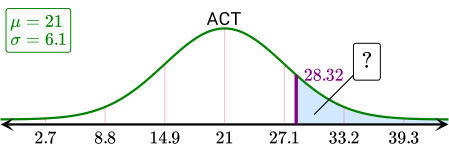
P(z>1.2)=1−P(z≤1.2)
Using a standard normal table, the percentage of people who scored less than or the same as Kevin can be determined. Keep in mind that the table has the percentages written as decimal numbers. | .0 | .1 | .2 | .3 | .4 | .5 | .6 | .7 | .8 | .9 | |
|---|---|---|---|---|---|---|---|---|---|---|
| -3 | .00135 | .00097 | .00069 | .00048 | .00034 | .00023 | .00016 | .00011 | .00007 | .00005 |
| -2 | .02275 | .01786 | .01390 | .01072 | .00820 | .00621 | .00466 | .00347 | .00256 | .00187 |
| -1 | .15866 | .13567 | .11507 | .09680 | .08076 | .06681 | .05480 | .04457 | .03593 | .02872 |
| -0 | .50000 | .46017 | .42074 | .38209 | .34458 | .30854 | .27425 | .24196 | .21186 | .18406 |
| 0 | .50000 | .53983 | .57926 | .61791 | .65542 | .69146 | .72575 | .75804 | .78814 | .81594 |
| 1 | .84134 | .86433 | .88493 | .90320 | .91924 | .93319 | .94520 | .95543 | .96407 | .97128 |
| 2 | .97725 | .98214 | .98610 | .98928 | .99180 | .99379 | .99534 | .99653 | .99744 | .99813 |
| 3 | .99865 | .99903 | .99931 | .99952 | .99966 | .99977 | .99984 | .99989 | .99993 | .99995 |
P(z>1.2)=1−0.88493⇕P(z>1.2)=0.11507
Consequently, 11.507% of people scored higher than Kevin. To find out how many people this percentage represents, multiply it by 2000.
11.507%⋅2000=230.14
In this context, only whole numbers make sense. Therefore, it can be concluded that about 230 people scored higher than Kevin on the math portion of the ACT.
c Similarly to Part B, the probability that a randomly chosen classmate of LaShay's has scored less than or equal to her on the SAT is given by the area below the normal curve and to the left of her score.
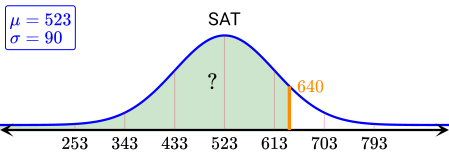
As before, the Empirical Rule is not helpful because LaShay's score is not of the form μ+kσ. Therefore, the area will be found using z-scores. The z-score that corresponds to 640 was found to be 1.3 in Part A. This means that the area is given by P(z≤1.3), which can be found on the standard normal table.
| .0 | .1 | .2 | .3 | .4 | .5 | .6 | .7 | .8 | .9 | |
|---|---|---|---|---|---|---|---|---|---|---|
| -3 | .00135 | .00097 | .00069 | .00048 | .00034 | .00023 | .00016 | .00011 | .00007 | .00005 |
| -2 | .02275 | .01786 | .01390 | .01072 | .00820 | .00621 | .00466 | .00347 | .00256 | .00187 |
| -1 | .15866 | .13567 | .11507 | .09680 | .08076 | .06681 | .05480 | .04457 | .03593 | .02872 |
| -0 | .50000 | .46017 | .42074 | .38209 | .34458 | .30854 | .27425 | .24196 | .21186 | .18406 |
| 0 | .50000 | .53983 | .57926 | .61791 | .65542 | .69146 | .72575 | .75804 | .78814 | .81594 |
| 1 | .84134 | .86433 | .88493 | .90320 | .91924 | .93319 | .94520 | .95543 | .96407 | .97128 |
| 2 | .97725 | .98214 | .98610 | .98928 | .99180 | .99379 | .99534 | .99653 | .99744 | .99813 |
| 3 | .99865 | .99903 | .99931 | .99952 | .99966 | .99977 | .99984 | .99989 | .99993 | .99995 |
The probability that a randomly chosen classmate of LaShay's has scored less than or equal to her is 0.90320.
d To determine whether LaShay will be accepted by the university, find the number of people who scored higher than she did on the SAT math section. Part C found that 90.32% of people scored less than or equal to LaShay. The number of people who scored higher than she did can be found by subtracting this percentage from 100%.
100%−90.32%=9.68%
Of the 1000 people who took the SAT test, 9.68% scored higher than LaShay. To figure out how many people this represents, multiply this percentage by 1000.
1000⋅9.68%=96.8 people
In this context, only whole numbers make sense. After rounding down, it can be said that about 96 people scored higher than LaShay did. This means that she is in the top 100 math scores and the university will therefore accept her.
Closure
Probability of Calls Handled
In the challenge presented at the beginning, it was said that Kevin has a summer internship at a tech company. The daily number of calls the company receives is normally distributed with a mean of 2240 calls and a standard deviation of 150 calls. The corresponding normal curve is represented in the following graph.
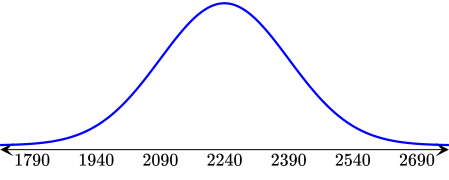
In order to improve the company, Kevin's boss is interested in knowing the answer to the next couple of questions.
a What is the probability that on a random day more than 2540 calls are received?
{"type":"text","form":{"type":"math","options":{"comparison":"1","nofractofloat":false,"keypad":{"simple":true,"useShortLog":false,"variables":[],"constants":[]},"rendered":false},"text":"<span class=\"katex\"><span class=\"katex-html\" aria-hidden=\"true\"><\/span><\/span>"},"formTextBefore":null,"formTextAfter":null,"answer":{"text":["0.025"]}}
b What is the probability that on a random day, between 2300 and 2420 calls are received? Round the answer to two decimal places.
{"type":"text","form":{"type":"math","options":{"comparison":"1","nofractofloat":false,"keypad":{"simple":true,"useShortLog":false,"variables":[],"constants":[]},"rendered":false},"text":"<span class=\"katex\"><span class=\"katex-html\" aria-hidden=\"true\"><\/span><\/span>"},"formTextBefore":"<span class=\"katex\"><span class=\"katex-html\" aria-hidden=\"true\"><span class=\"base\"><span class=\"strut\" style=\"height:0.48312em;vertical-align:0em;\"><\/span><span class=\"mrel\">\u2248<\/span><\/span><\/span><\/span>","formTextAfter":null,"answer":{"text":["0.23"]}}
Hint
a Use the Empirical Rule.
b Convert each number into a z-score. Use the standard normal table to find the area to the left of each z-score. Subtract the smaller area from the greater area.
Solution
a The probability that on a random day more than 2540 calls are received is the area below the curve that is to the right of 2540.
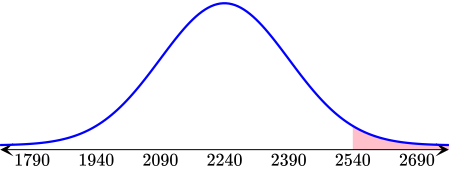
Notice that 2540 is exactly two standard deviations above the mean. Therefore, the required area can be found by using the Empirical Rule. This rule tells the percentage of data that fall within certain intervals. The graph below shows the distribution divided into labeled intervals according to the Empirical Rule.
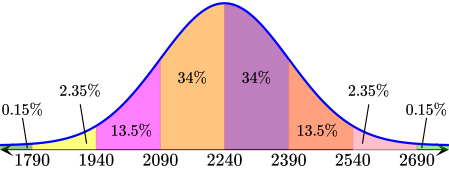
2.35%+0.15%=2.5%
Consequently, the probability that more than 2540 calls are received on a random day is 0.025
b The probability that between 2300 and 2420 calls are received on a random day is given by the area below the normal curve that is between 2300 and 2420.
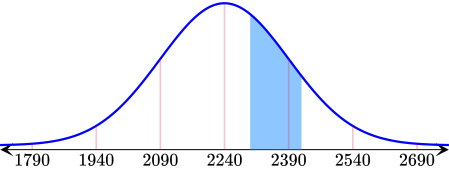
z=σx−μ
Substitute x=2300 and x=2420 into the formula. Remember that μ=2240 and σ=150. | x-value | z=σx−μ | z-score |
|---|---|---|
| 2300 | z=1502300−2240 | 0.4 |
| 2420 | z=1502420−2240 | 1.2 |
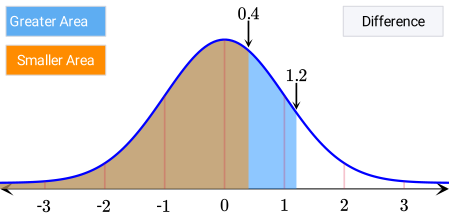
P(0.4≤z≤1.2)=P(z≤1.2)−P(z≤0.4)
The two values on the right-hand side can be found using a standard normal table. | .0 | .1 | .2 | .3 | .4 | .5 | .6 | .7 | .8 | .9 | |
|---|---|---|---|---|---|---|---|---|---|---|
| -3 | .00135 | .00097 | .00069 | .00048 | .00034 | .00023 | .00016 | .00011 | .00007 | .00005 |
| -2 | .02275 | .01786 | .01390 | .01072 | .00820 | .00621 | .00466 | .00347 | .00256 | .00187 |
| -1 | .15866 | .13567 | .11507 | .09680 | .08076 | .06681 | .05480 | .04457 | .03593 | .02872 |
| -0 | .50000 | .46017 | .42074 | .38209 | .34458 | .30854 | .27425 | .24196 | .21186 | .18406 |
| 0 | .50000 | .53983 | .57926 | .61791 | .65542 | .69146 | .72575 | .75804 | .78814 | .81594 |
| 1 | .84134 | .86433 | .88493 | .90320 | .91924 | .93319 | .94520 | .95543 | .96407 | .97128 |
| 2 | .97725 | .98214 | .98610 | .98928 | .99180 | .99379 | .99534 | .99653 | .99744 | .99813 |
| 3 | .99865 | .99903 | .99931 | .99952 | .99966 | .99977 | .99984 | .99989 | .99993 | .99995 |
P(0.4≤z≤1.2)=P(z≤1.2)−P(z≤0.4)
SubstituteII
P(z≤1.2)=0.88493, P(z≤0.4)=0.65542
P(0.4≤z≤1.2)=0.88493−0.65542
SubTerm
Subtract term
P(0.4≤z≤1.2)=0.22951
RoundDec
Round to 2 decimal place(s)
P(0.4≤z≤1.2)≈0.23
Alternative Solution
Using a Graphing CalculatorGraphing calculators are helpful for graphing a normal distribution and finding the area under the curve between specific limits. Additionally, the area can be found by using either the original normal distribution values or using z-scores.
Using the z-Scores
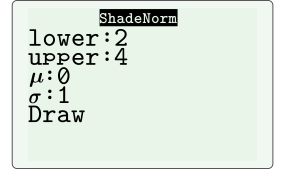
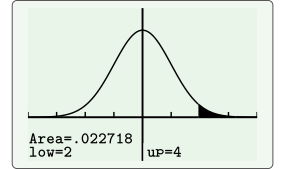
In Part A, the value 2540 is two standard deviations to the right of the mean. Therefore, its z-score is 2. To find the area below the curve that is to the right of z=2, follow these three steps in the calculator.
- Adjust the window size so that the graph fits on the screen. To do this, push WINDOW and enter the following values.
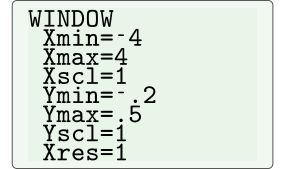
- Next, press 2nd and VARS, scroll right to the DRAW section, and choose the first option
ShadeNorm(.
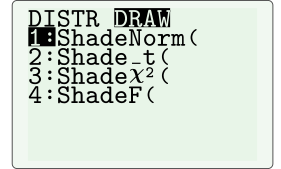
- Finally, set the lower limit to 2. Since most of the values of a standard normal distribution are within the interval [-4,4], set the upper limit to 4. Keep μ=0 and σ=1 and press
DRAW.
z1=0.4andz2=1.2
To find the area between 0.4 and 1.2, the first two steps are the same. However, in the third step, set 0.4 as the lower limit and 1.2 as the upper limit. 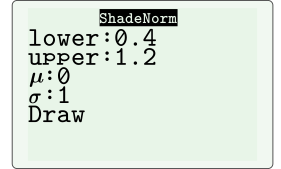
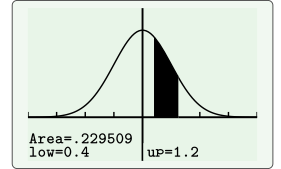
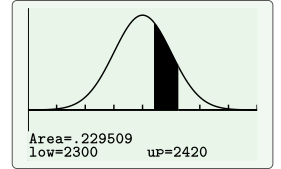
Consequently, P(0.4≤z≤1.2) is about 0.23.
Using the Original Values
The steps for computing the area below the original normal curve are quite similar. But here, the window size has to be carefully adjusted. In general, the values should have the following form.XminXmaxXscl=μ−4σ=μ+4σ=σYminYmaxYscl=2Ymax=2π⋅σ1=1
For Part A, use the following window settings. 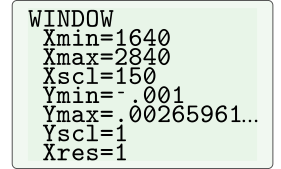
In the third step set the values corresponding to the distribution and press DRAW.
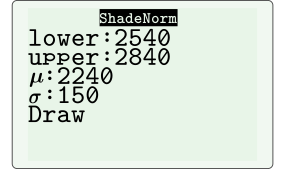
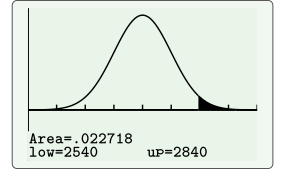
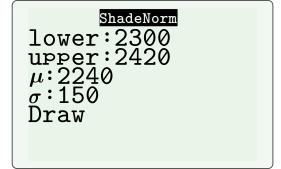
As seen, the result obtained is the same as before. Finally, for Part B, keep the window settings and only update the lower and upper limits.
Loading content