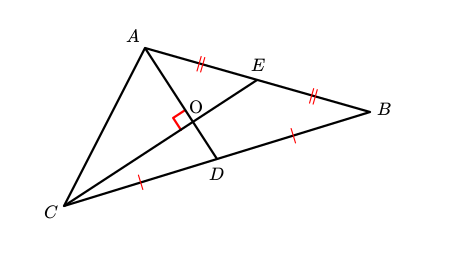
We are given that AD is perpendicular to CE. Also, we know that CE and AD are the medians of △ABC. This means that E and D are the midpoints of AB and CB respectively. Let's mark these pieces of information on the given diagram.
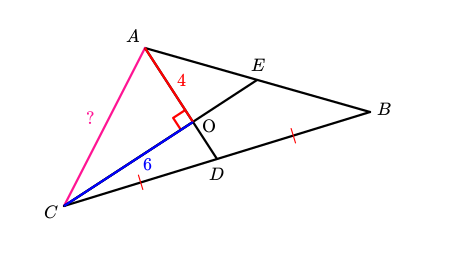
As we can see, △AOC is a right triangle. Thus, to find AC we can use the Pythagorean Theorem. Although, first we need to find CO and AO. Let's do this!
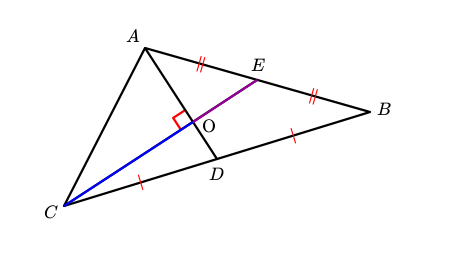
Finding CO
We are going to use the fact that CE and AD are the medians of △ABC. A point of intersection of triangle medians, which in our case is O, is called a centroid. Let's recall what the Centroid Theorem states.
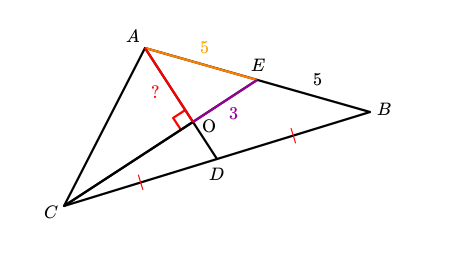
We also know that AB measures 10. Because CE is a median of AB, segments AE and EB are congruent and have the same measure. Dividing 10 by 2, we get that each of them measures 5.
Let's now consider the triangle △AOE. It is a right triangle, as CE and AD are perpendicular and form a right angle∠AOE. Hence, we can apply to it the Pythagorean Theorem.
AO2+OE2=AE2
We know the values of OE and AE, so we can substitute OE with 3 and AE with 5.
Mathleaks uses cookies for an enhanced user experience. By using our website, you agree to the usage of cookies as described in our policy for cookies.