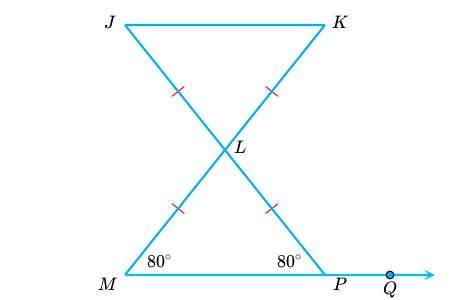
In this solution, we used the fact that vertical angles are always congruent. This is true due the Vertical Angle Theorem. We will learn a bit more about this theorem by considering the next diagram.
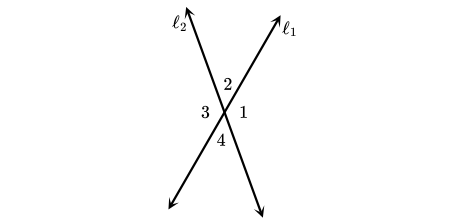
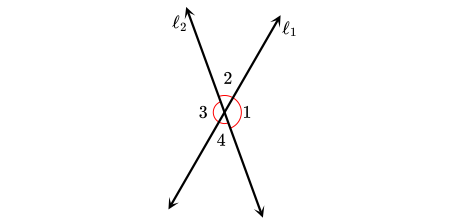
Analyzing the diagram, it can be observed that ∠1 and ∠2 form a straight angle, so these are supplementary angles. Similarly, ∠2 and ∠3 are also supplementary angles.
Therefore, by the Angle Addition Postulate, the sum of m∠1 and m∠2 is 180∘, and the sum of m∠2 and m∠3 is also 180∘. These facts can be used to express m∠2 in terms of m∠1 and also in terms of m∠3.
By the definition of congruent angles, this means that the vertical angles ∠1 and ∠3 are congruent angles. Using the same argumentation, ∠2 and ∠4 can also be proven to be congruent.
Mathleaks uses cookies for an enhanced user experience. By using our website, you agree to the usage of cookies as described in our policy for cookies.