Sign In
Start by considering the Isosceles Triangle Theorem, then use the Triangle Sum Theorem.
y=14
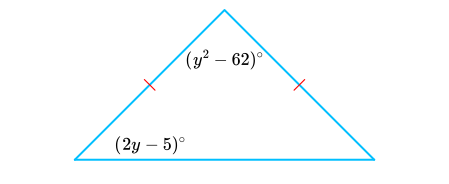
Consider the given triangle.
We want to find the value of y. To do so, we will start by identifying the type of triangle. Let's recall the classification of triangles.
| Classification of Triangles | |
|---|---|
| Scalene Triangle | A scalene triangle is a triangle in which all three sides have different lengths. |
| Isosceles Triangle | An isosceles triangle is a triangle that has two congruent sides and two base angles with the same measure. |
| Equilateral Triangle | An equilateral triangle is a triangle in which all the sides are congruent. |
| Acute Triangle | An acute triangle is a triangle where all angles are less than 90^(∘) or π2. |
| Obtuse Triangle | An obtuse triangle is a triangle with exactly one an angle whose measure is greater than 90^(∘) or π2. |
| Right Triangle | A right triangle is a specific type of triangle that contains one angle of 90^(∘). |
|
Isosceles Triangle Theorem |
|
If two sides of a triangle are congruent, then the angles opposite those sides are congruent. |
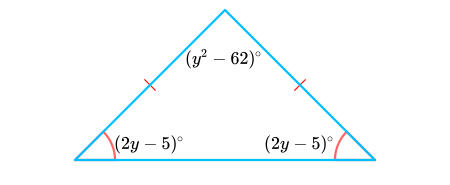
Using this theorem, let's label the congruent angles.
Now we can find y by using the Triangle Sum Theorem.
Remove parentheses
Add and subtract terms
LHS-180=RHS-180
Write as a difference
Factor out y
Factor out -14
Factor out (y+18)
Zero Property of Multiplication
(I): LHS-18=RHS-18
(II): LHS+14=RHS+14
As a result, the value of y will be either -18 or 14. However, -18 may not satisfy 2y-5 because it is negative. Let's check!
Since an angle measure cannot be negative, the only possible value of y is 14.