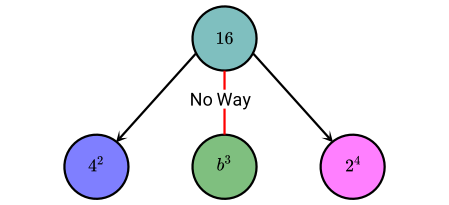
In the expressions above, a,b, and c are positive whole numbers. Using the definition of the nth root of a number, we obtain the following relations.
k=a2k=b3k=c4
Notice that k is a number that can be written as three different powers.
Additionally, c must be multiplied by itself 4 times to get the value of k, while a and b require fewer multiplications by themselves. This leads us to the following relation.
c<b<a
We can also set the following identities.
c4=b3=a2
Since c is the smallest value, we will substitute some values for c and calculate k. After that, our mission will be to find the numbers a and b.
c=2⇒c4=24=16=k
Next, we will try to write 16 as a whole number b cubed and as another whole number a squared.
Since 16 cannot be written as a whole number cube, c cannot be 2. Let's make a table where we try some more numbers.
c
c4=k
a2=k
b3=k
3
34=81
92=81
No way
4
44=256
162=256
No way
5
54=625
252=625
No way
6
64=1296
362=1296
No way
7
74=2041
492=2041
No way
8
84=4096
642=4096
163=4096
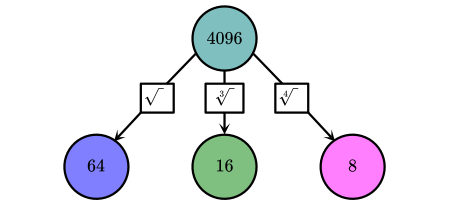
From the table above, one number that satisfies the required condition is 4096.
Alternative Solution
Using Rational Exponents
We need to find a number such that its square, cube, and fourth roots are positive whole numbers.
k=wholenumber3k=wholenumber4k=wholenumber
Let's write the number we are looking for as ab, where a and b are positive whole numbers. Next, we will rewrite the roots as rational exponents.
ab/2=wholenumberab/3=wholenumberab/4=wholenumber
Here the key is the indexes of the roots, or equivalently, the denominators of the exponents: 2,3, and 4. Since a is a whole number, we need each exponent to be a whole number too.
2b=wholenumber3b=wholenumber4b=wholenumber
From the above, we need b to be divisible by 2,3, and 4. One number that satisfies this condition is the least common multiple (LCM) of these numbers.
21231342122⇒LCM(2,3,4)=2⋅3⋅2=12
Consequently, any whole number a raised to b=12 will have a positive whole number for a square, cube, and fourth root. We can check it by trying some values.
k
k
3k
4k
212=4096
4096=64
34096=16
44096=8
312=531441
531441=729
3531441=81
4531441=27
412=16777216
16777216=4096
316777216=256
416777216=64
Therefore, any number raised to the 12th power will satisfy the given condition. Particularly, we can pick 4096.
Mathleaks uses cookies for an enhanced user experience. By using our website, you agree to the usage of cookies as described in our policy for cookies.