10. Graphing Absolute Value Inequalities
Sign In
An error ocurred, try again later!
Chapter 2
10.
Graphing Absolute Value Inequalities
This lesson provides a deep exploration into graphing absolute value inequalities. It emphasizes the importance of understanding the boundary line, which plays a pivotal role in determining the solution set. By analyzing the relationship between two variables, one can graphically represent the solution sets of these inequalities. The lesson also touches upon real-world scenarios, such as determining the value of an object over time or interpreting the reflection of light. By mastering these concepts, one can effectively graph and interpret absolute value inequalities in various mathematical and real-world contexts.
Show less Show more expand_more 


Lesson Settings & Tools
| | 8 Theory slides |
| | 10 Exercises - Grade E - A |
| | Each lesson is meant to take 1-2 classroom sessions |
Graphing Absolute Value Inequalities
Slide of 8
In this lesson, linear inequalities involving two variables and absolute values will be analyzed. The solution sets of these inequalities will also be drawn and interpreted.
Catch-Up and Review
Here are a few recommended readings before getting started with this lesson.
Explore
Graph of Absolute Value Equation in Two Variables
Consider the vertex form of absolute value equations in two variables.
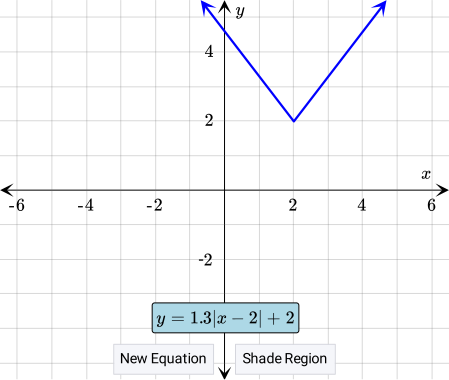 How does the given equation need to be changed to represent the shaded region? If the graph of the equation becomes dashed, what does this affect?
y=a∣x−h∣+k
When the vertex form of an absolute value equation is known, its graph can be drawn easily because the vertex of the graph is at (h,k) and the graph is symmetric about x=h. Examine the graph of the indicated absolute value equation and the shaded region.
Discussion
Absolute Value Inequalities in Two Variables
An absolute value inequality in two variables is an inequality that contains an absolute value expression and shows the relationship between two variables. If the relationship is linear, then the inequality is similar to the equation of an absolute value function.
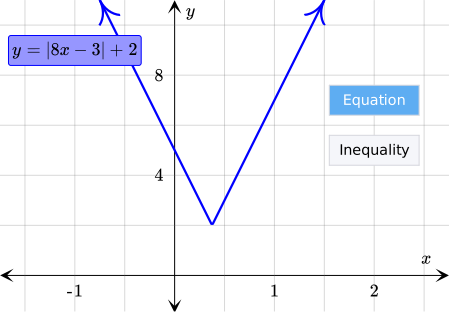
Example Equation: y=∣8x−3∣+2Inequality: y≤∣8x−3∣+2
While the graph of an absolute value equation is a V-shaped graph, the graph of a two-variable absolute value inequality is a region. When graphing a two-variable absolute value inequality, its boundary line plays an important role. Method
Graphing an Absolute Value Inequality in Two Variables
The steps for graphing an absolute value inequality in two variables are similar to the steps for graphing other types of inequalities. The general method is to draw the graph of the boundary line and then determine the region to be shaded by testing a point. The following inequality will be drawn as an example.
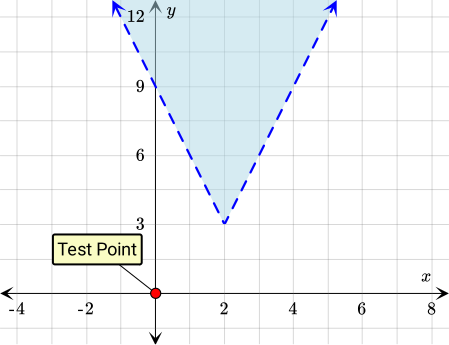
y−3>∣3x−6∣
To draw the graph of this inequality, the following steps can be followed.
1
Graph the Boundary Line
expand_more The boundary line of the inequality can be determined by replacing the inequality symbol with the equals sign.
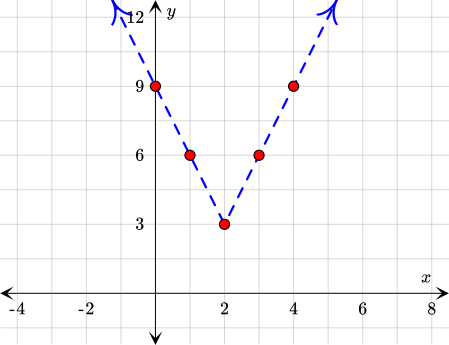
Inequality: Boundary Line: y−3 > ∣3x−6∣ y−3 = ∣3x−6∣
The graph of the boundary line can be drawn using a table of values. To make calculations easy, first y will be isolated.
y−3=∣3x−6∣⇕y=∣3x−6∣+3
Now some points on the boundary line can be found. | x | y=∣3x−6∣+3 | y |
|---|---|---|
| 0 | y=∣3(0)−6∣+3 | 9 |
| 1 | y=∣3(1)−6∣+3 | 6 |
| 2 | y=∣3(2)−6∣+3 | 3 |
| 3 | y=∣3(3)−6∣+3 | 6 |
| 4 | y=∣3(4)−6∣+3 | 9 |
Plot the points and draw the boundary line. Since the given inequality is strict, the boundary line will be dashed.
2
Test a Point
expand_more Next, the region that represents the solution set for the inequality needs to be determined. To do so, choose an arbitrary point not on the boundary line and substitute it into the inequality. (0,0) is not on the boundary, so it can be used.
Since -3>6 is a false statement, it is not a solution to the inequality.
y−3>∣3x−6∣
SubstituteII
x=0, y=0
0−3>?∣3(0)−6∣
ZeroPropMult
Zero Property of Multiplication
0−3>?∣0−6∣
SubTerms
Subtract terms
-3>?∣-6∣
AbsNeg
∣-6∣=6
-3>6 ×
3
Shade the Region
expand_more The test point is not a solution, so the region that does not contain the test point — inside the V-shaped graph — represents the solution set for the inequality. Finally, the appropriate region can be shaded.
Pop Quiz
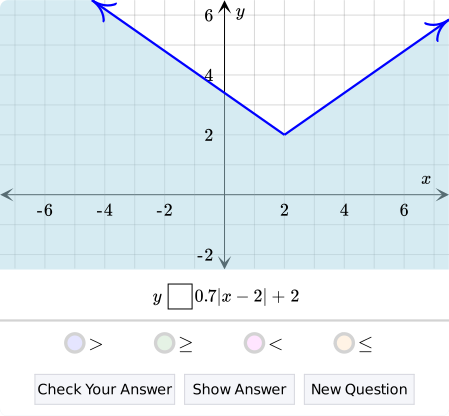
Determining Inequality Symbol
Analyze the graph of the given absolute value inequality in two variables to determine the proper inequality symbol.
Example
Writing an Absolute Value Inequality
Dylan writes an absolute value equation in two variables for the shape of a mirror.
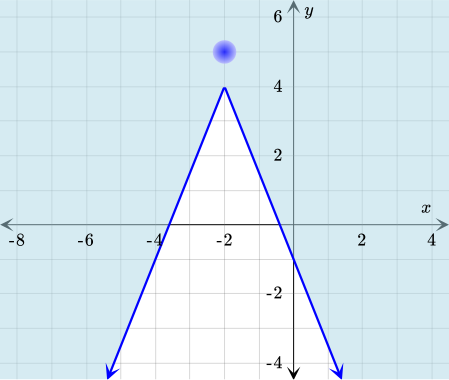
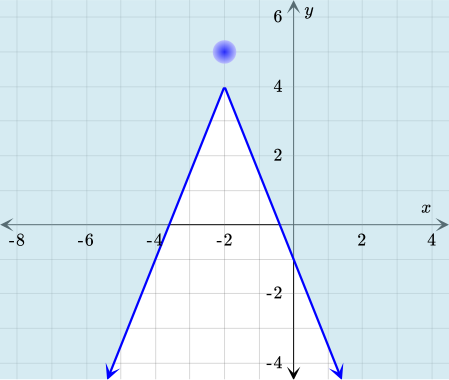
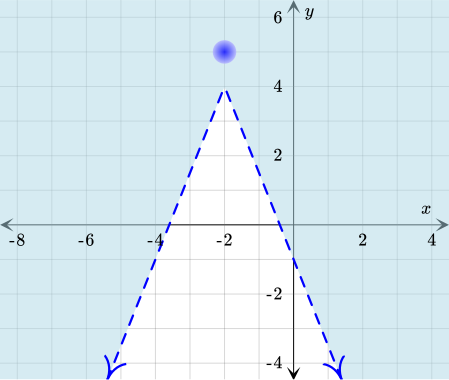 The shaded region represents the y-values greater than -∣∣∣25x+5∣∣∣+4. The inequality symbol will be strict because the graph of the mirror is not part of the solution set.
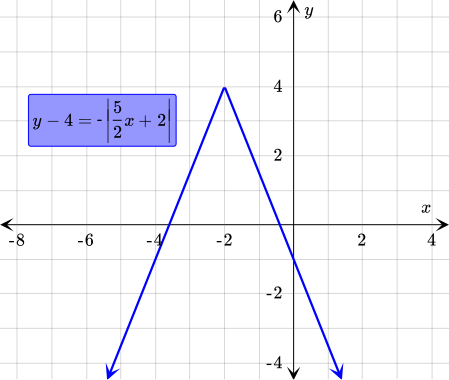
y−4=-∣∣∣∣∣25x+5∣∣∣∣∣
He knows that only the outside of the mirror is reflective. a Draw the graph of the given equation.
b Suppose a spherical blue light source is placed above the vertex of the graph. Shade the region where the blue light can reach on the graph.
c Write an absolute value inequality whose solution set is the shaded region, excluding the graph of the line.
Answer
a Graph:
b Graph:
c y>-∣∣∣∣∣25x+5∣∣∣∣∣+4
Hint
a Isolate the y-variable and make a table of values.
b What are the coordinates of the vertex of the absolute value equation? Put a point above it.
c For strict inequalities, the points on the boundary line are not solutions. Therefore, strict inequalities have dashed boundary lines.
Solution
a Notice that the absolute value equation for the shape of the mirror is not in vertex form.
y−4=-∣∣∣∣∣25x+5∣∣∣∣∣
The equation will be written in vertex form as follows.
y−4=-∣∣∣∣∣25x+5∣∣∣∣∣
▼
Rewrite
AddEqn
LHS+4=RHS+4
y=-∣∣∣∣∣25x+5∣∣∣∣∣+4
NumberToFrac
a=22⋅a
y=-∣∣∣∣∣25x+22⋅5∣∣∣∣∣+4
FactorOut
Factor out 25
y=-∣∣∣∣∣25(x+2)∣∣∣∣∣+4
Substitute
∣a⋅b∣=∣a∣⋅∣b∣
y=-∣∣∣∣∣25∣∣∣∣∣⋅∣x+2∣+4
AbsPos
∣∣∣∣∣25∣∣∣∣∣=25
y=-25∣x+2∣+4
a=-(-a)
y=-25∣x−(-2)∣+4
Vertex Form: Vertex: y=-25∣x−(-2)∣+4(-2,4)
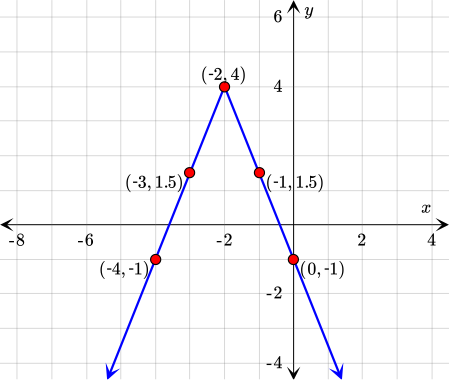
Since the x-coordinate of the vertex is -2, a table of values will be made using some x-values below. | x | -25∣x+2∣+4 | y=-25∣x+2∣+4 |
|---|---|---|
| -4 | -25∣-4+2∣+4=-1 | -1 |
| -3 | -25∣-3+2∣+4=1.5 | 1.5 |
| -2 | -25∣-2+2∣+4=4 | 4 |
| -1 | -25∣-1+2∣+4=1.5 | 1.5 |
| 0 | -25∣0+2∣+4=-1 | -1 |
Finally, plot the points and draw the absolute value equation.
As can be seen, the mirror has a V-shape with a vertex of (-2,4) in the coordinate plane.
b Now the region illuminated by a spherical blue light source is shaded when the source is placed above the vertex of the mirror. From Part A, the vertex is at (-2,4). Therefore, the light source can be placed, for example, at (-2,5). Then, the region illuminated by the source will be as shown.
c The aim is to write an absolute value inequality for the region illuminated by the light source, excluding the mirror itself. Since the mirror is excluded, its graph needs to be dashed.
Inequality: y>-∣∣∣∣∣25x+5∣∣∣∣∣+4
In this example, the mirror represents the boundary line of the inequality, the spherical light source represents a test point that satisfies the inequality, and the shaded region represents the graph of the inequality. Example
Graphing an Absolute Value Inequality
Ignacio buys an antique object at an auction. He plans to sell it in a few years. He describes the value of the object y (in thousands dollars) after x years as follows.
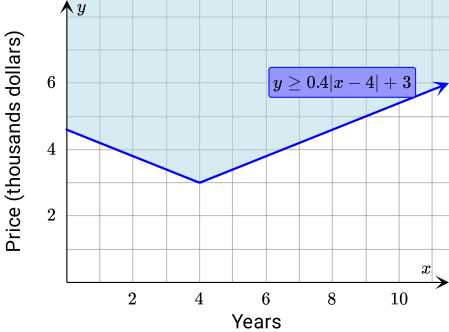
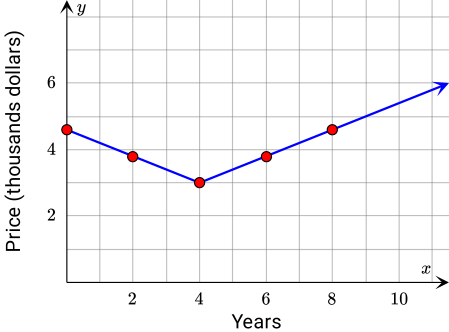 Next, the region to be shaded will be determined. To do so, choose an arbitrary point not on the boundary line and substitute it into the inequality. Let the point be (0,0).
Since 0≥4.6 is a false statement, it is not a solution to the inequality. Therefore, the region that does not contain the test point should be shaded.
Next, the region to be shaded will be determined. To do so, choose an arbitrary point not on the boundary line and substitute it into the inequality. Let the point be (0,0).
Since 0≥4.6 is a false statement, it is not a solution to the inequality. Therefore, the region that does not contain the test point should be shaded. 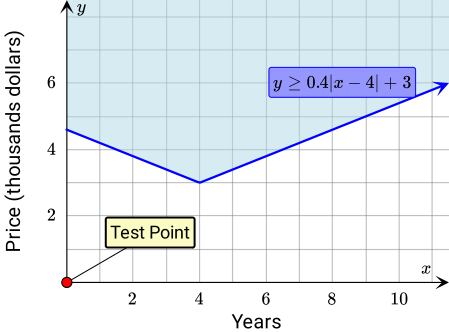 This means that Ignacio will be willing to sell the object at any price greater than or equal to $5000. Therefore, $5000 is the minimum price Ignacio can accept after 9 years.
y=0.4∣x−4∣+3
He is also willing to sell the object at any time for any price greater than or equal to the value found by the above equation. a Write an absolute value inequality for the given situation and graph it.
b What is the minimum price Ignacio would be willing to sell the object for 9 years from now?
Answer
a Inequality: y≥0.4∣x−4∣+3
Graph:
Graph:
b $5000
Hint
a Which inequality symbol should be used? To graph the absolute value inequality, start by making a table of values for its boundary line.
b Substitute the given value for x into the inequality found in the previous part.
Solution
a The value of the object after x years is represented by the right-hand side of the given equation.
0.4∣x−4∣+3
If Ignacio can find someone who is ready to pay greater than or equal to the amount after x years, the object is sold. Therefore, the following inequality will describe the situation.
y≥0.4∣x−4∣+3
To graph this absolute value inequality, its boundary line will be drawn first. To do so, make a table of values for y=0.4∣x−4∣+3. Note that since x represents the number of years, it cannot be negative. | x | y=0.4∣x−4∣+3 | y |
|---|---|---|
| 0 | y=0.4∣0−4∣+3 | 4.6 |
| 2 | y=0.4∣2−4∣+3 | 3.8 |
| 4 | y=0.4∣4−4∣+3 | 3 |
| 6 | y=0.4∣6−4∣+3 | 3.8 |
| 8 | y=0.4∣8−4∣+3 | 4.6 |
Plot the points and draw the boundary line. Since the inequality is non-strict, the boundary line will be solid. Note that only positive values of x and y makes sense in the context of the situation.
b It is asked to find the minimum price Ignacio would be willing to sell the object for 9 years from now. To do so, 9 needs to be substituted for x into the inequality found in Part A.
Example
Writing an Absolute Value Inequality From a Graph
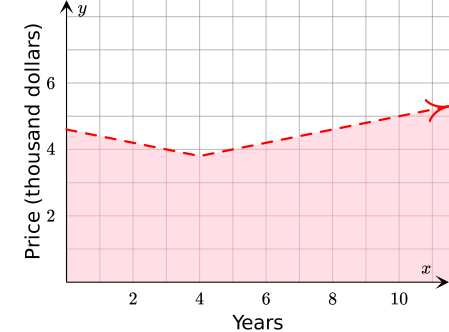
In the same auction, Emily was also interested in the object that Ignacio bought. Emily knows that Ignacio will sell it sooner or later. The maximum amount of money Emily can allocate to buy Ignacio's object is represented by the following graph.
{"type":"text","form":{"type":"math","options":{"comparison":"1","nofractofloat":false,"keypad":{"simple":false,"useShortLog":false,"variables":["x","y"],"constants":["PI"]},"rendered":false},"text":"<span class=\"katex\"><span class=\"katex-html\" aria-hidden=\"true\"><\/span><\/span>"},"formTextBefore":null,"formTextAfter":null,"answer":{"text":["y < 0.2|x-4|+3.8"]}}
Hint
To write the equation of the boundary line, use the vertex form of an absolute value equation y=a∣x−h∣+k, where (h,k) is the vertex of the absolute value equation.
Solution
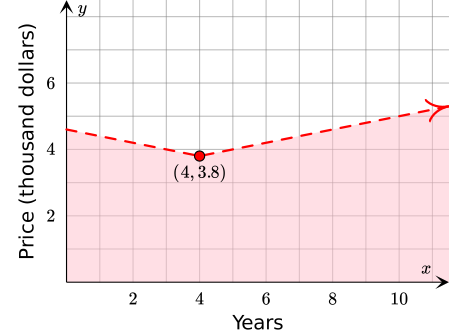
On the given graph, x represents the years after the auction and y represents the price of the object in thousands of dollars. Since Emily can allocate any amount less than $3800 for the object 4 years after the auction, these values correspond to point (4,3.8), which is the vertex of the boundary line.
y=a∣x−h∣+k
Since the vertex of the boundary line is (4,3.8), the corresponding values can be substituted.
y=a∣x−h∣+k⇓y=a∣x−4∣+3.8
To find a a point on the boundary line will be substituted. From the graph, (10,5) lies on the boundary line.
y=a∣x−4∣+3.8
SubstituteII
x=10, y=5
5=a∣10−4∣+3.8
▼
Solve for a
SubTerm
Subtract term
5=a∣6∣+3.8
AbsPos
∣6∣=6
5=a⋅6+3.8
SubEqn
LHS−3.8=RHS−3.8
1.2=a⋅6
DivEqn
LHS/6=RHS/6
0.2=a
RearrangeEqn
Rearrange equation
a=0.2
y=a∣x−4∣+3.8⇓y=0.2∣x−4∣+3.8
Since the boundary line is dashed, the inequality will be strict. The shaded region is below the boundary line. Therefore, the inequality symbol should be less than,<.
Boundary Line:Inequality: y=0.2∣x−4∣+3.8 y<0.2∣x−4∣+3.8
Closure
Absolute Value Inequalities on the Same Coordinate Plane
When absolute value inequalities in two variables are drawn on the same coordinate plane, they might intersect. The region where the graphs of the inequalities intersect represents the solutions that satisfy both inequalities. Consider the following absolute value inequalities.
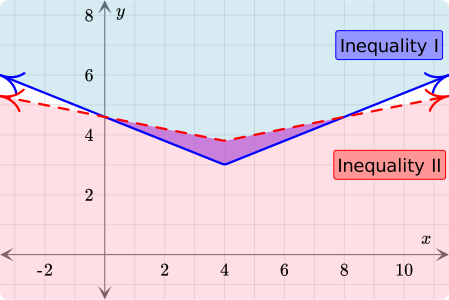
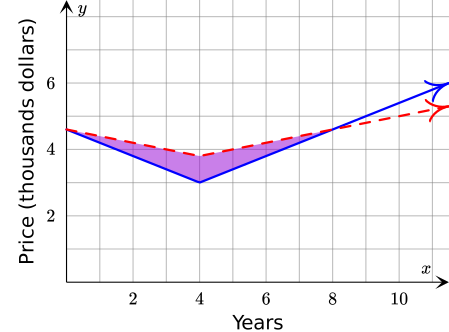
Inequality I:Inequality II: y≥0.4∣x−4∣+3 y<0.2∣x−4∣+3.8
There is a small region where the graphs of these inequalities intersect. Any point in this region is the solution to both inequalities. In the context of the last two examples, Ignacio and Emily can make a deal as long as the values stay in that region.
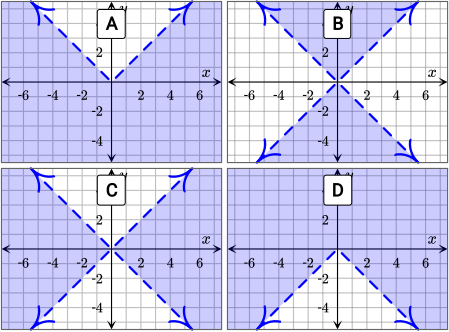
Which graph represents the solution set of the inequality ∣y∣<∣x∣?
{"type":"choice","form":{"alts":["<span class=\"katex\"><span class=\"katex-html\" aria-hidden=\"true\"><span class=\"base\"><span class=\"strut\" style=\"height:0.7109375em;vertical-align:0em;\"><\/span><span class=\"mord text\"><span class=\"mord Roboto-Bold textbf\">A<\/span><\/span><\/span><\/span><\/span>","<span class=\"katex\"><span class=\"katex-html\" aria-hidden=\"true\"><span class=\"base\"><span class=\"strut\" style=\"height:0.7109375em;vertical-align:0em;\"><\/span><span class=\"mord text\"><span class=\"mord Roboto-Bold textbf\">B<\/span><\/span><\/span><\/span><\/span>","<span class=\"katex\"><span class=\"katex-html\" aria-hidden=\"true\"><span class=\"base\"><span class=\"strut\" style=\"height:0.73046875em;vertical-align:-0.009765625em;\"><\/span><span class=\"mord text\"><span class=\"mord Roboto-Bold textbf\">C<\/span><\/span><\/span><\/span><\/span>","<span class=\"katex\"><span class=\"katex-html\" aria-hidden=\"true\"><span class=\"base\"><span class=\"strut\" style=\"height:0.7109375em;vertical-align:0em;\"><\/span><span class=\"mord text\"><span class=\"mord Roboto-Bold textbf\">D<\/span><\/span><\/span><\/span><\/span>"],"noSort":true},"formTextBefore":"","formTextAfter":"","answer":2}
security
report
code
security
report
code
We can write the given inequality as a compound inequality. |y| < |x| ⇓ y < |x| and y > - |x| We will draw the inequalities separately. Then, we will find the overlapping region of the inequalities, which represents the solution set the given inequality.
Graphing y < |x|
Let's start by determining the boundary line of the inequality by changing the inequality symbol to an equal sign. Inequality & Boundary Line y < |x| & y = |x| We have seen that an absolute value equation y=|x| gives us a vertical V-shaped graph with the vertex at the origin. Since the inequality is strict, the boundary line should be dashed.
We can now test a point to determine the region to be shaded. Let's use (1,0). y < |x| [( 1, 0)]Substitute 0 < | 1| ✓ Because (1,0) created a true statement, we will shade the region that contains this point.
Graphing y > - |x|
The boundary line of the second inequality is y = - |x|. Inequality & Boundary Line y > - |x| & y = - |x| The graph of this boundary line is an inverted V-shaped graph with vertex at the origin. The boundary line is also dashed because of the strict inequality symbol.
We can use (1,0) again to test which side of the line to shade. y > - |x| [( 1, 0)]Substitute 0 > - | 1| ✓ Substituting the point created a true statement, so the region that contains this point must be shaded.
Combining the Inequality Graphs
Let's draw the graphs of the inequalities on the same coordinate plane.
Finally, we remove the shading from the unnecessary regions. We are only interested in the overlapping regions of the two inequalities, so we will consider only this area.
We obtained the graph from option C. Therefore, this is the correct answer.
security
report
code
Graphing Absolute Value Inequalities
Recommended exercises
To get personalized recommended exercises, please login first.
Loading content
Loading content