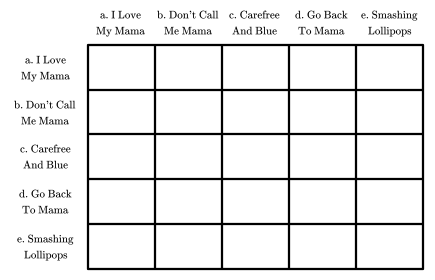
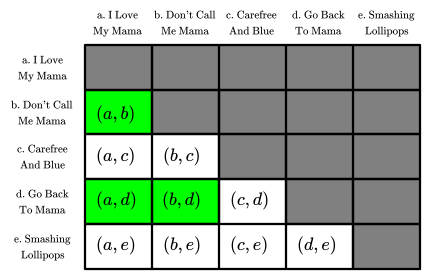
A sample space is a two way table that lists all the options both vertically and horizontally. Doing this, you can be sure to have captured all of the combinations.
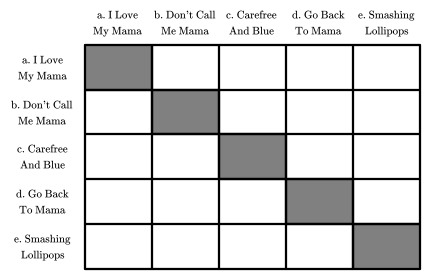
Note that the same song cannot be played twice. Therefore, we have to exclude all combinations of the same song being played by shading those fields.
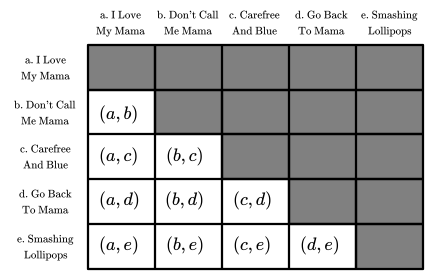
Also, the order she hears the song does not matter. For example, the combination I Love My Mama,Don't Call Me Mama and Don't Call Me Mama,I Love My Mama is regarded as the same combination. Therefore, we have to shade a few more combinations to avoid double counting.
In total there are 10 combinations. Let's list all of the them.
(a,b), (a,c), (a,d), (a,e), (b,c),
(b,d), (b,e), (c,d), (c,e), (d,e)
Yes, each combination is equally likely. If it wasn't we wouldn't be able to calculate the probability of a certain outcome using the Probability Formula.
P=Number of favorable outcomes/Number of possible outcomes
Let's highlight the combinations of two played songs that both contain the word Mama in our sample space.
There are a total of 3 combinations where both songs contain the word "Mama". From Part A, we know that there is a total of 10 combinations. With this, we can determine the probability of Renae listening to two songs with the name Mama in the title.
P(two songs with "Mama")=3/10
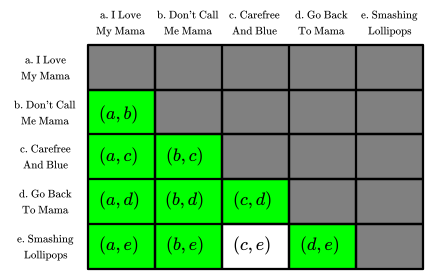
Now we are looking for all combinations that contain at least one of the letters a, b, or d. Let's highlight these in the sample space.
There are a total of 9 combinations where at least one song contain the word "Mama". From Part A we know that there is a total of 10 combinations. With this, we can determine the probability of Renae listening to at least one song with the word "Mama".
P(two songs with "Mama")=9/10
If both songs has to contain the word Mama, this excludes all combinations of songs where one song does not contain this word. If only one song has to contain the word, it opens up for more combinations which means the number of favorable outcomes is greater. For this reason, it makes sense that the probability is higher.