a On the unit circle, the sine value is given by the y-coordinate.
B
b The tangent of an angle is the ratio of its sine value to its cosine value.
C
c On the unit circle, the cosine value is given by the x-coordinate.
D
d On the unit circle, the sine value is given by the y-coordinate.
A
a θ=30^(∘) and θ=150^(∘)
B
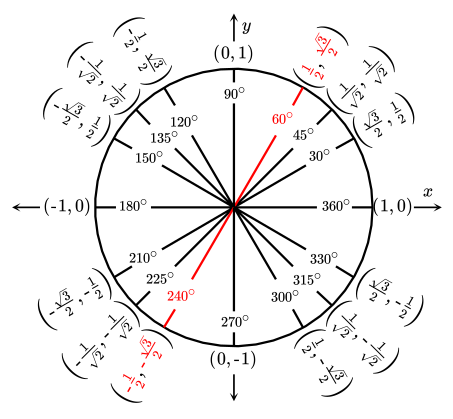
b θ=60^(∘) and θ=240^(∘)
C
c θ=30^(∘) and θ=330^(∘)
D
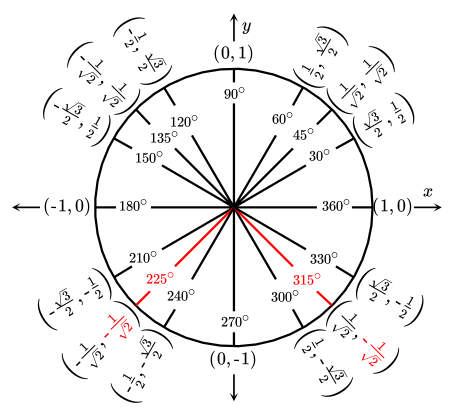
d θ=225^(∘) and θ=315^(∘)
Practice makes perfect
a To find the angles that make the equation true, we can use the following diagram.
The sine of a trig expression is given by the unit circle's vertical axis. Examining the diagram, we notice that two angles result in a sine value of 12.
Our two solutions are θ=30^(∘) and θ=150^(∘)
b The tangent of an angle is the angle's sine value to its cosine value.
tan θ = sin θ/cos θ
To get a tangent value of sqrt(3), we can either divide sqrt(3)2 with 12 or we can divide - sqrt(3)2 with - 12. Therefore, we have two different angles that would work.
Our two solutions are θ=60^(∘) and θ=240^(∘).
c The cosine of a trig expression is given by the unit circle's horizontal axis. Examining the diagram, we notice that two angles result in a cosine value of sqrt(3)2.
Our two solutions are θ=30^(∘) and θ=330^(∘).
d Just like in Part A, we have to identify the point on the unit circle where the y-coordinate is - sqrt(2)2. Notice that - sqrt(2)2 is the same thing as - 1sqrt(2). With this information, we can find the corresponding angles.