b The tangent of an angle is the ratio of the angles sine value to its cosine value.
C
c Sine is measured on the unit circle's vertical axis.
D
d Cosine is measured on the unit circle's horizontal axis.
A
a θ=60^(∘) and θ=300^(∘)
B
b θ=135^(∘) and θ=315^(∘)
C
c θ=60^(∘) and θ=120^(∘)
D
d θ=150^(∘) and θ=210^(∘)
Practice makes perfect
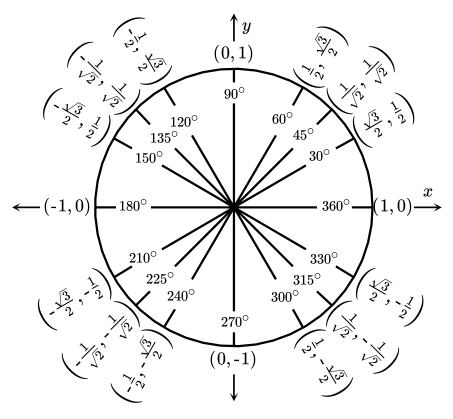
a To answer this exercise, we can use the following diagram.
The cosine of a trig expression is given by the unit circle's horizontal axis. Any point on the unit circle is given as (cos θ, sin θ). Examining the diagram, we notice that two angles result in a cosine value of 12.
Our two solutions are θ=60^(∘) and θ=300^(∘).
b The tangent value of an angle is the ratio of the angle's sine value to its cosine value.
tan θ = sin θ/cos θ
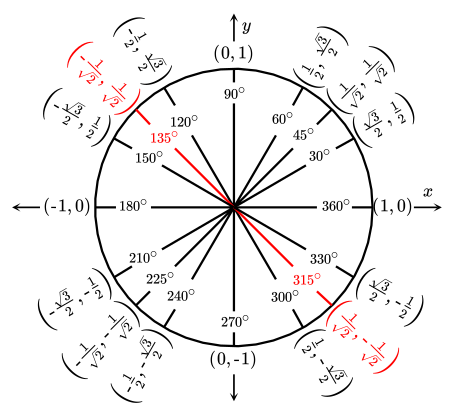
In order for a tangent value to be - 1, the cosine and sine values have to be opposite numbers. For the given interval, there are two possibilities.
When the angle of rotation is θ = 135^(∘) and θ = 315^(∘) the sine and cosine value are opposite numbers, which means the tangent value is - 1 for these angles.
c The sine of a trig expression is given by the unit circle's vertical axis. Examining the diagram, we notice that two angles result in a sine value of sqrt(3)2.
Our two solutions are θ=60^(∘) and θ=120^(∘).
d Like in Part A, we determine the cosine of an angle on the unit circle's horizontal axis. Examining the diagram below, we can identify two angles with a cosine value of - sqrt(3)2.