15. Constructions Using Different Tools
+ Customize lesson
0
0
Sign In
This lesson delves into specialized methods of geometric constructions, such as copying a segment with a string, locating a triangle's incenter, bisecting an angle by paper folding, and drawing a perpendicular bisector. These techniques are not confined to academic learning; they have practical applications as well. For example, locating a triangle's incenter is a skill used in various engineering projects to optimize structural balance. Similarly, drawing a perpendicular bisector is often required in fields like architecture and urban planning. Whether you're using different tools for classroom exercises or applying these constructions in a professional setting, understanding these methods can significantly enhance your problem-solving capabilities.
Show less Show more expand_more| Student Learning Objectives: |
|---|
|
| | 11 Theory slides |
| | 6 Exercises - Grade E - A |
| | Each lesson is meant to take 1-2 classroom sessions |
Ignacio needs to determine if the following segments are congruent to each other. However, he only has a piece of string and a pencil. Is he able to do it? If so, how?

Show Pencilbutton. Then, move the pencil tip over the place to mark. Finally, release the click.
A natural history museum manager hopes to place a replica of a moai statue in a triangular room in such a manner that the statue is equidistant from the walls that will have detailed diagrams and explanations. The location of the statue corresponds to the incenter of the triangle formed by the walls. This placement will allow for a clear walking path.

When copying a segment using a straightedge and compass, the function of the compass is to measure the length of the segment. With this in mind, a string can be a good substitute for the compass.
Using a straightedge and a string, it is possible to construct a copy of a segment.

The following three steps can be used to draw a segment with the same length as AB.


The marked point on the string indicates the location of B'. Then, mark this point on A'C and label it as B'.

Finally, by erasing the unnecessary part of A'C, a segment whose length is the same as the length of AB will be obtained.

As can be seen, AB and A'B' are copies of each other.
Using a straightedge and a string, it is possible to construct a copy of an angle.

The following five steps can be used to draw an angle whose measure is equal to the measure of ∠ ABC.


Next, holding down the end that is on B, stretch the string. Keeping the string stretched, make an arc that intersects the sides of ∠ ABC. Let P and Q be these points of intersection.

Finally, move the free end of the string to E and draw an arc centered at E. Let D be the intersection point between the ray and the arc.


Then, mark the point on the string that is on Q and tie the pencil to the string so that its tip is over the mark. It is not a necessity, but the remaining part of the string can be removed.


Paper folding, also referred to as origami, provides an alternative method for making constructions when tools such as a compass are not on hand.
An angle can be bisected using only a straightedge and folding the paper.

To bisect ∠ ABC, the following two steps can be done. If available, it is recommended to use tracing paper.


Using the folding paper technique, the challenge presented at the beginning of the lesson can be solved. A natural history museum manager hopes to place a replica of a moai statue in a triangular room in such a manner that the statue is equidistant from the walls that will have detailed diagrams and explanations. The location of the statue corresponds to the incenter of the triangle formed by the walls. This placement will allow for a clear walking path.

The manager's son, Kevin, sees the blueprint and wants to help to locate the incenter. Unfortunately, he does not have a protractor. Can he locate the incenter on the blueprint? If so, how?

|
Incenter |
|
The incenter of a triangle is the point of intersection of the triangle's angle bisectors. |
To obtain the point of intersection, Kevin needs to draw at least two angle bisectors to locate the incenter. To do so, begin by labeling the vertices of the triangle.

To draw the angle bisector of ∠ A, fold the blueprint so that AB lies on AC. Once the blueprint is unfolded, the crease made will represent the angle bisector.

To draw the angle bisector ∠ C, the blueprint has to be folded so that AC lies on BC. That way, a second crease will be made in the blueprint, representing the angle bisector of ∠ C.

The point where the two creases intersect each other corresponds to the incenter of the triangle. Consequently, this is the location where the moai replica has to be placed.

Notice that, thanks to the Incenter Theorem, the angle bisector of ∠ B does not have to be drawn to locate the incenter.
The usual way to draw the perpendicular bisector of a segment involves a straightedge and a compass. However, the same construction can be done without a compass.
Given a segment drawn on a paper, its perpendicular bisector can be drawn only using a straightedge and a pencil.

To draw the perpendicular bisector of AB, the following two steps can be used. If available, tracing paper is recommended.


Math teacher by day, the world's greatest futsal coach by night, Coach Tiffaniqua drew the following formation on a board to teach her players where to position themselves when taking a free kick near the court's center.

Ali, ecstatic, asked where he should be in the formation. Coach Tiffaniqua told Ali that he should be positioned the same distance from Diego, Ignacio, and Kevin. Determine where Ali should be positioned on the futsal field.


By definition, the circumcenter of a triangle is equidistant from the vertices. Therefore, to know where Ali should be placed, find the circumcenter of △ KDI. To do so, begin by drawing this triangle on a piece of paper.

Since the circumcenter is the point of intersection of the triangle's perpendicular bisectors, at least two perpendicular bisectors need to be drawn. Start by drawing the perpendicular bisector of KD. To do it, fold the paper so that K matches D.

Then, draw the perpendicular bisector of KI by folding the paper so that K and I match.

The circumcenter of △ KDI is the point where the two creases intersect each other. Finally, place the paper over the board and mark the circumcenter on it. This is the position where Ali should be positioned.

The last construction of this lesson will be to draw a line perpendicular to a given line through a point that is not on the line. Of course, this can be done using a straightedge and compass. However, it is possible to do so without the use of a compass.
A line perpendicular to a given line through a point not on the line can be drawn by using only a straightedge and a pencil.

To draw a line perpendicular to AB through P the following two steps can be used.


Ali has a piece of paper with an acute triangle drawn on it. He wants to draw the orthic triangle corresponding to △ ABC whose vertices are the feet of the altitudes of △ ABC.

However, Ali does not have a compass at hand. Help Ali draw the desired triangle.


Using the same method, the altitudes from B and C can also be drawn.

This construction gives the feet of the altitudes and the orthocenter of △ ABC. Finally, draw the orthic triangle by connecting A', B', and C'.

Before finishing the lesson, two interesting facts about the orthic triangle — also called the pedal triangle.

In the following diagram, P is the vertex of an isosceles right triangle so that the angle at P is acute. Which of the points Q, R, S, and T has the second acute angle if part of l is one of the legs? We may use the string below.
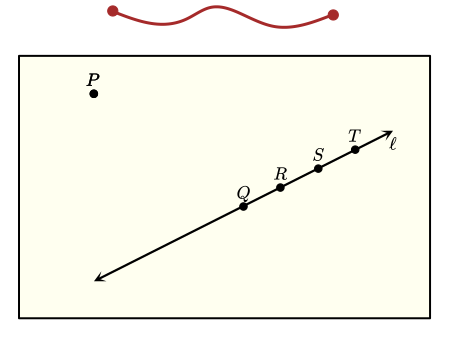
To draw this triangle, we must first create the right angle with l. To do this, we will fold the paper such that the crease goes through P and l traces itself.
Let's unfold the paper revealing one of the legs of the right triangle.
We know that the right triangle should be isosceles. Therefore, we must first find the length of the leg we already know. For this purpose, we will use the string. Place one endpoint of the string at P, and let it trace the crease. Make a mark on the string where it coincides with the vertex of the right angle.
Next, we will let the string trace l placing the endpoint that was previously at P at the vertex of the right angle.
As we can see, the second acute angle must be at S for the triangle to be an isosceles right triangle. Let's finish by actually drawing the triangle.