Interest Rate: 0.08 or 8 % Balance After 10 Years: $315
Practice makes perfect
We want to calculate the interest rate of the account and the balance after 10 years. We can determine each of these things one at a time.
Interest Rate
We want to calculate the interest rate of the account. We can do so using the simple interest formula which tells us that simple interest I is the product of the principal P, annual interest rate (in decimal form) r, and time (in years) t.
I=Prt
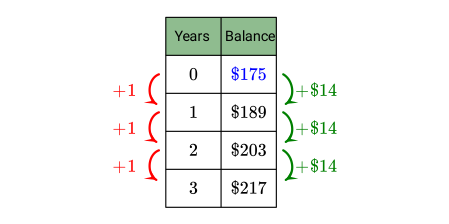
Now, we can look at the given table!
Notice that every year, the balance of the account increases by $14. We can use this information to calculate the interest rate r. Here, the interest I is 14 dollars, the principal P is 175 dollars, and the time t is 1 year. Now, we can substitute these values into the formula.
The annual interest rate on the account is 0.08, which can be also written as 8 %.
Balance After 10 Years
We want to calculate the balance of the account after 10 years. First, we can calculate the interest when the principal P is 175 dollars, the interest rate r is 0.08, and the time t is 10 years. Let's substitute these values in the formula for the simple interest!
The interest after 10 years is $140. Now, we can calculate the total balance on the account by adding the principal in dollars, 175, and the interest in dollars, 140.
175+140=315
The balance after 10 years is $315.