a To begin we will define three different variables as follows.
Let s represent the distance a person can swim.
Let t be the number of minutes a person can tread water.
Let u be the distance a person can swim underwater without taking a breath.
We will separate each of the inequalities into individual sections.
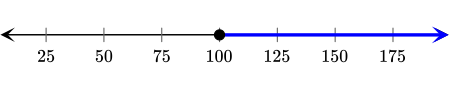
Swim at Least 100 Yards
The first requirement is that the person swims at least 100 yards. The phrase at least is another way to say greater than or equal to. Therefore, we can write an inequality to represent this requirement.
s ≥ 100
To graph this inequality, we will place a closed circle at 100, because s can equal 100, and shade the region to the right on the number line.
Tread Water for at Least Five Minutes
The second requirement is that the person treads water for at least five minutes. Again, the phrase at least is another way to say greater than or equal to. Therefore, we can use an inequality to represent this requirement.
t ≥ 5
To graph this inequality, we will place a closed circle at 5, because t can equal 5, and shade the region to the right on the number line.
Swim 10 Yards or More Underwater Without Taking a Breath
The third requirement is that the person swims 10 yards or more underwater without taking a breath. The phrase or more is another way to say greater than or equal to. Therefore, we can use the following inequality to represent this requirement.
u ≥ 10
To graph this inequality, we will place a closed circle at 10, because u can equal 10, and shade the region to the right on the number line.
b For this exercise, we must determine if given values lie within the solution set for each inequality we created. We will first translate the given criteria into equations. Then we will plot a point on the corresponding graph for each equation.
Swim at Least 100 Yards
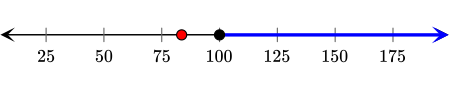
It is given that the we can swim 250 feet. We must first convert this into yards so we can compare the values. There are 3 feet in 1 yard, so we can multiply 250 feet by the conversion factor 1 yard3 feet to convert 250 feet to yards.
Therefore, we can swim 83.33 yards. This means s=83.33. We will place a point on the number line graph that we made for swimming at least 100 yards.
Notice that the point for s=83.33 is not within the shaded region on the graph. Therefore, we do not meet this requirement.
Tread Water for at Least Five Minutes
It is given that we can tread water for 6 minutes. Therefore, t=6. We will place a point on the number line graph made for treading water.
Notice that the point for t=6 is in the shaded region on the graph. Therefore, we meet this requirement.
Swim 10 Yards or More Underwater Without Taking a Breath
It is given that we can swim 35 feet underwater without taking a breath. We must first convert this into yards, so we can compare the values. There are 3 feet in 1 yard, so we can mutiliply 35 feet by the conversion factor 1 yard3 feet to convert 35 feet to yards.
Therefore, we can swim 11.67 yards underwater without taking a breath. This means u=11.67. We will place a point on the number line graph made for swimming underwater.
Notice that the point for u=11.67 is in the shaded region on the graph. Therefore, we meet this requirement.
Conclusion
We meet two of the three requirements for the course. Therefore, we do not satisfy all of the requirements.