{{ tocSubheader }}
{{ 'ml-label-loading-course' | message }}
An error ocurred, try again later!
Chapter {{ article.chapter.number }}
{{ article.number }}.
{{ article.displayTitle }}
{{ article.intro.summary }}
Show less Show more expand_more Lesson Settings & Tools
| | {{ 'ml-lesson-number-slides' | message : article.intro.bblockCount }} |
| | {{ 'ml-lesson-number-exercises' | message : article.intro.exerciseCount }} |
| | {{ 'ml-lesson-time-estimation' | message }} |
This lesson will explore the regions bounded by two radii of a circle and their intercepted arc. Additionally, the formula for the area of such regions will be derived considering the part-whole relationships.
Catch-Up and Review
Here is some recommended reading before getting started with this lesson.
Challenge
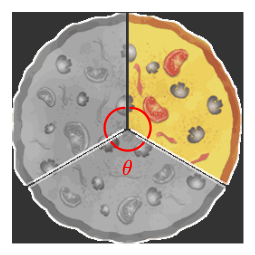
Investigating the Area of a Slice of Pizza
Three friends are sharing a 16-inch pizza equally. Emily is becoming a nutritionist and is curious about how many calories are in a slice. To find out, she will calculate the area of one slice.
Discussion
Investigating the Area of Sectors of a Circle
Concept
Sector of a Circle
A sector of a circle is a portion of the circle enclosed by two radii and their intercepted arc. 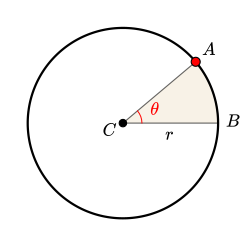 In the diagram, sector ACB is created by AC,BC, and AB.
Rule
Area of a Sector of a Circle
The area of a sector of a circle is calculated by multiplying the circle's area by the ratio of the measure of the central angle to 360∘.
Area of Sector=360∘θ⋅πr2
From the fact that 2π rad equals 360∘, an equivalent formula can be written if the central angle is given in radians.
Area of SectorArea of Sector=2πθ⋅πr2⇓=2θ⋅r2
Since the measure of an arc is equal to the measure of its central angle, the arc AB measures θ. Therefore, by substituting mAB for θ, another version of the formula is obtained which can also be written in degrees or radians.
Area of Sector=360∘mAB⋅πr2
or
Area of Sector=2mAB⋅r2
Proof
Consider sector ACB bounded by AC,BC, and AB.
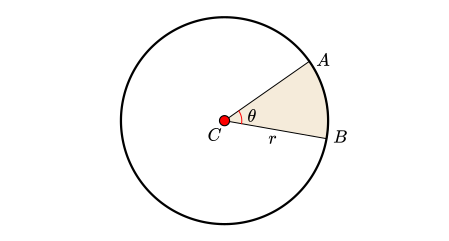
Area of CircleArea of Sector=360∘θ
Recall that the area of a circle is πr2. By substituting it into the equation and solving for the area of a sector, the desired formula can be obtained.
πr2Area of Sector=360∘θ
Therefore, the area of a sector of a circle can be found by using the following formula.
Area of Sector=360∘θ⋅πr2
Example
Using Sectors of Circles to Solve Problems
Like the pizza problem, numerous real-life problems can be modeled by sectors of a circle.
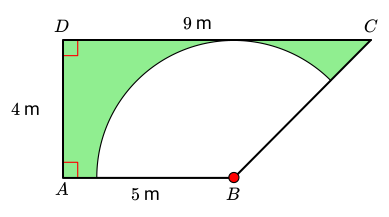
Tiffaniqua has a trapezoid-shaped yard whose side lengths are shown on the diagram. To water the lawn, she sets up a water sprinkler that can water the grass within a 4-meter radius. as shown.
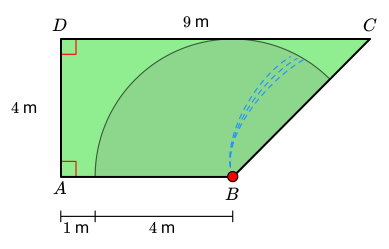
Tiffaniqua knows that ∠ABC measures 135∘.
a Help Tiffaniqua calculate the area of the lawn covered by the sprinkler. If necessary, round the answer to the nearest square meter.
{"type":"text","form":{"type":"math","options":{"comparison":"1","nofractofloat":false,"keypad":{"simple":true,"useShortLog":false,"variables":["x"],"constants":["PI"]},"rendered":false},"text":"<span class=\"katex\"><span class=\"katex-html\" aria-hidden=\"true\"><\/span><\/span>"},"formTextBefore":null,"formTextAfter":null,"answer":{"text":["19"]}}
b What is the area of the lawn that is not watered? If necessary, round the answer to the nearest square meters.
{"type":"text","form":{"type":"math","options":{"comparison":"1","nofractofloat":false,"keypad":{"simple":true,"useShortLog":false,"variables":["x"],"constants":["PI"]},"rendered":false},"text":"<span class=\"katex\"><span class=\"katex-html\" aria-hidden=\"true\"><\/span><\/span>"},"formTextBefore":null,"formTextAfter":null,"answer":{"text":["9"]}}
Hint
a The sprinkler covers a 135-degree sector of a circle with a radius of 4 meters.
b The area of a trapezoid is half the product of the height and the sum of the two bases.
Solution
a The sprinkler covers a 135-degree sector of a circle with radius 4 meters. The area of a sector of a circle can be calculated using the following formula.
Area of Sector=360∘θ⋅πr2
Substituting 135∘ for θ and 4 for r into the formula will give the result.
The area of the lawn covered is about 19 square meters.
b To find the area of the lawn that is not watered, the area found in Part A should be subtracted from the area of the trapezoid.
Area of Trapezoid=21h(b1+b2)
SubstituteValues
Substitute values
Area of Trapezoid=214(5+9)
▼
Evaluate right-hand side
AddTerms
Add terms
Area of Trapezoid=214(14)
Multiply
Multiply
Area of Trapezoid=2156
MoveRightFacToNumOne
b1⋅a=ba
Area of Trapezoid=256
CalcQuot
Calculate quotient
Area of Trapezoid=28
28−19=9
Tiffaniqua needs to water an area of 9 square meters.
Example
Calculating the Central Angle of Pac-Man's Mouth
When the area of a sector is given, the measure of the corresponding central angle can be calculated
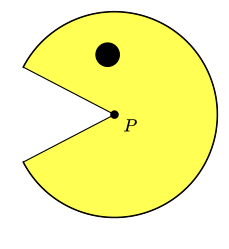
Consider a two-dimensional image of Pac-Man. The area covered by Pac-Man is about 66.5 square millimeters.
{"type":"text","form":{"type":"math","options":{"comparison":"1","nofractofloat":false,"keypad":{"simple":true,"useShortLog":false,"variables":["x"],"constants":["PI"]},"rendered":false},"text":"<span class=\"katex\"><span class=\"katex-html\" aria-hidden=\"true\"><\/span><\/span>"},"formTextBefore":null,"formTextAfter":null,"answer":{"text":["305"]}}
Hint
Pac-Man is essentially a sector of a circle. Use the formula for the area of a sector of a circle to find the measure of the angle.
Solution
To find the measure of the corresponding central angle, the formula for the area of a sector will be used.
Area of Sector=360∘θ⋅πr2
The area of the sector and the radius are given. Substitute these values into the formula.
The corresponding central angle is about 305∘.
Example
Comparing the Radius of Two Circles
The diagram below models the motion of two gears S and L. Gear S has a radius of 2 inches. 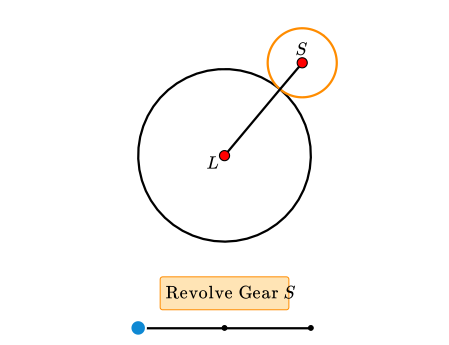
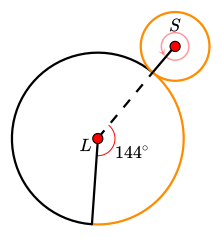 Furthermore, the length of the arc is equal to the circumference of ⊙S. Recall that the circumference is given by the formula C=2πr. Substituting r=2 into the formula will give the circumference CS of ⊙S.
The radius of the larger gear is 5 inches.
Furthermore, the length of the arc is equal to the circumference of ⊙S. Recall that the circumference is given by the formula C=2πr. Substituting r=2 into the formula will give the circumference CS of ⊙S.
The radius of the larger gear is 5 inches.
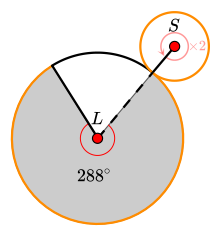 Note that the arc created due to revolutions also measures 288∘. In the previous part, the radius of ⊙L is found as 5 inches. Using the formula for the area of a sector, the sector of ⊙L can be calculated.
The area of the sector of ⊙L is 20π square inches.
Note that the arc created due to revolutions also measures 288∘. In the previous part, the radius of ⊙L is found as 5 inches. Using the formula for the area of a sector, the sector of ⊙L can be calculated.
The area of the sector of ⊙L is 20π square inches.
a Find the radius of the larger gear.
{"type":"text","form":{"type":"math","options":{"comparison":"1","nofractofloat":false,"keypad":{"simple":true,"useShortLog":false,"variables":["x"],"constants":["PI"]},"rendered":false},"text":"<span class=\"katex\"><span class=\"katex-html\" aria-hidden=\"true\"><\/span><\/span>"},"formTextBefore":null,"formTextAfter":null,"answer":{"text":["5"]}}
b Find the area of the sector of Gear L formed when Gear S completes two revolutions. Write the answer in terms of π.
{"type":"text","form":{"type":"math","options":{"comparison":"1","nofractofloat":false,"keypad":{"simple":false,"useShortLog":false,"variables":["x"],"constants":["PI"]},"rendered":false},"text":"<span class=\"katex\"><span class=\"katex-html\" aria-hidden=\"true\"><\/span><\/span>"},"formTextBefore":null,"formTextAfter":null,"answer":{"text":["20 \\pi"]}}
Hint
a How can the measure of the central angle formed in Gear L be used?
b Use the formula for the area of a sector of a circle.
Solution
a When the smaller gear completes a single revolution, the central angle measured in the larger gear becomes 144∘. Since the measure of an arc is the same as its corresponding central angle, the measure of the colored arc of ⊙L is also 144∘.
CS=2π(2)=4π
The length of the arc of ⊙L is, therefore, 4π inches. Now that the measure and length of the arc is known, the radius R of ⊙L can be found. To do so, substitute the values into the formula for the arc length.
Circumference of ⊙LArc length=360∘Arc measure
SubstituteValues
Substitute values
2πR4π=360∘144∘
▼
Solve for R
ReduceFrac
ba=b/2πa/2π
R2=360∘144∘
UseCalc
Use a calculator
R2=0.4
MultEqn
LHS⋅R=RHS⋅R
2=0.4R
DivEqn
LHS/0.4=RHS/0.4
5=R
RearrangeEqn
Rearrange equation
R=5
b As can be seen on the diagram, when Gear S makes two complete revolutions, the central angle measures 288∘.
Example
Using Areas Of Sectors to Solve Problems
In his free time, Dylan enjoys making decorative figures by hand. He has 5 identical sectors and brings these sectors together as shown.
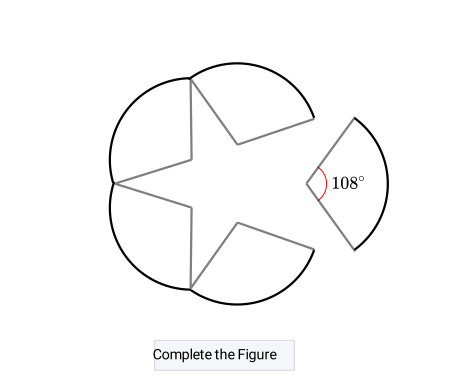
Dylan knows that the area of each sector is 18 square millimeters.
a Find the perimeter of the star-shaped figure. If necessary, round the answer to one decimal place.
{"type":"text","form":{"type":"math","options":{"comparison":"1","nofractofloat":false,"keypad":{"simple":true,"useShortLog":false,"variables":["x"],"constants":["PI"]},"rendered":false},"text":"<span class=\"katex\"><span class=\"katex-html\" aria-hidden=\"true\"><\/span><\/span>"},"formTextBefore":null,"formTextAfter":null,"answer":{"text":["44"]}}
b Find the perimeter of the figure. If necessary, round the answer to one decimal place.
{"type":"text","form":{"type":"math","options":{"comparison":"1","nofractofloat":false,"keypad":{"simple":true,"useShortLog":false,"variables":["x"],"constants":["PI"]},"rendered":false},"text":"<span class=\"katex\"><span class=\"katex-html\" aria-hidden=\"true\"><\/span><\/span>"},"formTextBefore":null,"formTextAfter":null,"answer":{"text":["41.5"]}}
Hint
a Notice that each side of the star-shaped figure is a radius.
b Start by finding the corresponding arc length of a sector.
Solution
a Notice that the sides of the star-shaped figure are the radii of the sectors.
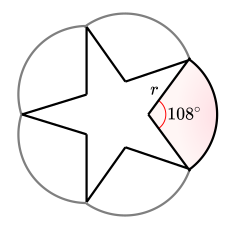
r=4.4⇔10r=44
The perimeter of the star-shaped figure is 44 millimeters.
b The perimeter of the figure created by Dylan is the sum of 5 identical arc lengths.
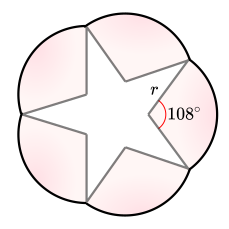
5×8.3≈41.5
Therefore, the figure has a perimeter of approximately 41.5 millimeters.
Closure
Solving Real Life Problems Using Sectors of Circles
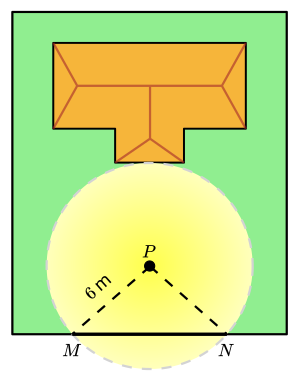
Mark set up a lamp in his courtyard. He uses a light bulb that illuminates a circular area with a radius of 6 meters. The diagram shows a bird's eye view of Mark's house.
{"type":"text","form":{"type":"math","options":{"comparison":"1","nofractofloat":false,"keypad":{"simple":true,"useShortLog":false,"variables":["x"],"constants":["PI"]},"rendered":false},"text":"<span class=\"katex\"><span class=\"katex-html\" aria-hidden=\"true\"><\/span><\/span>"},"formTextBefore":null,"formTextAfter":null,"answer":{"text":["13.69"]}}
Hint
The area of a triangle is half the product of the lengths of any two sides and the sine of the included angle.
Solution
From the diagram, it can be seen that the region bounded by MP, NP, and MN is a sector of ⊙P.
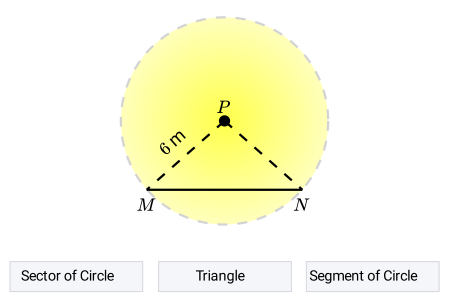
Asegment=Asector−Atriangle
The area of △MPN is half the product of the lengths of any two sides and the sine of the included angle. Atriangle=21⋅MP⋅NP⋅sin(θ)
Since MP and NP are radii of ⊙P, MP and NP are 6 meters. Moreover, the included angle MPN measures 100∘ because it intercepts a 100∘ arc. Substitute these values.
Atriangle=21⋅MP⋅NP⋅sin(θ)
SubstituteValues
Substitute values
Atriangle=21⋅6⋅6⋅sin(100∘)
Atriangle≈17.73
Asegment=Asector−Atriangle
SubstituteValues
Substitute values
Asegment≈31.42−17.73
SubTerm
Subtract term
Asegment≈13.69
Loading content