Areas of Parallelograms, Triangles, and Trapezoids

Rule

Area of a Trapezoid

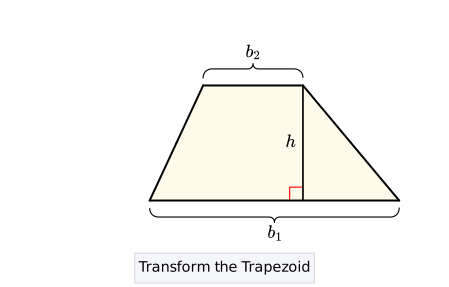
The area of a trapezoid is half the height times the sum of the lengths of the bases. In other words, the area of a trapezoid is the height multiplied by the average of the bases.

A=1/2h(b_1+b_2)

Proof

Consider a trapezoid with bases b_1 and b_2 and height h.

Drawing a diagonal divides the trapezoid into two triangles. Therefore, the area of the trapezoid can be written as the sum of the areas of the triangles.

Take b_2 as the base of the upper triangle and draw the corresponding altitude from the opposite vertex.

Notice that both triangles have the same height, which is the height of the trapezoid. The area of the bottom triangle is half the product of b_1 and h and the area of the upper triangle is half the product of b_2 and h. A_1 = 1/2b_1 h [1.2em] A_2 = 1/2b_2 h Finally, add these two areas to write a formula for the area of the trapezoid.

A = A_1 + A_2
A = 1/2b_1 h + 1/2b_2 h
A = 1/2h(b_1+b_2) ✓

Extra

Graphical Derivation
The formula for the area of a trapezoid with bases b_1 and b_2 and height h can be derived by transforming the trapezoid into a triangle with base b_1+b_2 and height h.

Converting a trapezoid into a triangle

Exercises
Edit Lesson