2. An Introduction to Periodic Functions
Sign In
An error ocurred, try again later!
Chapter 6
2.
An Introduction to Periodic Functions
This lesson delves into the intriguing world of periodic functions, focusing on their key features like amplitude and midline. It explains how these functions repeat their outputs at regular intervals, forming a definite pattern. The amplitude and midline are crucial for understanding the behavior of these functions. For instance, amplitude is half the difference between the maximum and minimum values of the function, while the midline is the average of these values. Real-life applications are also discussed, such as using periodic functions to understand heart rhythms via electrocardiograms or to study breathing patterns. Knowing these aspects can be invaluable in fields like healthcare, engineering, and even everyday problem-solving.
Show less Show more expand_more 


Lesson Settings & Tools
| | 10 Theory slides |
| | 8 Exercises - Grade E - A |
| | Each lesson is meant to take 1-2 classroom sessions |
An Introduction to Periodic Functions
Slide of 10
Sometimes patterns that repeat over time seem to emerge when using functions to model real-life situations. Knowing the properties of these functions is important to better understand their behavior. This lesson will introduce the concept of periodic function, as well as its key features.
Catch-Up and Review
Here are a few recommended readings before getting started with this lesson.
Explore
Share
Report error
Identifying Patterns in Graphs
Consider the following graphs.
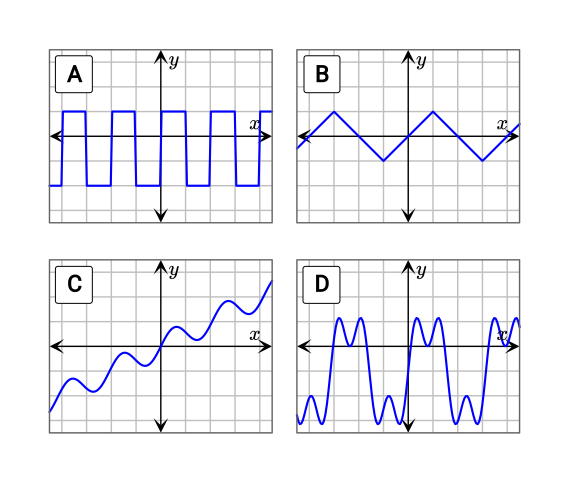
- What do these graphs have in common?
- What are their differences?
- Try determining if there is a repeating pattern in each graph.
Discussion
Share
Report error
Periodic Functions
A periodic function is a function that repeats its outputs at regular intervals, forming a definite pattern. The cycle of a periodic function is the shortest repeating portion of the graph, and the period is the horizontal length of one cycle. 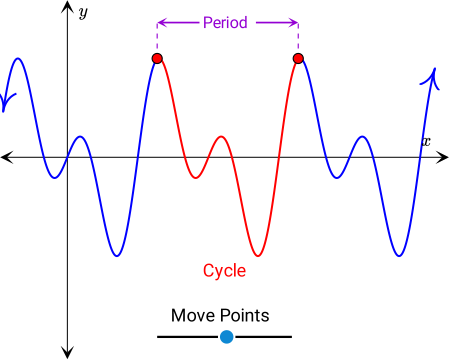 More precisely, a function f(x) is said to be periodic if a non-zero constant P exists such that f(x+P) and f(x) have the same value if and only if both x and x+P are in the domain.
f(x+P)=f(x)
Example
Share
Report error
A Visit to the Hospital
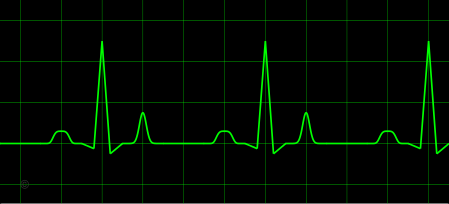
Kriz went to a hospital to with their cousin, who went there to donate blood. While waiting for their cousin, Kriz noticed that a nurse was setting up some device. They took a look at the screen and found a cool graph.
{"type":"text","form":{"type":"math","options":{"comparison":"1","nofractofloat":false,"keypad":{"simple":true,"useShortLog":false,"variables":[],"constants":[]},"rendered":false},"text":" "},"formTextBefore":null,"formTextAfter":"units","answer":{"text":["4"]}}
Hint
Identify and find the horizontal length of a cycle in the graph.
Solution
Begin by identifying a repeating portion of the graph. The peaks can be used as a reference in this case.
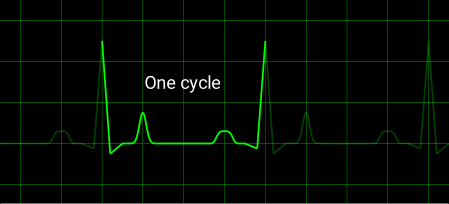
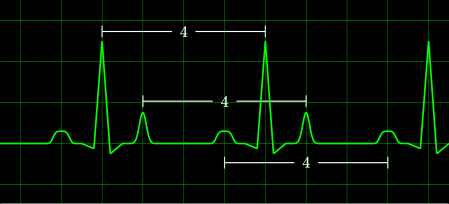
Note that any other portion of the graph could be used as well. This portion was chosen because the peaks fall on vertical gridlines and their heights stand out from the rest of the graph. Now that one cycle has been identified, the horizontal length of the cycle can be measured.
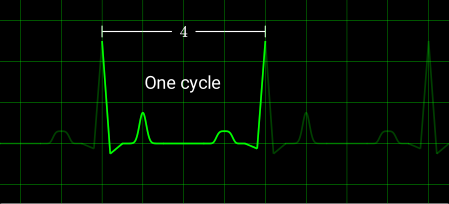
The horizontal length of the cycle is 4 units. This is the period of the function. Note that any other two points on the graph that are 4 units apart have the same y-value.
Pop Quiz
Share
Report error
Finding the Period of Periodic Functions
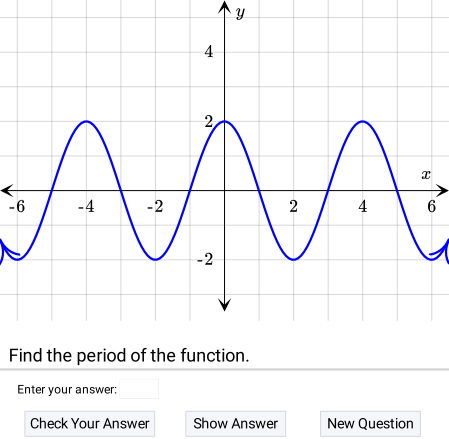
Consider the periodic function in the applet.
Example
Share
Report error
Is this a Periodic Function?
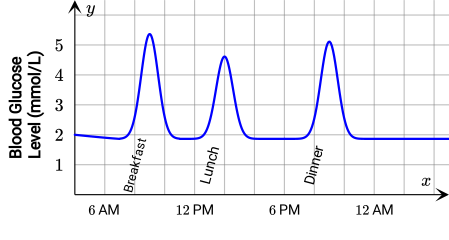
Still waiting for their cousin, Kriz picked up a pamphlet in the hospital waiting room about a diabetes awareness campaign. Kriz was interested in one particular graph in the pamphlet.
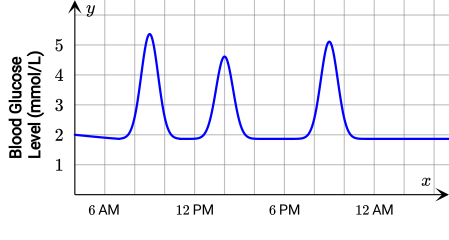
This graph represents the glucose level in blood during one day. Be aware that the graph for another day may be completely different. The pamphlet explains that a person's blood glucose level increases after every meal, and after a while it goes back down. Kriz noticed that each hump of the graph corresponds to a meal.
{"type":"choice","form":{"alts":["Yes","No"],"noSort":false},"formTextBefore":"","formTextAfter":"","answer":1}
Solution
Recall that a periodic function is a function that repeats its outputs at regular intervals, forming a distinct pattern. The humps of the graph appear to be a repeating pattern, so their heights will be inspected.
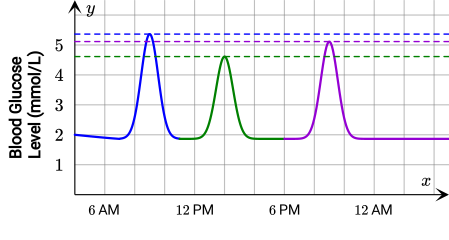
The heights of the humps are not equal, which means that the function does not repeat its outputs. Keep in mind that the graph for a different day may be completely different. Therefore, the given function is not a periodic function. This means that Kriz is not correct.
Discussion
Share
Report error
Midline and Amplitude of a Periodic Function
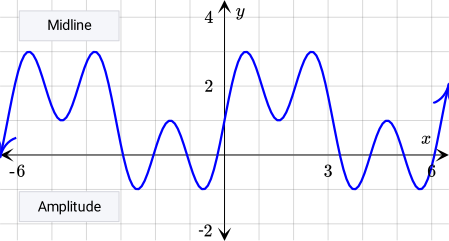
The main characteristic of periodic functions is their repeating behavior. For example, a periodic function alternates between its maximum and minimum values at a regular pace. For this reason, it is important to find the mean between the maximum and minimum values.
Concept
Share
Report error
Midline-Trigonometric Functions
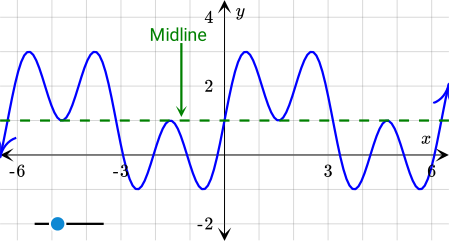
The midline of a periodic function is the horizontal line located in the middle of the minimum and maximum values.
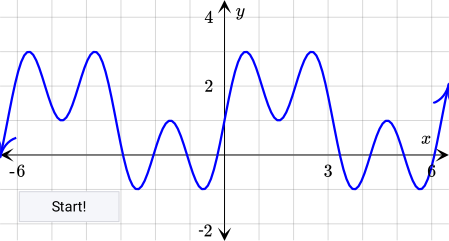 The value of the midline can be found by taking the average of the maximum and the minimum values of the function.
y_(mid) = y_(max) + y_(min)/2
Just like we can find the mean between the maximum and minimum values of a periodic function, we can also find their difference — or half their difference.
Concept
Share
Report error
Amplitude
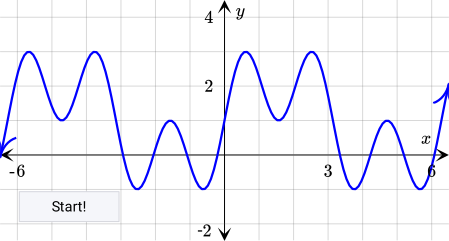
The amplitude is half the difference of the maximum and minimum values of a periodic function.
A = y_(max) - y_(min)/2
Extra
Peak-to-Peak AmplitudeThe peak-to-peak amplitude is defined as the distance between the highest value and the lowest value of a periodic function.
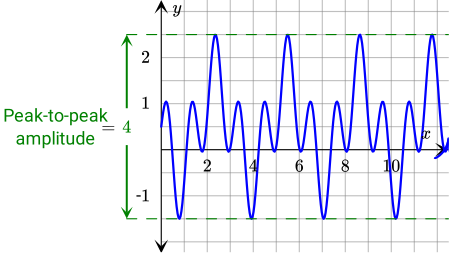
All in all, the amplitude of a periodic function is half the difference between the maximum and minimum values of the function. The midline is the horizontal line that passes right between these maximum and minimum values.
Example
Share
Report error
Inspecting the Rhythms of Breathing
Once Kriz's cousin finished donating blood, Kriz went back with the nurse to thank them for explaining the functionality of the electrocardiogram. The nurse smiled and told Kriz that they still need to wait a little more to see if Kriz's cousin would pass out due to the blood extraction.

The nurse decided to show them another device. This time it is a capnometer, which is a device used to monitor the concentration of carbon dioxide as a person breathes. The capnometer draws a capnogram.
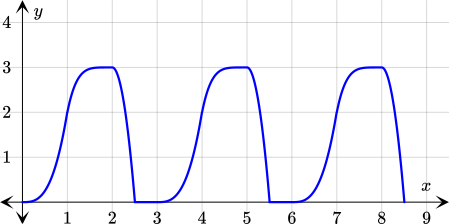
Kriz noticed how periodic functions are present even in breathing! Help Kriz study the properties of the graph shown in the capnogram.
a Find the amplitude of the graph shown in the capnogram.
{"type":"text","form":{"type":"math","options":{"comparison":"1","nofractofloat":false,"keypad":{"simple":true,"useShortLog":false,"variables":[],"constants":[]},"rendered":false},"text":" "},"formTextBefore":null,"formTextAfter":null,"answer":{"text":["1.5"]}}
b Find the midline of the graph shown in the capnogram.
{"type":"text","form":{"type":"math","options":{"comparison":"1","nofractofloat":false,"keypad":{"simple":true,"useShortLog":false,"variables":[],"constants":[]},"rendered":false},"text":" "},"formTextBefore":"y=","formTextAfter":null,"answer":{"text":["1.5"]}}
Hint
a Use the grid to find the maximum and the minimum values of the function's graph. Use these values to calculate the amplitude.
b Use the maximum and minimum values found in Part A to calculate the midline.
Solution
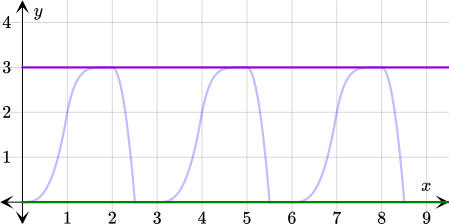
a Begin by recalling the formula for the amplitude of a periodic function.
A=y_(max)-y_(min)/2 Looking at the graph, notice how the y-values all lie between 0 and 3.
b Recall the formula for the midline of a periodic function.
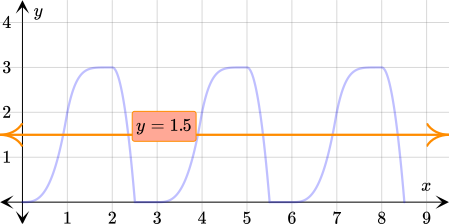
y_(mid)=y_(max)+y_(min)/2
SubstituteII
y_(max)= 3, y_(min)= 0
y_(mid)=3+ 0/2
IdPropAdd
Identity Property of Addition
y_(mid)=3/2
Pop Quiz
Share
Report error
Finding the Amplitude and Midline of Periodic Functions
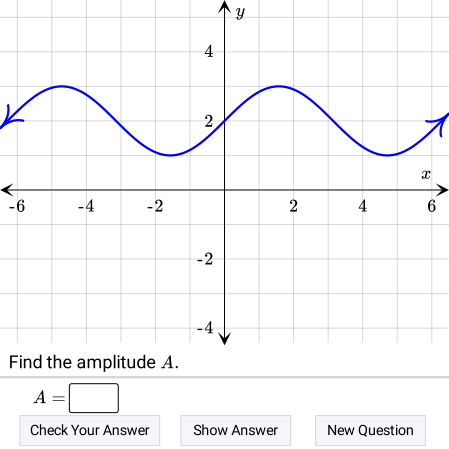
Consider the periodic function in the applet.
Closure
Share
Report error
The Periodicity of Trigonometric Ratios
In this lesson, the concept of a periodic function was introduced. A few real-life applications of this type of function were also presented. The main properties of periodic functions — the period, the amplitude, and the midline — were also discussed. 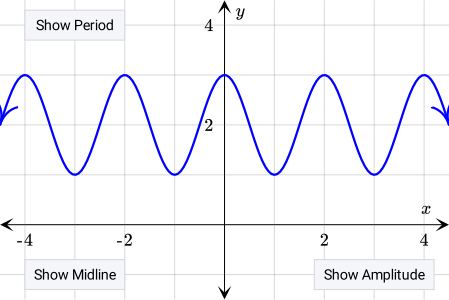 The function shown above is a special periodic function called a trigonometric function. This function takes an angle as an input and relates it to a trigonometric ratio of its corresponding reference angle. More details about this type of function will be covered in later lessons.
An Introduction to Periodic Functions
Exercise 2.1
Kriz looked at the following graph and wrote that the amplitude is 2.
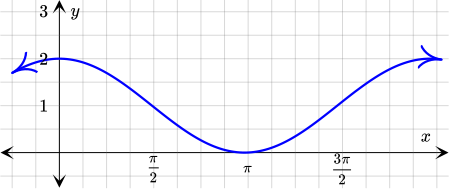
{"type":"text","form":{"type":"math","options":{"comparison":"1","nofractofloat":false,"keypad":{"simple":true,"useShortLog":false,"variables":["x"],"constants":["PI"]},"rendered":false},"text":" "},"formTextBefore":"Amplitude:","formTextAfter":null,"answer":{"text":["1"]}}
security
report
code
security
report
code
We are told that Kriz determined that the amplitude of the given function is 2. We want to find their error. To do so, let's first take a look at the given graph and consider its minimum and maximum values.
Now we will calculate the value of the amplitude. Recall that the amplitude of a periodic function is half the difference between the maximum and minimum values of the function. Amplitude = 1/2(max-min) As we can see from the graph, the maximum value of the function is 2 and the minimum value is 0. Now we will substitute these values into the amplitude formula.
It seems likely that Kriz did not identify the minimum and maximum values of the function correctly, so they determined the amplitude incorrectly. However, the correct value of the amplitude is 1.
security
report
code
Suppose f is a periodic function. The period of f is 5 and f(1)=2.
{"type":"text","form":{"type":"math","options":{"comparison":"1","nofractofloat":false,"keypad":{"simple":true,"useShortLog":false,"variables":["x"],"constants":["PI"]},"rendered":false},"text":" "},"formTextBefore":"f(6)=","formTextAfter":null,"answer":{"text":["2"]}}
{"type":"text","form":{"type":"math","options":{"comparison":"1","nofractofloat":false,"keypad":{"simple":true,"useShortLog":false,"variables":["x"],"constants":["PI"]},"rendered":false},"text":" "},"formTextBefore":"f(11)=","formTextAfter":null,"answer":{"text":["2"]}}
security
report
code
security
report
code
We know that f is a periodic function with a period of 5. This means that its y-values repeat over intervals of 5 units in x-values. f(n)=f(n+ 5), fornandn+ 5 in the domain off Since we are given that f(1)=2, we can find f(6), which is f(1+5).
Because the period of the function is 5, we know that f(6) is equal to f(6+ 5), which is the same as f(11). In Part A we found that f(6)=2. Therefore, by the Transitive Property of Equality, f(11) is also 2. f(6)=f(11) f(6)=2 ⇒ f(11)=2
security
report
code
A wave has a maximum of 6. If the equation of its midline is y=1, what is the minimum?
{"type":"text","form":{"type":"math","options":{"comparison":"1","nofractofloat":false,"keypad":{"simple":true,"useShortLog":false,"variables":["x"],"constants":["PI"]},"rendered":false},"text":" "},"formTextBefore":"Minimum:","formTextAfter":null,"answer":{"text":["-4"]}}
security
report
code
security
report
code
We are told that a wave has a maximum at y = 6 and that the equation of its midline is y= 1. Recall that the midline is an exact midway between the maximum and minimum values. Therefore, the distance between the maximum and the midline is the same as the distance between the midline and the minimum value of the function.
Since the distance between the maximum and the midline is 5, we can draw our minimum line 5 units below the midline, which corresponds to - 4. 1- x= 5 ⇔ x= - 4 The wave has a minimum of - 4.
security
report
code
An Introduction to Periodic Functions
Recommended exercises
To get personalized recommended exercises, please login first.
Loading content
≤
>
■2
■▢
e▢
7
8
9
×
÷■1
=
=
√▢
▢√
∫▢▢
4
5
6
+
−
≤
<
log
ln
log▢
1
2
3
()
∣
sin
cos
tan
0
.
π
x
y
Loading content