Table of contents
Sign In
An error ocurred, try again later!
Chapter 3
1.
Add and Subtract Fractions
This lesson delves into the intricacies of adding and subtracting fractions, focusing on both like and unlike fractions. It starts with real-world scenarios, such as Dylan eating a fraction of a berry pie, to make the concepts relatable. The lesson explains that fractions with the same denominator are called 'like fractions,' while those with different denominators are termed 'unlike fractions.' It then guides you through the process of converting unlike fractions into like fractions so that they can be added or subtracted easily. The lesson also touches on the importance of finding the least common denominator (LCD) when dealing with unlike fractions. It provides step-by-step methods for performing these operations, even when mixed numbers are involved. The aim is to make you comfortable with fraction operations through practical examples and straightforward explanations.
Show less Show more expand_more Lesson Settings & Tools
| | 10 Theory slides |
| | 9 Exercises - Grade E - A |
| | Each lesson is meant to take 1-2 classroom sessions |
Add and Subtract Fractions
Slide of 10
Fractions with the same or different denominators will be named in this lesson. Additionally, procedures for adding and subtracting fractions will be explored.
Catch-Up and Review
Here are a few recommended readings before getting started with this lesson.
Challenge
What Fraction of the Cake Did Dylan Eat?
Dylan is ecstatic to celebrate his birthday party. His mom baked a vanilla-strawberry cake for the party. Dylan cannot control himself and eats one-tenth of the cake before the party even starts. He also eats two-fifteenths of the cake during the party.

a What fraction of the cake did he eat?
{"type":"text","form":{"type":"math","options":{"comparison":"1","nofractofloat":false,"keypad":{"simple":true,"useShortLog":false,"variables":["x"],"constants":["PI"]},"rendered":false},"text":"<span class=\"katex\"><span class=\"katex-html\" aria-hidden=\"true\"><\/span><\/span>"},"formTextBefore":null,"formTextAfter":null,"answer":{"text":["\\dfrac{7}{30}"]}}
b What fraction of the cake is left for others to eat?
{"type":"text","form":{"type":"math","options":{"comparison":"1","nofractofloat":false,"keypad":{"simple":true,"useShortLog":false,"variables":["x"],"constants":["PI"]},"rendered":false},"text":"<span class=\"katex\"><span class=\"katex-html\" aria-hidden=\"true\"><\/span><\/span>"},"formTextBefore":null,"formTextAfter":null,"answer":{"text":["\\dfrac{23}{30}"]}}
Discussion
Like and Unlike Fractions
Fractions can be classified based on whether they have the same denominator or not.
Like Fractions
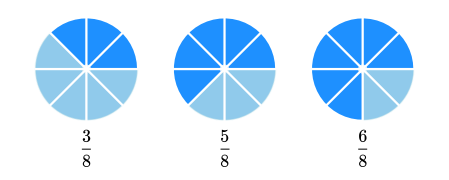
Two or more fractions that have the same denominator are called like fractions. For example, 83, 85, and 86 are all like fractions whose denominators are 8.
Integers such as 6, 11, and 43 are like fractions because they are considered to have a denominator of 1. Their fraction forms are 16, 111, and 143, respectively.
Unlike Fractions
Fractions with different denominators are called unlike fractions. For example, 82, 32, and 53 are unlike fractions. The denominators of these fractions are 8, 3, and 5, which are different from each other.

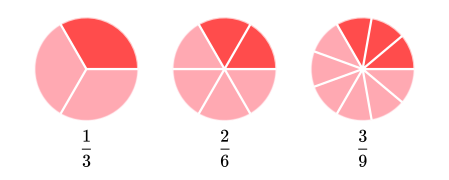
Fractions like 31, 62, and 93 are also unlike fractions, even though they all are equivalent to 31. This is because their denominators are different.
Pop Quiz
Identifying Like and Unlike Fractions
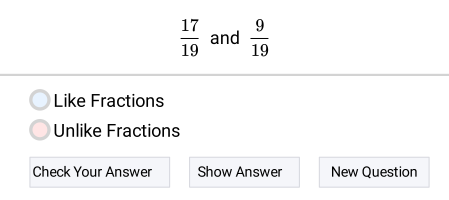
Determine whether the given fractions are like fractions or unlike fractions.
Discussion
Adding and Subtracting Fractions
The first step in adding and subtracting fractions is to check if they share the same denominator. Here, the methods of performing these operations on fractions and how to convert unlike fractions to like fractions will be discussed with examples.
Adding and Subtracting Like Fractions
The numerators of like fractions are added or subtracted when finding the sum or difference of the like fractions, respectively. The denominator remains the same in these situations.
ca+cb=ca+bca−cb=ca−b
Adding and Subtracting Unlike Fractions
Unlike fractions must first be converted to like fractions when the operation deals with the sum or difference. One way to convert them is to multiply the numerator and denominator of each fraction by the denominator of the other. Then, the given operation can be performed.
ca+db=cdad+bcca−db=cdad−bc
154−127
The result can be found in four steps.
1
Find the Least Common Denominator
expand_more The least common denominator is the least common multiple of the numbers in the denominators.
The least common denominator is the product of the highest power of each prime factor.
154−127
The numbers need to be expressed as a product of their prime factors to find their LCM. | Denominator | Prime Factorization |
|---|---|
| 15 | 3⋅5 |
| 12 | 22⋅3 |
LCD:22⋅3⋅5=60
2
Rewrite Each Fraction Using the LCD
expand_more The LCD was found to be 60. Now the fractions will be multiplied by the appropriate factors to make the denominators equal to 60. The first fraction must be multiplied by 4 and the second fraction by 5 to get the LCD.
154−127
ExpandFrac
ba=b⋅4a⋅4
15⋅44⋅4−127
Multiply
Multiply
6016−127
ExpandFrac
ba=b⋅5a⋅5
6016−12⋅57⋅5
Multiply
Multiply
6016−6035
3
Subtract the Numerators
expand_more 4
Simplify if Possible
expand_more Check if the resulting fraction can be simplified or not. It cannot be simplified since the numerator and denominator do not have any common factors.
60-19
Example
How Much Pie Is Left?
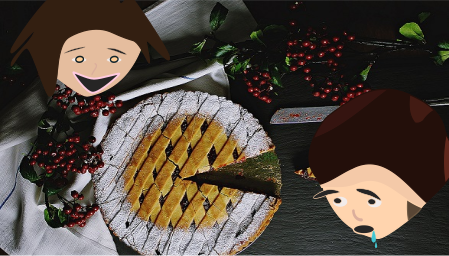
Dylan's mother serves a berry pie, a peanut butter pie, and cake at the birthday party. She cuts the berry pie into 10 equal pieces. Dylan takes three berry pie pieces. Dylan's sister smells the sweet aroma of the berry pie and takes two pieces for herself.
External credits: Toa Heftiba
a What fraction of the berry pie did Dylan and his sister eat all together?
{"type":"text","form":{"type":"math","options":{"comparison":"1","nofractofloat":false,"keypad":{"simple":true,"useShortLog":false,"variables":["x"],"constants":["PI"]},"rendered":false},"text":"<span class=\"katex\"><span class=\"katex-html\" aria-hidden=\"true\"><\/span><\/span>"},"formTextBefore":null,"formTextAfter":null,"answer":{"text":["\\dfrac{1}{2}"]}}
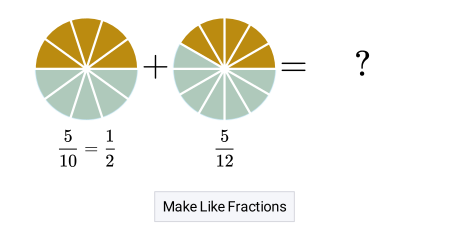
b Dylan's mother cut the peanut butter pie into 12 equal pieces. Party guests only ate five of the peanut butter pie pieces. Dylan and his sister did not eat any of the peanut butter pie. What fraction of the total amount of pie, both berry and peanut butter, was eaten at the party?
{"type":"text","form":{"type":"math","options":{"comparison":"1","nofractofloat":false,"keypad":{"simple":true,"useShortLog":false,"variables":["x"],"constants":["PI"]},"rendered":false},"text":"<span class=\"katex\"><span class=\"katex-html\" aria-hidden=\"true\"><\/span><\/span>"},"formTextBefore":null,"formTextAfter":null,"answer":{"text":["\\dfrac{11}{12}"]}}
Hint
a What fraction of the berry pie did Dylan eat? What fraction of the pie did his sister eat?
b Use the answer found in Part A to find the total amount of pie eaten.
Solution
a Dylan eats 3 pieces of the berry pie that was cut into 10 pieces. In other words, 103 of the pie is gone. Then, his sister eats another 2 pieces, or 102, of the same pie. The sum of these fractions gives the amount of pie eaten.
Amount of Pie Eaten103 + 102
Notice that both of these fractions have a denominator of 10. This denominator represents the whole pie's number of slices. These fractions are like fractions. Therefore, the sum of these fractions will be the sum of the numerators divided by 10.
The denominator is a multiple of the numerator. That is, 10 is a multiple of 5. This means the numerator and denominator have a common factor. Now, simplify the fraction. Start by rewriting 10 as a product of its factors. Then, cancel out the common factors.
105
SplitIntoFactors
Split into factors
2⋅55
CancelCommonFac
Cancel out common factors
2⋅55
SimpQuot
Simplify quotient
21
b The party guests ate 5 pieces of the 12-piece peanut butter pie. In other words, five-twelfths of this pie was eaten. In Part A, it was found that half of the berry pie was also eaten. The sum of these two amounts is the total amount of pie that was eaten at the party.
Total Amount of Pie Eaten21 + 125
Recall what to do when adding fractions with different denominators. The fractions must be expressed as equivalent fractions with the least common denominator. The prime factors of these numbers must be found first. | Denominators | Prime Factorization |
|---|---|
| 2 | 2 |
| 12 | 22⋅3 |
21+125
ExpandFrac
ba=b⋅6a⋅6
2⋅61⋅6+125
Multiply
Multiply
126+125
AddFrac
Add fractions
126+5
AddTerms
Add terms
1211
Pop Quiz
Finding the Sum and Difference of Fractions
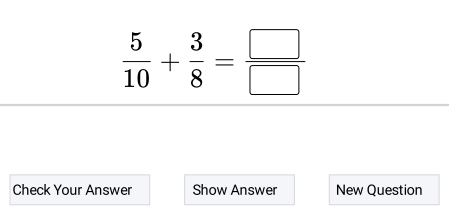
Perform the indicated operation. Simplify the result if it is possible.
Extra
Need an Extra Hand?Fractions must have the same denominators when adding and subtracting two or more fractions. What if two fractions with equal denominators are given? In that case, the denominator is kept the same and the sum or difference of the numerators is written into the numerator.
Example
Finding the Fraction of Guests Playing Games
The birthday party is going great. Right now 283 of the guests are dancing, while 71 of the guests are just listening to the music, and the others are playing games.

External credits: gpointstudio
{"type":"text","form":{"type":"math","options":{"comparison":"1","nofractofloat":false,"keypad":{"simple":true,"useShortLog":false,"variables":["x"],"constants":["PI"]},"rendered":false},"text":"<span class=\"katex\"><span class=\"katex-html\" aria-hidden=\"true\"><\/span><\/span>"},"formTextBefore":null,"formTextAfter":null,"answer":{"text":["\\dfrac{21}{28}","\\dfrac{3}{4}"]}}
Hint
Subtract the total fraction of the guests who are listening to music and dancing from the whole, or 1.
Solution
The given fractions 283 and 71 represent the fraction of the guests who are dancing and listening to music, respectively. The whole or 1 represents all guests at the party.
| All Guests | Fraction of the Guests Who Are Dancing | Fraction of the Guests Who Are Listening to Music |
|---|---|---|
| 1 | 283 | 71 |
1−(283+71)
Recall that every integer has 1 as its denominator. 11−(71+283)
The fractions are unlike fractions because they have different denominators. The fractions must have a common denominator to perform the operations. The prime factors of the denominators must be found first for this purpose. The least common denominator can then be determined. | Denominator | Prime Factorization | LCD |
|---|---|---|
| 1 | 1 | 22⋅7=28 |
| 7 | 7 | |
| 28 | 22⋅7 |
11−(71+283)
▼
Rewrite
ExpandFrac
ba=b⋅28a⋅28
1⋅281⋅28−(71+283)
MultByOne
a⋅1=a
2828−(71+283)
ExpandFrac
ba=b⋅4a⋅4
2828−(7⋅41⋅4+283)
Multiply
Multiply
2828−(284+283)
2828−(284+283)
AddFrac
Add fractions
2828−(284+3)
AddTerms
Add terms
2828−287
SubFrac
Subtract fractions
2828−7
SubTerm
Subtract term
2821
2821
SplitIntoFactors
Split into factors
4⋅73⋅7
CancelCommonFac
Cancel out common factors
4⋅73⋅7
SimpQuot
Simplify quotient
43
Example
Finding the Cups of Ingredients
A guest at the party asks Dylan's mother for the basic recipe of the cake. The recipe she is using calls for 241 cups of flour, 132 cups of sugar, and 21 cup of oil.

a What is the total amount of the listed ingredients needed to bake the cake? Write the answer as a mixed number.
{"type":"text","form":{"type":"math","options":{"comparison":"1","nofractofloat":false,"keypad":{"simple":true,"useShortLog":false,"variables":["x"],"constants":["PI"]},"rendered":false},"text":"<span class=\"katex\"><span class=\"katex-html\" aria-hidden=\"true\"><\/span><\/span>"},"formTextBefore":null,"formTextAfter":"cups","answer":{"text":["4\\dfrac{5}{12}"]}}
b The guest wants to make the cake a few days later. However, she forgot how many cups of sugar to use. She decides to use 231 cups of sugar. How much extra sugar did she use compared to the original recipe? Simplify the answer if possible.
{"type":"text","form":{"type":"math","options":{"comparison":"1","nofractofloat":false,"keypad":{"simple":true,"useShortLog":false,"variables":["x"],"constants":["PI"]},"rendered":false},"text":"<span class=\"katex\"><span class=\"katex-html\" aria-hidden=\"true\"><\/span><\/span>"},"formTextBefore":null,"formTextAfter":"cups","answer":{"text":["\\dfrac{2}{3}"]}}
Hint
a Start by converting the given mixed numbers into improper fractions.
b Subtract 132 from 231.
Solution
a The sum of the given mixed numbers and the fraction must be found to find the total number of cups of ingredients required for the cake.
241+132+21
Start by converting the mixed numbers into improper fractions. | acb | ca⋅c+b | Simplify |
|---|---|---|
| 241 | 42⋅4+1 | 49 |
| 132 | 31⋅3+2 | 35 |
49+35+21
Fractions should have the same denominator when adding or subtracting them. The fractions have different denominators in this expression. That means they should be made into like fractions before performing the operation. Find the least common denominator to do that. | Denominator | Prime Factorization | LCD |
|---|---|---|
| 4 | 22 | 22⋅3=12 |
| 3 | 3 | |
| 2 | 2 |
49+35+21
▼
Rewrite
ExpandFrac
ba=b⋅3a⋅3
4⋅39⋅3+35+21
ExpandFrac
ba=b⋅4a⋅4
4⋅39⋅3+3⋅45⋅4+21
ExpandFrac
ba=b⋅6a⋅6
4⋅39⋅3+3⋅45⋅4+2⋅61⋅6
Multiply
Multiply
1227+1220+126
AddFrac
Add fractions
1227+20+6
AddTerms
Add terms
1253
1253
▼
Write fraction as a mixed number
WriteSum
Write as a sum
1248+5
WriteSumFrac
Write as a sum of fractions
1248+125
CalcQuot
Calculate quotient
4+125
AddTerms
Add terms
4125
b The guest used 231 cups of sugar. That amount is greater than the amount Dylan's mom used. Rewrite 231 as an improper fraction so that it can be compared with 132, or equivalently 35.
231
▼
Write mixed number as a fraction
37
37>35
These fractions can now be used to find how much extra sugar Paulina's mother used. Subtract 35 from 37.
The guest used 32 cups more sugar. Closure
Finding the Amount of Cake in Fractions
Their is a key point in adding and subtracting fractions. Make sure that the denominators of the fractions are the same. Additionally, the following three steps are applied to perform arithmetic operations on mixed numbers. Remember, such operations include addition and subtraction.
- Convert mixed numbers into improper fractions.
- Check if they are unlike fractions. Write them as equivalent fractions with the common denominator if they are.
- Perform the operation.
Dylan eats one-tenth of his birthday cakebefore the party starts. He alsoeats two-fifteenths of the cake during the party.

a What fraction of the cake did he eat?
{"type":"text","form":{"type":"math","options":{"comparison":"1","nofractofloat":false,"keypad":{"simple":true,"useShortLog":false,"variables":["x"],"constants":["PI"]},"rendered":false},"text":"<span class=\"katex\"><span class=\"katex-html\" aria-hidden=\"true\"><\/span><\/span>"},"formTextBefore":null,"formTextAfter":null,"answer":{"text":["\\dfrac{7}{30}"]}}
b What fraction of the cake is left for others to eat?
{"type":"text","form":{"type":"math","options":{"comparison":"1","nofractofloat":false,"keypad":{"simple":true,"useShortLog":false,"variables":["x"],"constants":["PI"]},"rendered":false},"text":"<span class=\"katex\"><span class=\"katex-html\" aria-hidden=\"true\"><\/span><\/span>"},"formTextBefore":null,"formTextAfter":null,"answer":{"text":["\\dfrac{23}{30}"]}}
Hint
a Add the given fractions.
b Subtract the Part A's answer from 1.
Solution
a The given fractions must be added to find the fraction of the cake that Dylan ate. Write the verbally expressed fractions in mathematical terms to get started.
One-tenthTwo-fifteenths→101→152
The fractions do not have a common denominator. The fractions should have the same denominator to add them. Finding the least common denominator of the fractions will be helpful at this point. The denominators can then be written as products of their prime factors. | Denominator | Prime Factorization | LCD |
|---|---|---|
| 10 | 2⋅5 | 2⋅3⋅5=30 |
| 15 | 3⋅5 |
b Now, it is time to find the fraction of the cake that is remaining. Begin by subtracting 307 from 1. The value of 1 represents the whole cake.
1−307
Start by rewriting the number 1 as 3030 to perform the subtraction. The difference can be found after that. 1−307
Rewrite
Rewrite 1 as 3030
3030−307
SubFrac
Subtract fractions
3030−7
SubTerm
Subtract term
3023
Add and Subtract Fractions
Recommended exercises
To get personalized recommended exercises, please login first.
Loading content
Loading content