5. Writing and Graphing Equations in Point-Slope Form
Sign In
An error ocurred, try again later!
Chapter 2
5.
Writing and Graphing Equations in Point-Slope Form
This lesson focuses on two main mathematical concepts: graphing equations using point-slope form and writing equations in this form. It offers a step-by-step guide, complete with real-world examples, to help you understand these topics. Whether you're a student looking to improve your algebra skills or a teacher seeking a lesson for your class, this material serves as a valuable educational tool. It breaks down complex ideas into manageable pieces, making it easier for you to grasp the subject matter. The use cases include academic settings, test preparation, and even real-world applications like engineering or economics where understanding linear relationships is crucial.
Show less Show more expand_more 


Lesson Settings & Tools
| | 13 Theory slides |
| | 11 Exercises - Grade E - A |
| | Each lesson is meant to take 1-2 classroom sessions |
Writing and Graphing Equations in Point-Slope Form
Slide of 13
Among the ways of writing the equation of a line, point-slope form highlights the slope and a point on the line that is not the y-intercept. This lesson will explore how to write the point-slope form of a line and some of its applications. It will also show how to transform an equation in point-slope form to an equation in slope-intercept form and vice versa.
Catch-Up and Review
Here are a few recommended readings before getting started with this lesson.
Explore
Share
Report error
Exploring the Information Given by the Slope and a Point on the Line
The following applet shows the graph of a line and its slope. By clicking on the line, a point can be seen jointly with its coordinates.
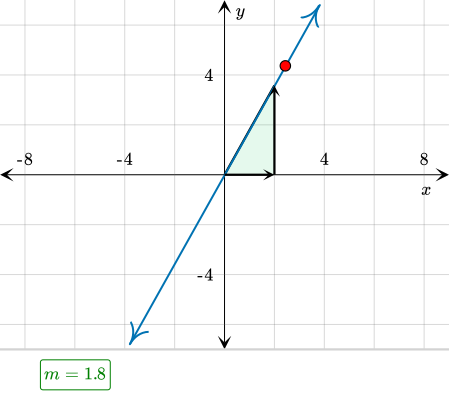 Think about the following questions.
- Is it possible to write an equation for the line using the slope and a point on the line?
- What happens if this information is substituted into the Slope Formula?
Discussion
Share
Report error
Finding the Equation of a Line in Point-Slope Form
A linear equation can be written in many ways. Depending on the information at hand, one can be more suitable than others. One case is when the slope and a point on the line are known. In this situation, the point-slope form may be the best option.
Concept
Share
Report error
Point-Slope Form
A linear equation with slope m through the point (x_1,y_1) is written in the point-slope form if it has the following form.
y-y_1 = m(x-x_1)
In this point-slope equation, (x_1,y_1) represents a specific point on the line, and (x,y) represents any point also on the line. Graphically, this means that the line passes through the point (x_1,y_1).
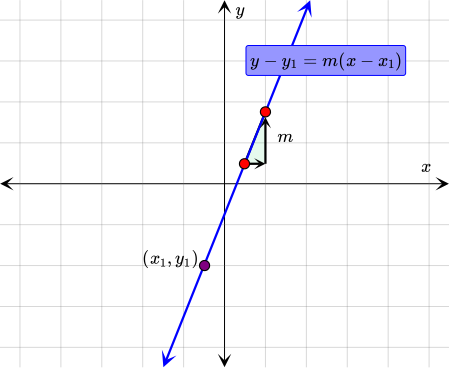
It is worth mentioning that the point-slope form can only be written for non-vertical lines.
Why
Derivation of the FormulaThe point-slope form can be derived by using the Slope Formula. To do so, (x,y) — which represents any point on the line — is substituted for (x_2,y_2) into the formula.
m = y_2-y_1/x_2-x_1
SubstituteII
x_2= x, y_2= y
m=y-y_1/x-x_1
MultEqn
LHS * (x-x_1)=RHS* (x-x_1)
m(x-x_1)=y-y_1
RearrangeEqn
Rearrange equation
y-y_1=m(x-x_1)
Pop Quiz
Share
Report error
Identifying the Point-Slope Form of a Linear Equation
The following applet shows linear equations representing the relationship between the variables x and y. Determine whether the given equation is written in point-slope form.

Pop Quiz
Share
Report error
Identifying the Essential Parts of Equations in Point-Slope Form
To get familiar with the point-slope form, it is essential to identify the parts of its composition. In the following applet, identify the slope or point used to create the given equation in point-slope form, depending on what is asked.
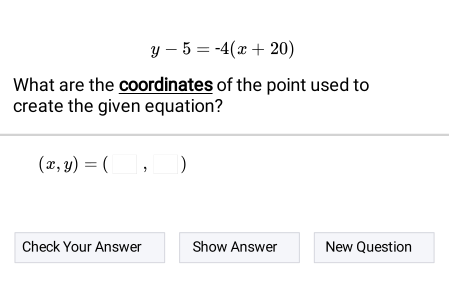
Discussion
Share
Report error
Visualizing the Graph of a Linear Equation in Point-Slope Form
Sometimes knowing the behavior of a linear equation by just looking at the equation can be complicated. In these cases, the graph can be helpful. Therefore, it is essential to have a straightforward way to graph equations in point-slope form.
Method
Share
Report error
Graphing a Linear Equation in Point-Slope Form
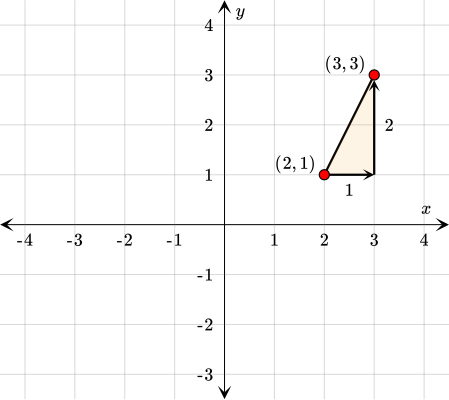
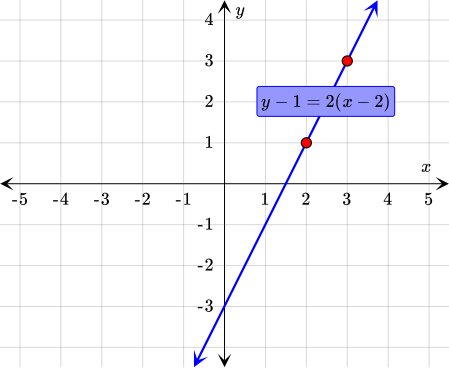
When working with a linear equation in point-slope form, the graph’s line is described by the equation. The known point and slope of the line to is used to find another point. A line is then drawn through the points to create its graph. Consider the following equation. y-1=2(x-2)
There are three steps to graph an equation written in point-slope form. 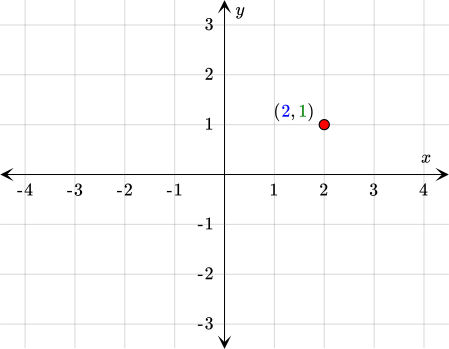
1
Plot the Point Given by the Equation
expand_more The point-slope form gives a point through which the line passes. This point needs to be identified first in order to graph it on the coordinate plane. Consider the given equation and compare it with the general equation in point-slope form. y- y_1&=m(x- x_1) y- 1&=2(x- 2) The point used to write the given equation is ( 2, 1). This point will be drawn on the coordinate plane.
2
Use the Slope to Find a Second Point
expand_more Next, a second point on the line can be found by using the slope. y-y_1&= m(x-x_1) y-1&= 2(x-2) In this case, the given equation has a slope of 2, which can be written as 21. Therefore, a second point can be plotted by going 1 unit to the right and 2 units up.
3
Draw a Line Through the Two Points
expand_more Finally, the line described by the equation in the point-slope form will be found by drawing a line through the two plotted points.
Example
Share
Report error
Graphing Equations in Point-Slope Form to Visualize Relationships Between Variables
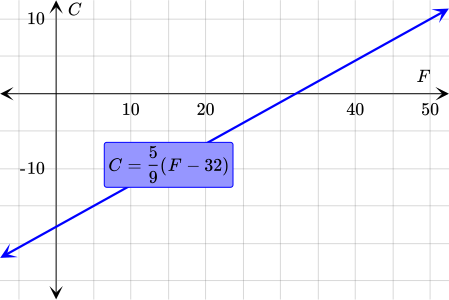
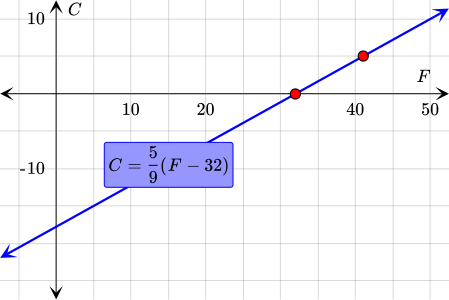
Izabella learned that the following equation gives the relationship between degrees Fahrenheit and degrees Celsius. Fahrenheit to Celsius C=5/9(F-32) Izabella knows that the equation is in point-slope form. However, she wonders if it is possible to have a graphical representation of this equation.
Answer
Graph:
Hint
Begin by identifying the point used to write the equation. Then, use the method for graphing a linear equation in point-slope form.
Solution
To make the graph, the point used to write the equation needs to be identified first. Then, the method for graphing an equation in point-slope form can be applied. A linear equation in point-slope form has the following form. y-y_1=m(x-x_1) In this equation, (x_1,y_1) is a specific point on the line, (x,y) represents any point on the line, and m is the slope of the line. Using this information, the specific point and the slope of the given equation can be found. C=&5/9(F-32) & ⇕ C- 0=& 5/9(F- 32) As can be seen, the slope is m= 59 and the given point is ( 32, 0). All the information needed for applying the method for graphing an equation in point-slope form has been found. The x-axis will represent the Fahrenheit degrees and the y-axis the Celsius degrees. Then, the point ( 32, 0) will be plotted on the coordinate plane.
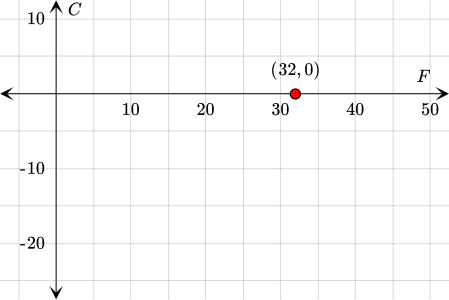
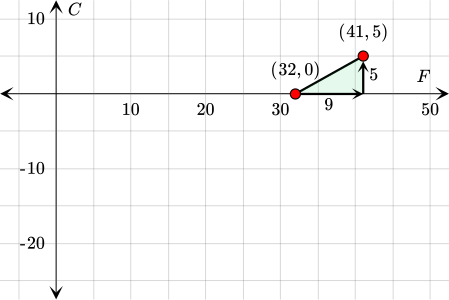
Next, a second point on the line can be found by using the slope. Because the given equation has a slope of 59, a second point can be plotted by going 9 units to the right and 5 units up.
Finally, the line described by the given equation will be found by drawing a line through the points.
Example
Share
Report error
Modeling Daily Situations Into Equations in Point-Slope Form
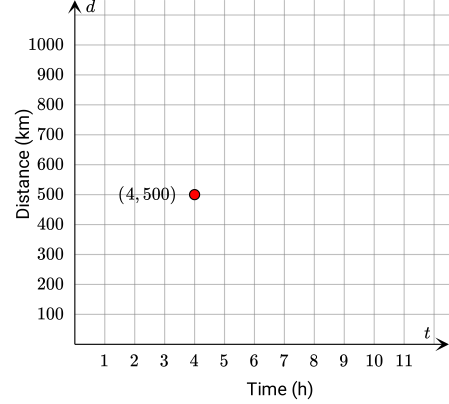
LaShay is traveling by bus to her hometown. After a certain distance, she feels bored and wants to have some fun analyzing the bus's movement. The bus driver tells her that the bus moves at a constant rate of 80 kilometers per hour. Four hours after LaShay started her analysis, the driver also tells her that the bus had traveled 500 kilometers.  Answer the following questions to help LaShay finish her analysis.
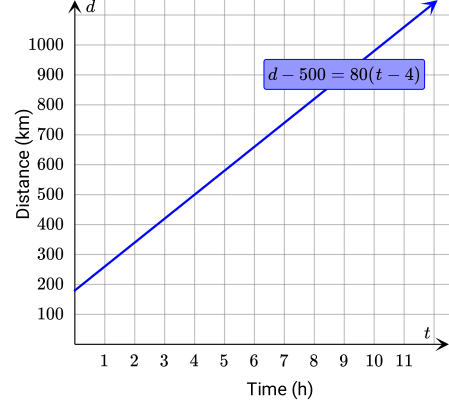
 After 10 hours, the bus has traveled 980 kilometers. Another way of finding the distance traveled is by looking at the graph of the equation.
 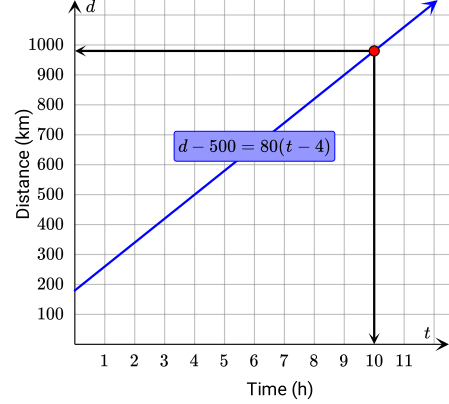 This means that LaShay started her analysis after the bus traveled 180 kilometers.
a Find an equation in point-slope form that models the distance d traveled by the bus after t hours.
b Graph the equation that describes the movement of the bus.
c How far has the bus driven 10 hours after LaShay started her analysis?
d How far had the bus driven before LaShay started analyzing its movement?
Answer
a d-500=80(t-4)
b Graph:
c 980 Kilometers
d 180 Kilometers
Hint
a The rate of change represents the line's slope, and the ordered pair given by the time and distance traveled is a point on the line.
b Begin by plotting the point given by the equation. Then, using the slope, find a second point.
c Evaluate the equation found in Part A when t=10.
d To find the distance where LaShay started her analysis, evaluate the equation found in Part A when t=0.
Solution
a Because the bus moves at a constant rate, its movement can be described with a linear equation in point-slope form. An equation in point-slope form through the point (x_1,y_1) and slope m has the following form.
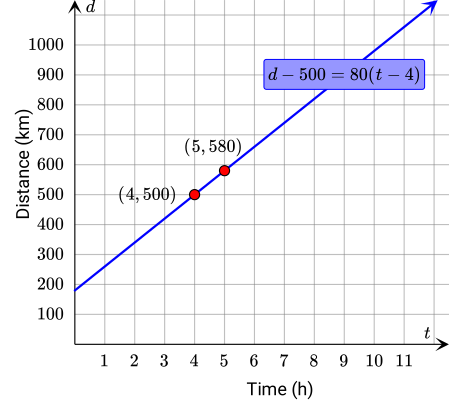
y-y_1=m(x-x_1) Since the distance d traveled depends on the time t, d is the dependent variable and t the independent variable. Therefore, the above equation can be rewritten in terms of d and t. d- d_1= m(t- t_1) Here, ( t_1, d_1) represents the distance traveled at a specific time. In this situation, it is given that after 4 hours that LaShay started her analysis, the bus has traveled 500 kilometers. Writing this information as an ordered pair will give the specific point needed to write the equation in point-slope form. (t_1,d_1)=( 4, 500) Moreover, the rate of change represents the slope of the line. Therefore, since the rate of change is given as a constant 80 kilometers per hour, the equation will have a slope of 80. Substituting these values into the equation will give the equation of the movement of the bus. d- d_1&= m(t- t_1) &⇓ d- 500&= 80(t- 4)
b To graph the equation that models the movement of the bus, the specific point given by the equation needs to be plotted first. This point is (4,500). Moreover, the graph will be only on the first quadrant since distance and time are non-negative quantities.
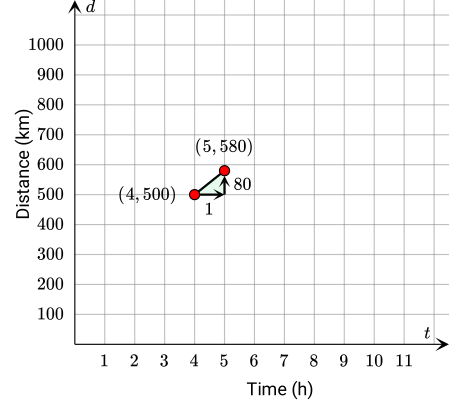
Next, using the slope, a second point on the line can be found. The equation has a slope of 80, which can be written as 801. This means that a second point can be found by going 1 unit to the right and 80 units up.
Finally, connecting the points with a line will give the graph of the equation.
Note that in this situation, it makes sense that the distance traveled at t=0 is greater than 0 because LaShay started counting after the bus had traveled a certain distance.
c To find the distance traveled after 10 hours, the equation from Part A can be evaluated when t= 10 and solved for d.
However, this approach will not guarantee an exact solution. From the graph, it can be said that the distance traveled is nearly 1000 kilometers, while it was found to be 980 kilometers by using the equation. The graph gives an approximate answer, but the equation gives a precise answer.
d The distance at which LaShay started her analysis can be calculated by evaluating the previous equation when t=0.
d-500=80(t-4)
Substitute
t= 0
d-500=80( 0-4)
▼
Solve for d
SubTerm
Subtract term
d-500=90(-4)
MultPosNeg
a(- b)=- a * b
d-500=-360
AddEqn
LHS+500=RHS+500
d=-360+500
AddTerms
Add terms
d=180
Discussion
Share
Report error
How Much Information Is Needed to Write an Equation in Point-Slope Form?
The point-slope form is a helpful tool because the information needed to write it is minimal. Once the equation is found, how it behaves at any point can be obtained. The following method describes how to find the point-slope form of a linear equation.
Method
Share
Report error
Writing a Linear Equation in Point-Slope Form
The slope and a point on a certain line are needed to write an equation in point-slope form. The slope can be found using two points on the line. That means this process begins by assuming that two points are given. After the slope is calculated, either point can be used to determine the equation. This method is illustrated using the following points that lie on a line. (-1,5) and (1,1)
Three steps are needed to find the equation in point-slope form.
Note that, unlike the slope-intercept form, an infinite number of equations written in point-slope form can represent the same line. In other words, when written in point-slope form, any line does not have only one unique equation.
1
Calculate the Slope
expand_more First, the slope of the line can be calculated by substituting the given points into the Slope Formula. Note that if the slope is given, this step is not needed. If only the line is provided, select two points on the line whose coordinates are easy to identify.
In this case, the slope of the line that passes through the given points is - 2.
m = y_2-y_1/x_2-x_1
SubstitutePoints
Substitute ( -1,5) & ( 1,1)
m=1- 5/1-( -1)
▼
Evaluate right-hand side
m=-2
2
Select One Point on the Line
expand_more Next, one point on the line needs to be selected. Ideally, one of the points used in the previous step is chosen, but it can be any other point on the line whose coordinates are known. Out the given points, (1,1) will be used.
3
Substitute Values
expand_more Finally, once the slope and a point on the line are known, the equation can be written by substituting these values into the general equation in point-slope form. Here, m= -2 and (x_1,y_1)=( 1, 1). y-y_1&=m(x-x_1) &⇓ y- 1&= -2(x- 1)
Example
Share
Report error
Using Point-Slope Form to Find Missing Information
Kevin went parachuting. The following graph describes his descent in terms of the time until he landed.
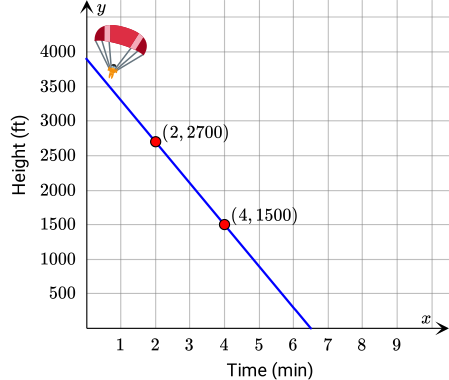
Use the given graph to find the following information.
a Find the equation of the line in point-slope form.
b What is the height at which Kevin starts descending?
c How long does it take Kevin to land?
Answer
a Example Equation: y-1500=-600(x-4)
b 3900 feet
c 6.5 minutes
Solution
a The equation of a line through the point (x_1,y_1) and slope m has the following form.
m = y_2-y_1/x_2-x_1
SubstitutePoints
Substitute ( 2,2700) & ( 4,1500)
m=1500- 2700/4- 2
▼
Evaluate right-hand side
SubTerms
Subtract terms
m=-1200/2
MoveNegNumToFrac
Put minus sign in front of fraction
m=-1200/2
CalcQuot
Calculate quotient
m= -600
b When x= 0, Kevin is at the height where he started descending. It means that the initial height can be found by solving the equation found in Part A for y when x= 0.
y-2700=-600(x-2)
Substitute
x= 0
y-2700=-600( 0-2)
▼
Solve for y
SubTerm
Subtract term
y-2700=-600(-2)
MultNegNegOnePar
- a(- b)=a* b
y-2700=1200
AddEqn
LHS+2700=RHS+2700
y=3900
c When Kevin landed, he was at the height of y= 0. Therefore, to find how long it took Kevin to land, the equation needs to be solved for x when y= 0.
y-2700=-600(x-2)
Substitute
y= 0
0-2700=-600(x-2)
▼
Solve for x
SubTerm
Subtract term
-2700=-600(x-2)
DivEqn
.LHS /(-600).=.RHS /(-600).
-2700/-600=x-2
DivNegNeg
- a/- b=a/b
2700/600=x-2
AddEqn
LHS+4=RHS+4
2700/600+2=x
RearrangeEqn
Rearrange equation
x=2700/600+2
NumberToFrac
a = 600* a/600
x=2700/600+1200/600
AddFrac
Add fractions
x=3900/600
ReduceFrac
a/b=.a /300./.b /300.
x=13/2
WriteDec
Write as a decimal
x=6.5
Example
Share
Report error
Matching Equivalent Equations in Point-Slope Form and Slope-Intercept Form
Kriz is doing their math homework assignment. They are asked to transform each equation on the left to its corresponding equation in point-slope or slope-intercept forms using the provided information. Moreover, for the equations in slope-intercept form, the point that it is provided should be used as a guide to finding its equivalent equation in point-slope form.
| Equation | Equivalent Equation |
|---|---|
| y+2=1/2(x+1) | |
| y=1/5x+1/3, (1,8/15) | |
| y-30=5(x+1) | |
| y=- 2x+3, (1,- 1) |
Answer
| Equation | Equivalent Equation |
|---|---|
| y+2=1/2(x+1) | y=1/2x-3/2 |
| y=1/5x+1/3, (1,8/15) | y-8/15=1/5(x-1) |
| y-30=5(x+1) | y=5x+35 |
| y=- 2x+3, (1,- 1) | y+1=- 2 (x-1) |
Solution
For equations in slope-intercept form, its equivalent equation will be found by isolating the y variable. On the other hand, the given point jointly with the slope will be used to find the equivalent equation of the equations in slope-intercept form.
First Equation
The first equation is in point-slope form. Then, the y variable will be isolated to find its equivalent equation in slope-intercept form.y+2=1/2(x+1)
Distr
Distribute 1/2
y+2=1/2x+1/2*1
MultByOne
a * 1=a
y+2=1/2x+1/2
SubEqn
LHS-2=RHS-2
y=1/2x+1/2-2
NumberToFrac
a = 2* a/2
y=1/2x+1/2-4/2
SubTerm
Subtract term
y=1/2x-3/2
Second Equation
The second equation is in slope-intercept form and has a slope of 15. Therefore, using the point ( 1, 815), an equation in point-slope form can be written. y-y_1&=m(x-x_1) &⇓ y- 8/15&= 1/5(x- 1)
Third Equation
The third equation is written in point-slope form. Again, its equivalent equation in slope-intercept form will be found by solving the equation for y.Fourth Equation
Finally, the fourth equation is in slope-intercept form. Using the slope 2 and the point ( 1, -1), its equivalent equation in point-slope form can be written. y-( -1)&= -2(x- 1) &⇕ y+1&=-2(x-1)
Completing the Table
With the information found, the table can be now completed.
| Equation | Equivalent Equation |
|---|---|
| y+2=1/2(x+1) | y=1/2x-3/2 |
| y=1/5x+1/3, (1,8/15) | y-8/15=1/5(x-1) |
| y-30=5(x+1) | y=5x+35 |
| y=- 2x+3, (1,- 1) | y+1=- 2 (x-1) |
Pop Quiz
Share
Report error
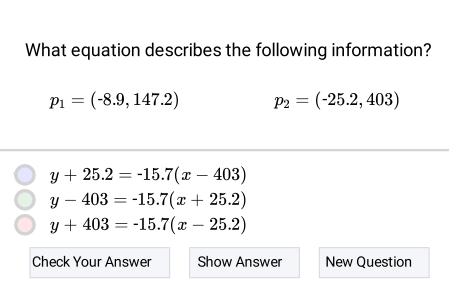
Using Different Information to Find Equations in the Point-Slope Form
The following applet provides some information about a linear equation. Identify the equation in the point-slope form that corresponds to the given information.
Closure
Share
Report error
Infinite Equations in the Point-Slope Form
In this lesson, the point-slope form of linear equations was explored. As its name suggests, this form communicates the slope and a point on the line described by the equation. Point-Slope Form y-y_1=m(x-x_1)
Since a line has infinite points, any of these points can be used to find its equation. Therefore, a line has infinite equivalent equations in point-slope form. This can be visualized in the following applet. Select any point on the line to see how the equation varies depending on the point selected. 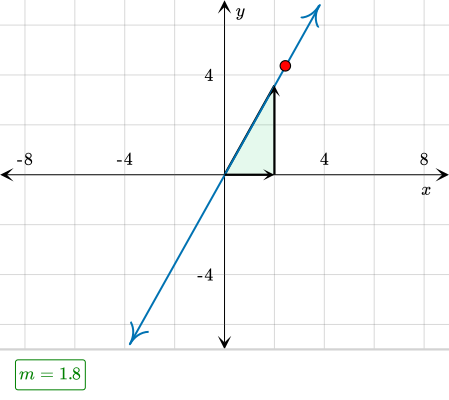 Moreover, transforming between point-slope and slope-intercept forms can be addressed by the following procedure.
- If the equation is in slope-intercept form, evaluate the equation for some x-value to find a point on the line. Then, use this point to find its equivalent equation in point-slope form.
- If the equation is in point-slope form, isolate the y-variable and simplify to find its equivalent equation in slope-intercept form.
Writing and Graphing Equations in Point-Slope Form
Exercise 1.1
{"type":"text","form":{"type":"math","options":{"comparison":"1","nofractofloat":false,"keypad":{"simple":false,"useShortLog":false,"variables":["x","y"],"constants":[]},"rendered":false},"text":" "},"formTextBefore":null,"formTextAfter":null,"answer":{"text":["y-4 = -5(x+3)","y-4 = -5(x-(-3))"]}}
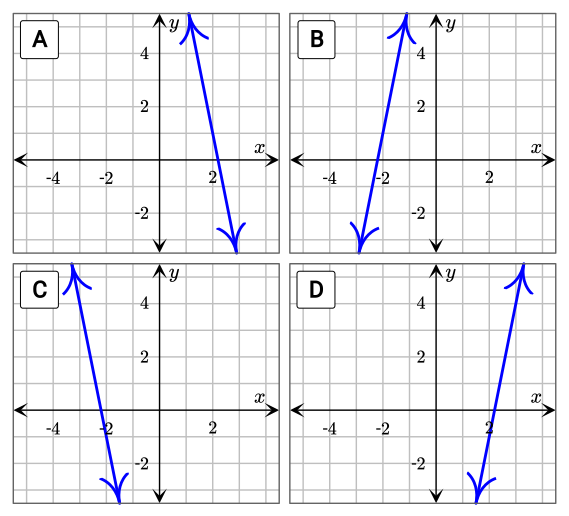
Which graph is the graph of the equation written in Part A?
{"type":"choice","form":{"alts":["A","B","C","D"],"noSort":true},"formTextBefore":"","formTextAfter":"","answer":2}
security
report
code
security
report
code
Consider the general form of an equation in point-slope form. y- y_1= m(x- x_1) In this equation, m is the slope and the point ( x_1, y_1) is a specific point that lies on the graph of the line. We are given the point ( -3, 4) and the slope -5. To determine the equation, we will substitute this information into the general form.
We will graph the equation on a coordinate plane to determine which of the given graphs corresponds to the equation. Let's plot the point (-3,4).
Next, we will use the slope -5 to find a second point on the line. Note that -5 can be written as -51. Recall that slope represents the rise over run of the line. This means that a second point can be found by going 1 unit to the right and 5 units down.
We can now connect the points with a line to get the graph of the equation.
This corresponds to option C.
security
report
code
Write an equation in point-slope form for the given graph by using the given point.
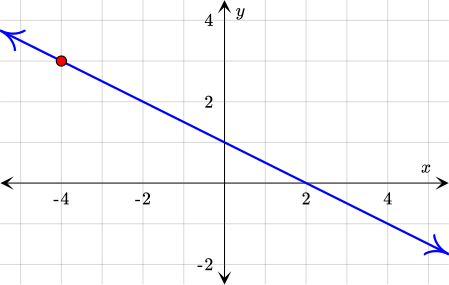
{"type":"text","form":{"type":"math","options":{"comparison":"1","nofractofloat":false,"keypad":{"simple":false,"useShortLog":false,"variables":["x","y"],"constants":["PI"]},"rendered":false},"text":" "},"formTextBefore":null,"formTextAfter":null,"answer":{"text":["y-3=-\\dfrac{1}{2}(x+4)"]}}
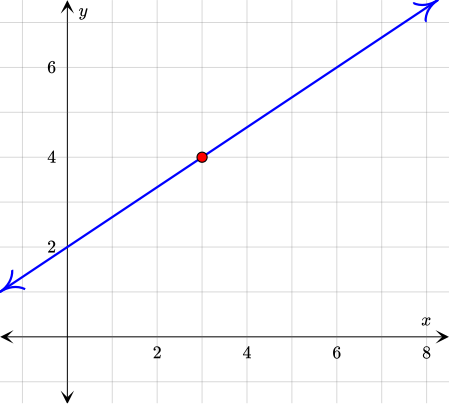
{"type":"text","form":{"type":"math","options":{"comparison":"1","nofractofloat":false,"keypad":{"simple":false,"useShortLog":false,"variables":["x","y"],"constants":["PI"]},"rendered":false},"text":" "},"formTextBefore":null,"formTextAfter":null,"answer":{"text":["y-4=\\dfrac{2}{3}(x-3)"]}}
security
report
code
security
report
code
Consider the general form of an equation in point-slope form. y- y_1= m(x- x_1) In this equation, m is the slope and ( x_1, y_1) is a specific point on the graph of the equation. We need to determine this information for the given graph.
In this graph, ( -4, 3) is a point on the line and its slope, calculated by the rise over run of the line, is m= -12. Let's substitute this information into the general form of an equation in point-slope form. y- 3= - 1/2(x-( -4)) [0.3em] ⇕ [0.3em] y-3=-1/2(x+4)
We can follow a similar reasoning to the previous part to find an equation for the given graph.
In this case, the line that passes through ( 3, 4) has a slope of 23. Let's substitute this information into the formula to to find the equation of the line in point-slope form. y- 4= 2/3(x- 3)
security
report
code
Determine which equation does not belong with the other equations.
A. y-3=2(x+2)
B. y-9=2(x-1)
C. y+2=2(x+5)
D. y+1=2(x+4)
{"type":"choice","form":{"alts":["A","B","C","D"],"noSort":true},"formTextBefore":"","formTextAfter":"","answer":2}
security
report
code
security
report
code
Note that all the equations are written in point-slope form. This makes it difficult to identify which equation does not belong. We will find the equivalent equation in slope-intercept form of each equation to determine which one is different. Let's rewrite the first equation.
The slope-intercept form of the first equation is y=2x+7. We can use the same process to determine the slope-intercept forms of the remaining equations.
| Point-Slope Form | Calculations | Slope-Intercept Form |
|---|---|---|
| y-3=2(x+2) | y-3=2x+4 | y=2x+7 |
| y-9=2(x-1) | y-9=2x-2 | y=2x+7 |
| y+2=2(x+5) | y+2=2x+10 | y=2x+8 |
| y+1=2(x+4) | y+1=2x+8 | y=2x+7 |
We can see that the equivalent equations in slope-intercept form for all the equations is the same, except for the third one. This means that equation C does not belong with the others.
security
report
code
Which is a possible equation for a line passing through (2,3)?
A. & y+12 = 7(x+13) [0.4em]
B. & y - 3 = 5(x-15) [0.4em]
C. & y- 953 = 23(x-45) [0.4em]
D. & y + 1 = - 3(x+18)
{"type":"choice","form":{"alts":["A","B","C","D"],"noSort":true},"formTextBefore":"","formTextAfter":"","answer":2}
security
report
code
security
report
code
If a true statement is obtained when evaluating an equation at a certain point, it means that the graph of the equation goes through that point. Using this fact, let's evaluate each equation at the point (2,3). Then we can determine which equation is correct. We will start with the first equation.
We get a false statement. This means that the first equation is not a possible equation for the line. Following a similar reasoning, we will evaluate the remaining equations.
| Equation | Substitution | Simplification |
|---|---|---|
| y+12=7(x+13) | 3+12? =7( 2+13) | 15=105 |
| y-3=5(x-15) | 3-3? =5( 2-15) | 0=-65 |
| y-95/3=2/3(x-45) | 3-95/3? =2/3( 2-45) | -86/3=- 86/3 |
| y+1=-3(x+18) | 3+1? =-3( 2+18) | 4=-60 |
Only the third equation resulted in a true statement after substituting the point (2,3) for x and y and simplifying. This means this equation is a possible equation for the line through (2,3). This corresponds to option C.
security
report
code
Which equation is equivalent to y-3=2(x+5)?
A. & y=2x+7
B. &y=2x+8
C. & y=2x-13
D. &y=2x+13
{"type":"choice","form":{"alts":["A","B","C","D"],"noSort":true},"formTextBefore":"","formTextAfter":"","answer":3}
security
report
code
security
report
code
We will determine which of the equations is equivalent to the equation given in point-slope form. We can see that all of the options are written in the slope-intercept form. This means that to determine the right option, we need to consider the following factors.
- The slope-intercept form is unique.
- Any equation in point-slope form can be transformed into its equivalent equation in slope-intercept form by performing inverse operations and isolating the y-variable. In other words, we can rewrite the given equation in slope-intercept form to find its equivalent equation so that we can easily compare the equations.
We have found that the equation y=2x+13 is equivalent to the equation y-3=2(x+5). y-3=2(x+5) ⇔ y=2x+13 Because we know that this equation is unique, we can discard the other options. Therefore, the equivalent equation is given by option D.
security
report
code
Writing and Graphing Equations in Point-Slope Form
Recommended exercises
To get personalized recommended exercises, please login first.
Loading content
≤
>
■2
■▢
e▢
7
8
9
×
÷■1
=
=
√▢
▢√
∫▢▢
4
5
6
+
−
≤
<
log
ln
log▢
1
2
3
()
∣
sin
cos
tan
0
.
π
x
y
Loading content