{{ tocSubheader }}
{{ 'ml-label-loading-course' | message }}
An error ocurred, try again later!
Chapter {{ article.chapter.number }}
{{ article.number }}.
{{ article.displayTitle }}
{{ article.intro.summary }}
Show less Show more expand_more Lesson Settings & Tools
| | {{ 'ml-lesson-number-slides' | message : article.intro.bblockCount }} |
| | {{ 'ml-lesson-number-exercises' | message : article.intro.exerciseCount }} |
| | {{ 'ml-lesson-time-estimation' | message }} |
Life deals plenty of change whether it is doing business or simply noting an increase or decrease in value. This lesson will introduce how to calculate the percent of change between two given amounts. In addition to that, the lesson mentions how to express the amount of error as a percent.
Catch-Up and Review
Here are a few recommended readings before getting started with this lesson.
Challenge
Paying a Loan
Kevin really wants to buy this cherry-red vintage bicycle. However, there is a major issue — he is just shy of the amount he needs! He talks with Uncle Dev, also a cyclist, about the issue. Uncle Dev offers Kevin a loan.
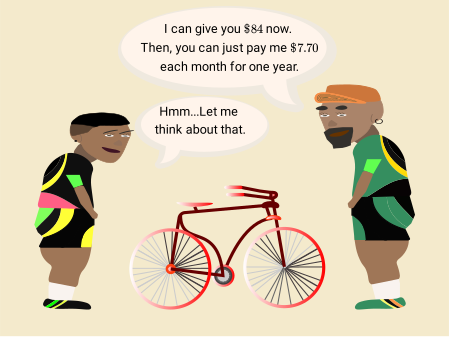
What is the percent of change from the price of the bicycle to the total amount that Kevin would pay his uncle?
{"type":"text","form":{"type":"math","options":{"comparison":"1","nofractofloat":false,"keypad":{"simple":true,"useShortLog":false,"variables":["x"],"constants":["PI"]},"rendered":false},"text":"<span class=\"katex\"><span class=\"katex-html\" aria-hidden=\"true\"><\/span><\/span>"},"formTextBefore":null,"formTextAfter":"<span class=\"katex\"><span class=\"katex-html\" aria-hidden=\"true\"><span class=\"base\"><span class=\"strut\" style=\"height:0.80556em;vertical-align:-0.05556em;\"><\/span><span class=\"mord\">%<\/span><\/span><\/span><\/span>","answer":{"text":["10"]}}
Discussion
Writing the Percent as a Ratio
There are several ways to solve percent problems. One of them is to write the percent as a ratio.
Concept
Percent Proportion
In a percent proportion, the ratio of a part of a quantity to the whole of that quantity is equal to the percent written as a fraction.
ba=100p
In this proportion, a is a part of the whole b. Likewise, p is the part - or percent - of the whole 100.Example
Finding the Percent of Toys
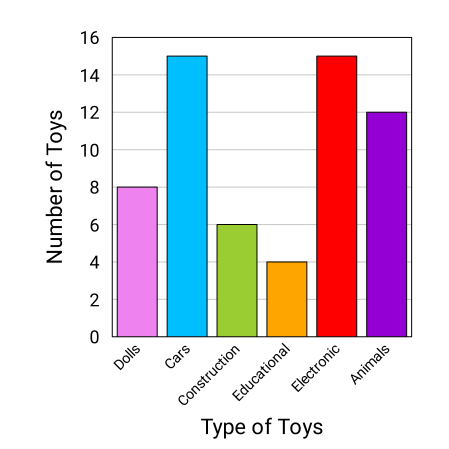
Kevin's uncle Dev works in a toy shop as a sales manager. He is responsible for monitoring the number of products sold. The following graph shows the number of toys sold by the shop in one day.
a What percent of the toys sold are construction toys?
{"type":"text","form":{"type":"math","options":{"comparison":"1","nofractofloat":false,"keypad":{"simple":true,"useShortLog":false,"variables":["x"],"constants":["PI"]},"rendered":false},"text":"<span class=\"katex\"><span class=\"katex-html\" aria-hidden=\"true\"><\/span><\/span>"},"formTextBefore":null,"formTextAfter":"<span class=\"katex\"><span class=\"katex-html\" aria-hidden=\"true\"><span class=\"base\"><span class=\"strut\" style=\"height:0.80556em;vertical-align:-0.05556em;\"><\/span><span class=\"mord\">%<\/span><\/span><\/span><\/span>","answer":{"text":["10"]}}
b What percent of the toys sold are electronic toys?
{"type":"text","form":{"type":"math","options":{"comparison":"1","nofractofloat":false,"keypad":{"simple":true,"useShortLog":false,"variables":["x"],"constants":["PI"]},"rendered":false},"text":"<span class=\"katex\"><span class=\"katex-html\" aria-hidden=\"true\"><\/span><\/span>"},"formTextBefore":null,"formTextAfter":"<span class=\"katex\"><span class=\"katex-html\" aria-hidden=\"true\"><span class=\"base\"><span class=\"strut\" style=\"height:0.80556em;vertical-align:-0.05556em;\"><\/span><span class=\"mord\">%<\/span><\/span><\/span><\/span>","answer":{"text":["25"]}}
Hint
a Find the total number of toys from the graph and use the percent proportion.
b Use the percent proportion.
Solution
a The given graph categorizes the number of toys sold into six different categories. The task at hand is to figure out the number of construction toys sold as a percent rather than a whole number. Finding the percent proportion can accomplish this.
wa=100p
Recall what each variable represents. awp→Part→Whole→Percent
Retrieve from the graph the number of construction toys sold. It is 6, which is the value of a. Now, find the total number of toys sold by adding the corresponding numbers of the six categories from the graph.
Dolls=Cars=Construction=Educational=Electronic=Animals= 8 15 6 4 15 12
Now calculate the sum of these numbers to find the value of w.
There are 60 toys sold. This is the value of the whole w. Now that the part and whole are known, the percent can be calculated. Substitute the obtained values into the percent proportion.
wa=100p
SubstituteII
a=6, w=60
606=100p
▼
Solve for p
ReduceFrac
ba=b/6a/6
101=100p
MultEqn
LHS⋅100=RHS⋅100
10100=p
CalcQuot
Calculate quotient
10=p
RearrangeEqn
Rearrange equation
p=10
b Once again, apply the same process from Part A to find the percent that represents the number of electronic toys sold. Start by recalling the percent proportion.
wa=100p
The total number of toys sold was already found in Part A. There are 60 toys sold and this is the value of w. On the other hand, 15 electronic toys were sold. This is the value of a. Substitute these values into the percent proportion and solve it for p.
wa=100p
SubstituteII
a=15, w=60
6015=100p
▼
Solve for p
ReduceFrac
ba=b/15a/15
41=100p
MultEqn
LHS⋅100=RHS⋅100
4100=p
CalcQuot
Calculate quotient
25=p
RearrangeEqn
Rearrange equation
p=25
Pop Quiz
Solving a Percent Proportion
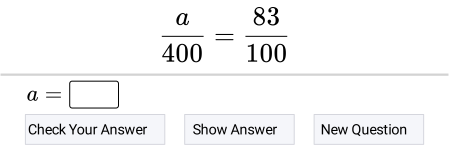
Solve the given percent proportion for the missing value. Note that a is part of the whole w and p% or 100p is the percent value.
Discussion
Using the Percent in an Equation
Percent problems can also be solved by expressing the given situation as an equation. In that case, it is needed to write the percent as a decimal or as a fraction while solving the equation.
Concept
Percent Equation
In a percent equation, the part is equal to the product of the corresponding percent and the whole. The phrase 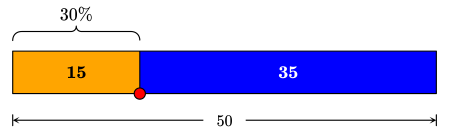 As an example, 30% of 50 can be calculated by multiplying these values.
a is p percent of wis represented as the following equation.
a=p%⋅w
For instance, consider the case that the whole is 50 which represents the value of 100%.
a=30%⋅50
Example
Arranging the Toys According to Age Groups
Kids learn and grow through playing with toys that match their developmental stages. Uncle Dev is organizing toys at the shop according to age groups: infants, toddlers, and preschoolers. By category, the circle graph shows the percents of toddler and infant toys and number of preschool toys.
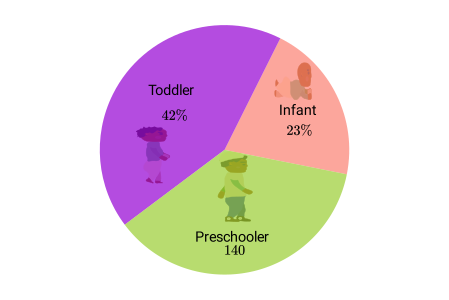
a Find the total number of toys.
{"type":"text","form":{"type":"math","options":{"comparison":"1","nofractofloat":false,"keypad":{"simple":true,"useShortLog":false,"variables":["x"],"constants":["PI"]},"rendered":false},"text":"<span class=\"katex\"><span class=\"katex-html\" aria-hidden=\"true\"><\/span><\/span>"},"formTextBefore":null,"formTextAfter":null,"answer":{"text":["400"]}}
b Find the number of toys for infants.
{"type":"text","form":{"type":"math","options":{"comparison":"1","nofractofloat":false,"keypad":{"simple":true,"useShortLog":false,"variables":["x"],"constants":["PI"]},"rendered":false},"text":"<span class=\"katex\"><span class=\"katex-html\" aria-hidden=\"true\"><\/span><\/span>"},"formTextBefore":null,"formTextAfter":null,"answer":{"text":["92"]}}
Hint
a Express all categories as a percent. Then, use the percent equation to find the value of whole.
b Use the total number of toys in the given three categories. Then use the percent equation to find the part.
Solution
a In the given graph, the numbers of toys are represented with percents or it is just written as a the number.
ToddlerInfantPreschooler⇒42%⇒23%⇒140
Recall that the total percents in a circle graph needs to represent 100%. This means that the sum of 42%, 23%, and the missing percent of preschool toys x% will be 100%. Write this situation as an equation and solve for x.
This means that 140 toys are 35% of the number of toys in all three categories. Since it is asked to find the total number of toys, the following question can be asked.
140 is 35% of what number?
This question can be solved by using a percent equation.
a=p%⋅w
Recall that a is the value of part, p is the value of percent, and w is the value of whole. Note that the above question asks for the whole. Now, substitute the obtained values into the equation and then solve it for w. Try to write the percent as a decimal.
a=p%⋅w
SubstituteII
a=140, p=35
140=35%⋅w
▼
Solve for w
WriteDec
Write as a decimal
140=0.35⋅w
DivEqn
LHS/0.35=RHS/0.35
0.35140=w
RearrangeEqn
Rearrange equation
w=0.35140
CalcQuot
Calculate quotient
w=400
b The next task for Uncle Dev is to determine the number of toys made for infants. As of right now, he knows it is 23% of all toys. In Part A, he found that there are 400 toys in total.
What number is 23% of 400?
This question can be solved by using a percent equation which states that the product of the percent and whole is equal to the value of part.
a=p%⋅w
Notice that 400 is the whole and 23 is the percent value. With this in mind, substitute these values into the percent equation and calculate the result. Remember to write the percent as a decimal.
There are 92 toys for infants in the toy shop.
Pop Quiz
Solving a Percent Equation
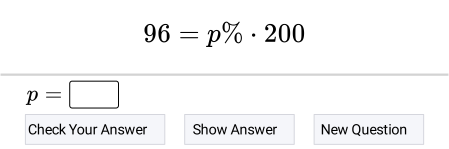
In the following applet, there is a percent equation representing the situation in which the part a is p percent of the whole w. Solve the equation for the missing value.
Discussion
Expressing the Change as a Percent
Sometimes it may be easier to evaluate the amount of change when it is expressed as a percent rather than as a number or a ratio. In that case the percent of change can be used.
Concept
Percent of Change
Percent of change, or percent change, is a percent that expresses an amount of change as a percent of the original amount. It is calculated as the ratio of the change in the amount to the original amount.
Percent of Change,p%=Original AmountAmount of Change
If the new amount is greater than the original amount, the percent of change is called a percent of increase.
Percent of Increase=Original AmountNew Amount−Original Amount
If the new amount is less than the original amount, the percent of change is called a percent of decrease. Percent of Decrease=Original AmountOriginal Amount−New Amount
Discussion
Calculating Percent of Change
The percent change is the change in percent when a quantity has changed. It is calculated by writing a ratio of the amount of change to the original amount as a percent.
Percent Change=Original AmountAmount of Change
For example, buying a collector's item for $12 and selling it for $15 results in a profit. What is the percent change? It can be calculated in four steps.
1
Determine if the Change is an Increase or a Decrease
expand_more Determine if the price of the item increases or decreases by looking at the difference between the new and original amounts.
| Increase | New amount > Original amount |
| Decrease | Original amount > New amount |
The change represents an increase since 15 is greater than 12.
2
Calculate the Amount of Change
expand_more When the change is an increase, subtract the original amount from the new amount to find the difference. Since the new amount is greater than the original amount, the difference will be positive.
15−12=3
3
Calculate the Ratio for Percent of Change
expand_more Now that the amount of increase and the original amounts are known, find the ratio of these amounts.
4
Write the Result as a Percent
expand_more As a final step, write the obtained number as a percent by multiplying 0.25 by 100.
0.25⋅100=25
The percent of change is 25%. This means that the price of the collector's item increased by 25%. Example
Calculating the Change as a Percent
Uncle Dev now wants to examine the percent of changes between visitors over the last two weeks. He prepares the following table that shows the number of people that visited the toy shop.
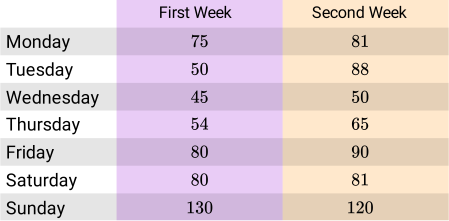
a What is the percent of change in the number of people that visit the toy shop on Monday from the first week to the second week?
{"type":"text","form":{"type":"math","options":{"comparison":"1","nofractofloat":false,"keypad":{"simple":true,"useShortLog":false,"variables":["x"],"constants":["PI"]},"rendered":false},"text":"<span class=\"katex\"><span class=\"katex-html\" aria-hidden=\"true\"><\/span><\/span>"},"formTextBefore":null,"formTextAfter":"<span class=\"katex\"><span class=\"katex-html\" aria-hidden=\"true\"><span class=\"base\"><span class=\"strut\" style=\"height:0.80556em;vertical-align:-0.05556em;\"><\/span><span class=\"mord\">%<\/span><\/span><\/span><\/span>","answer":{"text":["8"]}}
b What is the percent of change in the number of people that visit the toy shop from Friday to Saturday in the second week?
{"type":"text","form":{"type":"math","options":{"comparison":"1","nofractofloat":false,"keypad":{"simple":true,"useShortLog":false,"variables":["x"],"constants":["PI"]},"rendered":false},"text":"<span class=\"katex\"><span class=\"katex-html\" aria-hidden=\"true\"><\/span><\/span>"},"formTextBefore":null,"formTextAfter":"<span class=\"katex\"><span class=\"katex-html\" aria-hidden=\"true\"><span class=\"base\"><span class=\"strut\" style=\"height:0.80556em;vertical-align:-0.05556em;\"><\/span><span class=\"mord\">%<\/span><\/span><\/span><\/span>","answer":{"text":["10"]}}
Hint
a Use the percent of change formula. Is the new amount greater or less than the original amount?
b Use the percent of change formula. Is the new amount greater or less than the original amount?
Solution
a Uncle Dev wants to find the percent of change from the first Monday to the second Monday. Start by recalling the percent of change formula.

Notice that on the first week's Monday 75 person visited the toy shop but on the second week's Monday 81 people visited the shop. Since it shows an increase, the amount of change will be found by subtracting the original amount from the new amount.

Percent of Increase=7581−75
Now calculate this percent of increase!
Percent of Increase=7581−75
▼
Simplify right-hand side
SubTerms
Subtract terms
Percent of Increase=756
ReduceFrac
ba=b/3a/3
Percent of Increase=252
ExpandFrac
ba=b⋅4a⋅4
Percent of Increase=1008
WritePercent
Convert to percent
Percent of Increase=8%
b This time, the percent of change from Friday to Saturday at the second week needs to be calculated. Start by examining the numbers on those days.
Friday=90Saturday=75
Notice that the number of people decreased. This means that the percent of change will be found by using the percent of decrease formula. 
Percent of Decrease=9090−81
Now calculate this percent of decrease!
Percent of Decrease=9090−81
▼
Simplify right-hand side
SubTerms
Subtract terms
Percent of Decrease=909
ReduceFrac
ba=b/9a/9
Percent of Decrease=101
ExpandFrac
ba=b⋅10a⋅10
Percent of Decrease=10010
WritePercent
Convert to percent
Percent of Decrease=10%
Pop Quiz
Calculating the Percent of Change
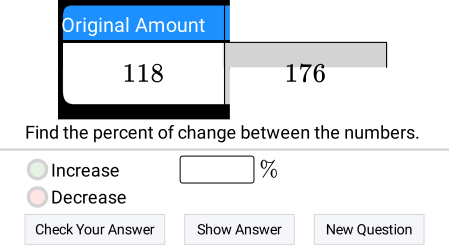
In the following applet, the original and new amounts are given in a table. Find the percent of change based on these values. Also determine if this change is an increase or decrease. Round the answer to the nearest hundredth if necessary.
Discussion
Expressing the Error as a Percent
Sometimes the amount of error can be too big or too small to understand its effect clearly. Expressing the error as a percent is an alternative way to show the amount of the error.
Concept
Relative Error and Percent Error
The relative error is the ratio of the absolute error of a measurement to the exact value. The relative error tells how good a measurement is relative to the size of the object being measured. In other words, the relative error indicates how significant the absolute error is.
Relative Error =Exact ValueAbsolute Error
The Relative Error Formula can be rewritten by substituting the Absolute Error Formula.
Relative Error =Exact Value∣Measured Value−Exact Value∣
The percent error is the product between the relative error and 100%. It represents the relative error as a percentage.
Percent Error =Relative Error⋅100%
Consider, for example, a person fishing who expected to catch 480 crayfish. However, the number of crayfish they ultimately caught was 400. The percent error explains the degree of the mistake in the person's estimation.
| Absolute Error | Relative Error | Percent Error |
|---|---|---|
| ∣480−400∣=80 | 40080=0.2 | 0.2⋅100%=20% |
Example
Estimating a Wrong Price
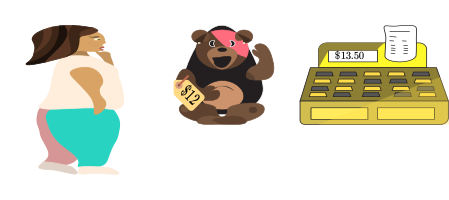
A customer falls in love with a toy for her daughter. It is called Luchador Teddy! Wait. It is missing a price. Uncle Dev estimates that it costs $12 and writes that. The customer goes to the register to buy it but sees she is about to be charged $13.50!
{"type":"text","form":{"type":"math","options":{"comparison":"1","nofractofloat":false,"keypad":{"simple":false,"useShortLog":false,"variables":["x"],"constants":["PI"]},"rendered":false},"text":"<span class=\"katex\"><span class=\"katex-html\" aria-hidden=\"true\"><\/span><\/span>"},"formTextBefore":"About","formTextAfter":"<span class=\"katex\"><span class=\"katex-html\" aria-hidden=\"true\"><span class=\"base\"><span class=\"strut\" style=\"height:0.80556em;vertical-align:-0.05556em;\"><\/span><span class=\"mord\">%<\/span><\/span><\/span><\/span>","answer":{"text":["11.1"]}}
Hint
Calculate the amount of error. Then, find the relative error.
Solution
Percent of error problems are kinds of a percent of change problems. With this in mind, start by finding the relative error. Then multiply the relative error by 100% to express it as a percent error.
Finally, multiply the obtained number by 100% to express it as a percent.
The percent error between the Uncle Dev's estimate and the actual price of the toy is about 11.1%. Uncle Dev then decides to offer the customer a discount to make up for the error.
Relative Error=Exact ValueAbsolute Error
Now, find the absolute error by calculating the difference between the estimated price and the exact price.
Absolute Error∣$13.50−$12∣=$1.50
The absolute error is $1.50. Now, use the relative error formula.
Relative Error=Exact ValueAbsolute Error
SubstituteII
Absolute Error=1.50, Exact Value=13.50
Relative Error=13.501.50
UseCalc
Use a calculator
Relative Error=0.111111…
Closure
Calculating the Percent of Change for a Loan
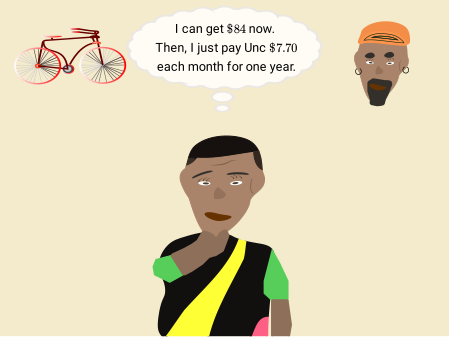
This lesson introduced how to find the percent of change using original and new amounts. The challenge presented at this chapter's start focuses on Kevin's tough decision. If he accepts the loan, he could get his dream bicycle. On the other hand, he could owe too large of an amount!
{"type":"text","form":{"type":"math","options":{"comparison":"1","nofractofloat":false,"keypad":{"simple":true,"useShortLog":false,"variables":["x"],"constants":["PI"]},"rendered":false},"text":"<span class=\"katex\"><span class=\"katex-html\" aria-hidden=\"true\"><\/span><\/span>"},"formTextBefore":null,"formTextAfter":"<span class=\"katex\"><span class=\"katex-html\" aria-hidden=\"true\"><span class=\"base\"><span class=\"strut\" style=\"height:0.80556em;vertical-align:-0.05556em;\"><\/span><span class=\"mord\">%<\/span><\/span><\/span><\/span>","answer":{"text":["10"]}}
Hint
Find the amount of change between the price of the bicycle and the amount that Kevin would have to pay back. Then, apply the percent of change formula.
Solution
Recall that Kevin's uncle offers to give 84 dollars in total but he wants Kevin to pay him 7.70 dollars every month for one year. Since there are twelve months in a year, start by calculating the total amount that Kevin needs to pay back by multiplying 7.70 and 12.
Notice that Kevin would pay more money than he receives. This means that 10% represents the percent of increase. Kevin's uncle wants Kevin to pay 10% more than he gives. OMG!
7.70⋅12=92.40
Kevin would need to pay $92.40 back to his Uncle. Now, recall the percent of change formula.
Percent of Change=Original AmountAmount of Change
Calculate the difference between the price of the bicycle and the amount Kevin will pay back to find the amount of change.
Amount of Change92.40−84=8.40
Now, substitute the obtained values into the percent of change formula.
Percent of Change=Original AmountAmount of Change
SubstituteII
Amount of Change=8.40, Original Amount=84
Percent of Change=848.40
ReduceFrac
ba=b/8.4a/8.4
Percent of Change=101
ExpandFrac
ba=b⋅10a⋅10
Percent of Change=10010
WritePercent
Convert to percent
Percent of Change=10%
Extra
Kevin Makes a CounterofferThe two regather after Kevin found the percent change that his Uncle originally offered.
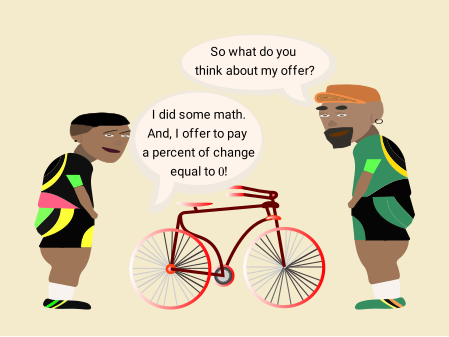
Uncle Dev is impressed, and embarrassed, by Kevin's math skills. Uncle Dev agrees to the counteroffer — realizing the overpayment.
The two can now take a cruise around town together!
Loading content