{{ tocSubheader }}
{{ 'ml-label-loading-course' | message }}
An error ocurred, try again later!
Chapter {{ article.chapter.number }}
{{ article.number }}.
{{ article.displayTitle }}
{{ article.intro.summary }}
Show less Show more expand_more Lesson Settings & Tools
| | {{ 'ml-lesson-number-slides' | message : article.intro.bblockCount }} |
| | {{ 'ml-lesson-number-exercises' | message : article.intro.exerciseCount }} |
| | {{ 'ml-lesson-time-estimation' | message }} |
When calculating probabilities, it is important to be able to find the number of possible outcomes of events. Listing all the possible outcomes of compound events can be very time-consuming, though. This is where the Fundamental Counting Principle comes in handy, making it possible to find the number of possible outcomes of a combination of events without listing them.
Catch-Up and Review
Here are a few recommended readings before getting started with this lesson.
Challenge
Charity Raffle
Tiffaniqua is helping organize a school fair fundraiser. Her job is to set up the raffle! She decided that everyone who buys a raffle ticket can also play a game of chance for an extra donation. This way, they could guarantee themselves a prize! Participants would first roll a die and then spin a spinner with four regions.
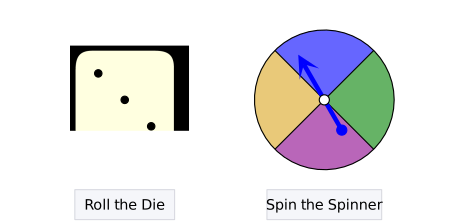 The prize for the game would be determined by the combination of the results of the toss of the die and the spin of the spinner.
a How many possible outcomes are there?
{"type":"text","form":{"type":"math","options":{"comparison":"1","nofractofloat":false,"keypad":{"simple":true,"useShortLog":false,"variables":["x"],"constants":["PI"]},"rendered":false},"text":"<span class=\"katex\"><span class=\"katex-html\" aria-hidden=\"true\"><\/span><\/span>"},"formTextBefore":null,"formTextAfter":null,"answer":{"text":["24"]}}
b What is the probability of getting a six and the spinner landing on the purple field? Write the answer as a fraction.
{"type":"text","form":{"type":"math","options":{"comparison":"1","nofractofloat":false,"keypad":{"simple":true,"useShortLog":false,"variables":[],"constants":[]},"rendered":false},"text":"<span class=\"katex\"><span class=\"katex-html\" aria-hidden=\"true\"><\/span><\/span>"},"formTextBefore":null,"formTextAfter":null,"answer":{"text":["\\frac{1}{24}"]}}
Discussion
Independent Events
When discussing probability, a pair of events can be either independent or dependent.
Concept
Independent Events
Two events A and B are independent events if the occurrence of one event does not affect the occurrence of the other. It is also said that they are independent if and only if the probability that both events occur is equal to the product of the individual probabilities.
P(A∩B)=P(A)⋅P(B)
Why
For example, suppose a bowl contains three marbles, one green, one orange, and one blue. Someone wants to find the probability of first drawing a green marble, then an orange one. The marbles will be drawn one at a time.
 Let G, B, and O be the events of drawing green, blue, and orange marbles, respectively. The probability of first picking a green marble can be calculated by dividing the favorable outcomes by the possible outcomes. The bowl currently contains 3 marbles in total, 1 of which is green.
P(G)=31
Suppose that the first marble is replaced before the second draw. After the replacement of the first marble drawn, there are again 3 marbles in the bowl, 1 of which is orange.
P(O)=31
Note that there are 9 possible outcomes for drawing two marbles if the marbles are drawn one at a time and then replaced before the next drawing. Only 1 of these options corresponds to an event of drawing a green marble and then an orange marble.
GGGBGOBBBGBOOOOGOB
Therefore, the combined probability of picking a green marble first and an orange marble second is 91. Since the probability of both events occurring equals the product of the individual probabilities, the events are independent.
31⋅31=91⇓P(G)⋅P(O)=P(G∩O)
Discussion
Dependent Events
Two events A and B are considered dependent events if the occurrence of either event affects the occurrence of the other. If the events are dependent, the probability that both events occur is equal to the product of the probability of the first event occurring and the probability of the second event occurring after the first event.
P(A∩B)=P(A)⋅P(B∣A)
Why
For example, suppose a bowl contains three marbles, one green, one orange, and one blue. Someone wants to find the probability of first drawing the green marble, then the orange one. The marbles will be drawn one at a time.
 Let G, B, and O be the events of drawing green, blue, and orange marbles, respectively. The probability of first picking the green marble can be calculated by dividing the favorable outcomes by the possible outcomes. The bowl currently contains 3 marbles in total, 1 of which is green.
 This affects the probability of picking the orange marble on the second draw. Now there is still 1 orange marble in the bowl, but instead of 3, there are 2 marbles in total in the bowl.
P(G)=31
Suppose that after the green marble is drawn, it is not replaced in the bowl. P(O∣G)=21
The sample space of the situation can be found using this information.
GBGOBGBOOGOB
Out of the 6 possible outcomes, only 1 outcome corresponds to first drawing the green marble and then the orange marble. Therefore, the probability of picking the green and then the orange marble is 61. 31⋅21=61⇓P(G)⋅P(O∣G)=P(G∩O)
Because the occurrence of the first event affects the occurrence of the second, these events can be concluded to be dependent.
Discussion
Fundamental Counting Principle
Finding the number of possible outcomes of a combination of independent events can be tricky or time-consuming. Luckily, there is a shortcut!
Rule
Fundamental Counting Principle
If an event A has n possible outcomes and an event B has m possible outcomes, then the total number of different outcomes for A and B combined is n×m. This principle is used to find the number of possible outcomes for a combination of independent events.
Proof
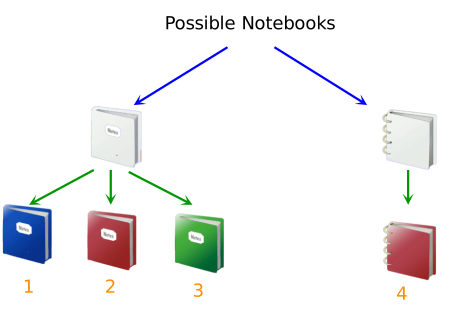
Informal JustificationConsider an arbitrary process that can be divided into two tasks. There are n ways to complete the first task and m ways to complete the second task. To complete the whole process, one of the n ways to start it is chosen first. From there, there will be m possible ways to finish the process. 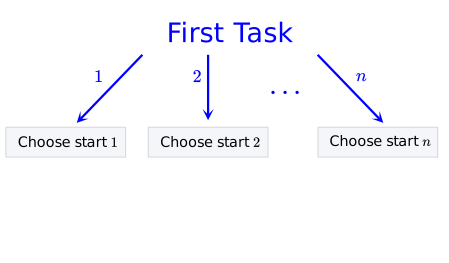 This happens for each of the n different ways in which the process can be started. Therefore, there are n×m different ways of completing the process. This is a generic argument that can be applied in multiple scenarios. For example, the following diagram shows the different choices of the notebooks that a store sells.
 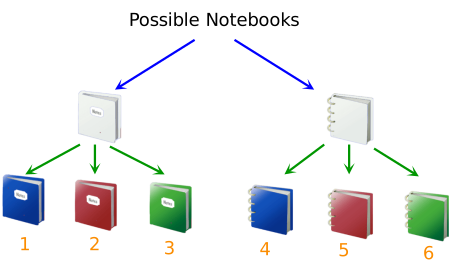 In this example, the store sells 2 types of notebooks, one with a ring binding and one with a spiral binding. Each notebook type comes in 3 different colors: blue, red, and green. According to the Fundamental Counting Principle, there are 6 different outcomes for which notebook a customer may buy.
2×3=6
It should be noted that this is an informal justification and should not be taken as a formal proof.
Extra
Counting the Outcomes of Dependent EventsAs mentioned above, this principle holds true only if the events are independent of each other. If the events are dependent, multiplying the number of possible outcomes for each event will not reflect the actual number of possible outcomes. Returning to the notebooks for sale, suppose now that the spiral-bound notebooks only come in red.
There are still 2 types of notebooks and a total of 3 colors for the ring-bound notebooks. However, the possible number of different notebooks a customer may buy is not 2×3=6. Rather, it is 4. This happens because the number of possible colors of the notebook now depends on the type of notebook.
Example
Coming up With Ideas for the Raffle
While preparing the raffle, Tiffaniqua considered inviting everyone who purchased a ticket to roll a die and toss a coin.

a How many different prizes would Tiffaniqua have to prepare?
{"type":"text","form":{"type":"math","options":{"comparison":"1","nofractofloat":false,"keypad":{"simple":true,"useShortLog":false,"variables":["x"],"constants":["PI"]},"rendered":false},"text":"<span class=\"katex\"><span class=\"katex-html\" aria-hidden=\"true\"><\/span><\/span>"},"formTextBefore":null,"formTextAfter":null,"answer":{"text":["12"]}}
b One of the prizes is a teddy bear. To win the teddy bear, someone would have to roll a 5 and get tails on the coin toss. What is the probability of winning the teddy bear? Write the answer as a fraction.
{"type":"text","form":{"type":"math","options":{"comparison":"1","nofractofloat":false,"keypad":{"simple":true,"useShortLog":false,"variables":[],"constants":[]},"rendered":false},"text":"<span class=\"katex\"><span class=\"katex-html\" aria-hidden=\"true\"><\/span><\/span>"},"formTextBefore":null,"formTextAfter":null,"answer":{"text":["1\/12"]}}
Hint
a There are 6 sides on a die and 2 sides of a coin.
b Only one outcome results in winning the teddy bear. How many possible outcomes are there in total?
Solution
a Winning a prize in Tiffaniqua's game of chance can be considered a compound event consisting of two simple events. The first simple event is rolling the die and the second one is tossing the coin.
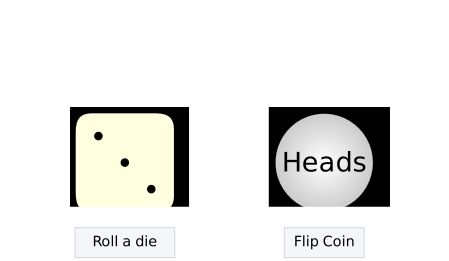
|
Fundamental Counting Principle |
|
If an event A has n possible outcomes and an event B has m possible outcomes, then the total number of different outcomes for A and B combined is n⋅m. |
6⋅2=12
There are 12 possible outcomes, so Tiffaniqua would need to come up with 12 prizes for the raffle. The number of possible outcomes can also be found using a tree diagram. 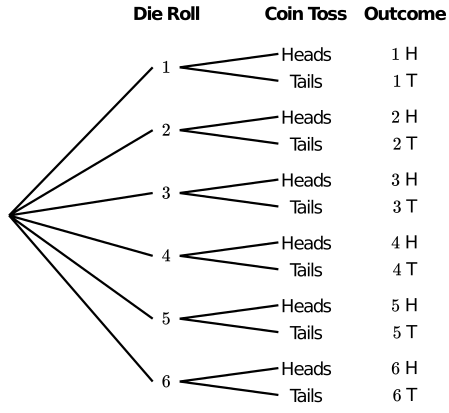
According to the tree diagram, there are 12 possible outcomes. This is the same number as the one found using the Fundamental Counting Principle. Tiffaniqua wanted to have more possible prizes, so she decided to come up with another idea for the game with more possible outcomes!
b To win a teddy bear, the result of rolling the die must be a 5 and the result of tossing the coin must be tails.
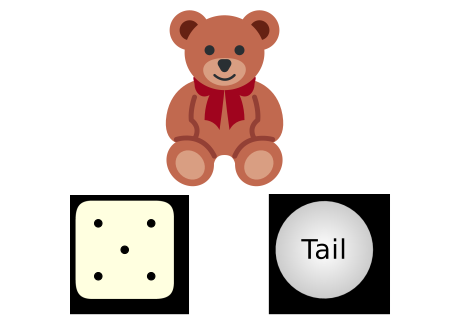
P(Teddy bear)P(Teddy bear)=Possible outcomesFavorable outcomes⇓=121
The probability of winning a teddy bear is 121.
Discussion
Permutation
In a compound event, the order in which the outcomes occur can sometimes be important. For example, suppose three digits are randomly chosen as a combination to a lock. The outcome 482
is different from the outcome 248,
even though they are made up of the same digits. When the order is important, permutations can be used.
Concept
Permutation
A permutation is an arrangement of objects in which the order is important. For example, consider constructing a number using only the digits 4, 5, and 6 without repetitions. Any of the three digits can be picked for the first position, leaving two choices for the second position, then only one choice for the third position.
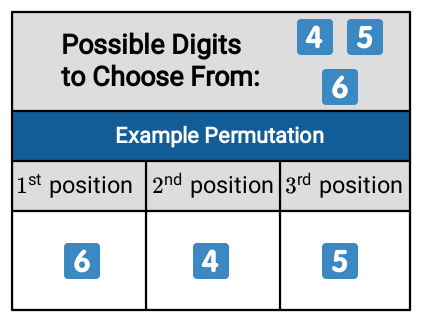
456465546564645654
Although all these numbers are formed with the same three digits, the order in which the digits appear affects the number produced. Each different order of the digits creates a different number. The number of permutations can be calculated by using the Fundamental Counting Principle. Number of permutationsNumber of permutations=3⋅2⋅1⇕=6
Example
Lining Up the Display
Tiffaniqua chose 5 prizes to display at her stall — a movie ticket, a CD, a basketball, a teddy bear, and a pair of sunglasses. She was sure they would attract many people to her raffle!

The next step was to decide what order she should line the prizes up in.
a How many different ways can Tiffaniqua arrange the prizes?
{"type":"text","form":{"type":"math","options":{"comparison":"1","nofractofloat":false,"keypad":{"simple":true,"useShortLog":false,"variables":["x"],"constants":["PI"]},"rendered":false},"text":"<span class=\"katex\"><span class=\"katex-html\" aria-hidden=\"true\"><\/span><\/span>"},"formTextBefore":null,"formTextAfter":null,"answer":{"text":["120"]}}
b Tiffaniqua decided to choose the order of the prizes at random. What is the probability that the teddy bear was the first prize in the lineup and the CD was the third? Write the answer as a fraction in simplest form.
{"type":"text","form":{"type":"math","options":{"comparison":"1","nofractofloat":false,"keypad":{"simple":true,"useShortLog":false,"variables":[],"constants":[]},"rendered":false},"text":"<span class=\"katex\"><span class=\"katex-html\" aria-hidden=\"true\"><\/span><\/span>"},"formTextBefore":null,"formTextAfter":null,"answer":{"text":["1\/20"]}}
Hint
a When choosing the first prize to display, Tiffaniqua has 5 choices. When choosing the second prize, she has 4 choices. How many choices does she have when choosing the third, fourth, and fifth prizes in the arrangement?
b The favorable outcomes are the outcomes where the teddy bear is the first prize and the CD is the third prize.
Solution
a Arranging the prizes on the stall can be considered as five separate choices: choosing the first prize, choosing the second prize, and so on. When choosing the first prize, there are 5 possible outcomes because there are five available prizes.
| First Prize | 5 choices |
|---|---|
| Second Prize | |
| Third Prize | |
| Fourth Prize | |
| Fifth Prize |
When choosing the second prize, there are only 4 possible outcomes because one of the five items has already been chosen for the first prize in the arrangement.
| First Prize | 5 choices |
|---|---|
| Second Prize | 4 choices |
| Third Prize | |
| Fourth Prize | |
| Fifth Prize |
For the same reason, there are 3 choices for the third prize, 2 choices for the fourth prize, and only 1 choice for the fifth prize.
| First Prize | 5 choices |
|---|---|
| Second Prize | 4 choices |
| Third Prize | 3 choices |
| Fourth Prize | 2 choices |
| Fifth Prize | 1 choice |
5⋅4⋅3⋅2⋅1=120
There are 120 possible ways for Tiffaniqua to order the five prizes. In other words, there are 120 permutations of the 5 prizes.
b The probability that the teddy bear will be the first prize in the arrangement and the CD will be the third prize is equal to the quotient of the number of favorable outcomes and the total number of possible outcomes. In any favorable outcome, the teddy bear must be the first prize and the CD must be the third prize.
| First Prize | 1 option (Teddy Bear) |
|---|---|
| Second Prize | |
| Third Prize | 1 option (CD) |
| Fourth Prize | |
| Fifth Prize |
The second prize could be the sunglasses, the basketball, or the movie ticket, so there are 3 options for the second prize in the lineup.
| First Prize | 1 option (Teddy Bear) |
|---|---|
| Second Prize | 3 options |
| Third Prize | 1 option (CD) |
| Fourth Prize | |
| Fifth Prize |
The fourth prize cannot be the teddy bear, the CD, or whatever was placed in the second place in the arrangement. This means that there are 2 options left for the fourth prize. Similarly, there is only 1 option left for the final item in the arrangement after the fourth prize is chosen.
| First Prize | 1 option (Teddy Bear) |
|---|---|
| Second Prize | 3 options |
| Third Prize | 1 option (CD) |
| Fourth Prize | 2 options |
| Fifth Prize | 1 option |
1⋅3⋅1⋅2⋅1=6
There are 6 possible ways to arrange the second, fourth, and fifth items when the first item in the lineup is the teddy bear and the third item is the CD. This means that out of the 120 arrangements found in Part A, there are 6 outcomes where the first prize is the teddy bear and the third prize is the CD.
P(Teddy bear first, CD third)=1206⇕P(Teddy bear first, CD third)=201
When choosing the order of the prizes for the display at random, the probability that the teddy bear is the first prize in the lineup and the CD is the third prize is 201.
Example
A Random Prize
Just before the fundraiser started, a new sponsor decided to donate a bunch of new prizes to Tiffaniqua! It was too late to change the way the game works to accommodate the new prizes, so Tiffaniqua decided to add a mystery prize grab.

Players can donate money to draw a random prize from a box of 20 unique prizes without taking part in the raffle. The big box contains prizes like a pair of gloves and a pair of socks.
a Tiffaniqua was worried that someone might not like the prize they drew. She decided that, for another small donation, the person could return the random prize back to the box and draw another time. What is the probability that a person taking part draws a pair of gloves and then a pair of socks in the second attempt? Express the answer as a fraction.
{"type":"text","form":{"type":"math","options":{"comparison":"1","nofractofloat":false,"keypad":{"simple":true,"useShortLog":false,"variables":["x"],"constants":["PI"]},"rendered":false},"text":"<span class=\"katex\"><span class=\"katex-html\" aria-hidden=\"true\"><\/span><\/span>"},"formTextBefore":null,"formTextAfter":null,"answer":{"text":["1\/400"]}}
b Zain bought two tickets for the prize grab, so they drew two prizes from the box! The box was not refilled between the draws, so Zain draw one prize and then immediately drew the other. What is the probability that they draw a pair of socks and a pair of gloves? Express the answer as a fraction in simplest form.
{"type":"text","form":{"type":"math","options":{"comparison":"1","nofractofloat":false,"keypad":{"simple":true,"useShortLog":false,"variables":[],"constants":[]},"rendered":false},"text":"<span class=\"katex\"><span class=\"katex-html\" aria-hidden=\"true\"><\/span><\/span>"},"formTextBefore":null,"formTextAfter":null,"answer":{"text":["1\/190"]}}
Hint
a In both attempts, there are 20 possible prizes to draw.
b When drawing the first prize, there are 20 prizes in the box. When drawing the second prize, there are only 19 prizes left in the box. Zain can draw either the socks or the gloves first.
Solution
a Each person taking part in the prize grab draws a prize from 20 available prizes. If they do not like their prize, they can make an extra donation, put their prize back in the box, and draw another prize. When making the second attempt, there are 20 items in the box again.
20⋅20=400
There is only one favorable outcome — drawing a pair of gloves and then drawing a pair of socks. The probability of drawing a pair of gloves and then a pair of socks is the quotient of the number of favorable outcomes and the number of all possible outcomes.
P(gloves, then socks)=4001
b Zain bought two tickets for the prize grab. Since they drew one prize and then the other without any items being placed in the box between drawings, there were 20 prizes available for the first draw and only 19 items in the box for the second.
20⋅19=380
There are 2 favorable outcomes — drawing the pair of socks first and the pair of gloves second or drawing the gloves first and then the socks. The probability that Zain wins the pair of socks and the pair of gloves is the quotient of the number of favorable outcomes and the number of all possible outcomes.
P(socks and gloves)=3802⇕P(socks and gloves)=1901
Closure
Combining Events
In Tiffaniqua's raffle, the prize won by the participant is determined by the combination of the results of a die roll and a spin of a spinner.
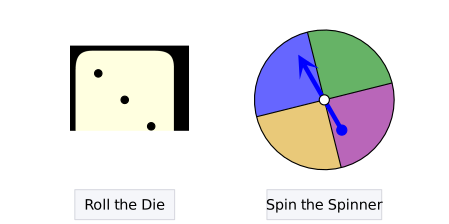 The Fundamental Counting Principle can be used to find the number of all possible outcomes. There are 6 possible outcomes of rolling the die and 4 possible outcomes of spinning the spinner.
6⋅4=24
This means that there are 24 possible outcomes. The probability of getting a six and the purple field is the quotient of the number of favorable outcomes and the number of possible outcomes. There is only 1 favorable outcome — getting a six on the die and purple on the spinner. P(6, purple)=241
The probability of getting a six and purple when rolling the die and spinning the spinner is 241.
Loading content