1. Representing One Variable Data
Sign In
An error ocurred, try again later!
Chapter 4
1.
Representing One Variable Data
This lesson offers a deep dive into the world of one-variable data analysis, focusing on descriptive statistics. It teaches how to use dot plots and box plots for visualizing data. These tools are essential for understanding various types of data, from test scores in a classroom to the heights of trees in a forest. The lesson is designed to be practical, showing how these statistical methods can be applied in real-world scenarios such as diet analysis or student performance. By mastering these techniques, you can better interpret data, make more informed decisions, and even solve complex problems in your daily life.
Show less Show more expand_more 


Lesson Settings & Tools
| | 12 Theory slides |
| | 11 Exercises - Grade E - A |
| | Each lesson is meant to take 1-2 classroom sessions |
Representing One Variable Data
Slide of 12
In this first lesson of the statistics unit, dot plots, box plots, and histograms will be used to analyze data.
Catch-Up and Review
Here are a few recommended readings before getting started with this lesson.
Explore
Share
Report error
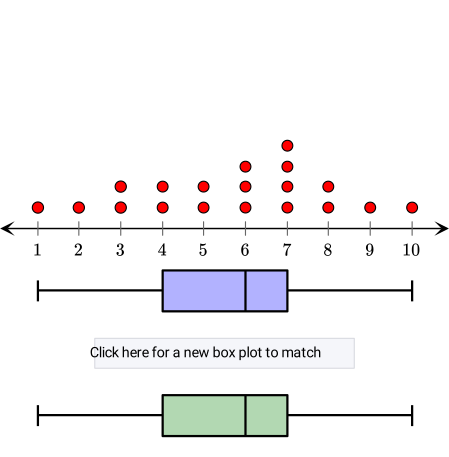
Matching Box Plots
Example
Share
Report error
Drawing a Dot Plot
Izabella's favorite candy, Frutty, is sold in packs of thirty candies with three different flavors — apple, orange, and banana.
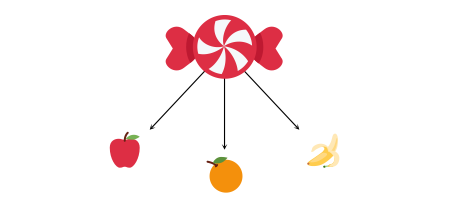
Izabella wants to know how many banana-flavored candies there are in each pack, so she bought ten packs and counted the number of banana candies in each. Her results are as follows. 10 , 8, 10, 9, 12, 9, 10, 10, 12, 10 Draw a dot plot to represent the data.
Answer
Hint
Begin by finding the range of the data, then draw a number line which covers this range.
Solution
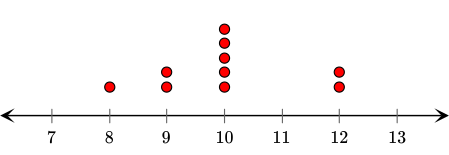
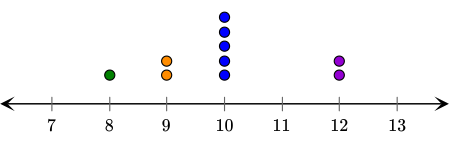
The smallest number in the data set is 8 and the largest is 12. This means that the dot plot can be displayed above a horizontal number line that covers at least the numbers from 8 to 12. Here, a number line from 7 to 13 will be used.

The number of dots drawn on the dot plot above a certain number should match the frequency of that number in the data set. 10, 8, 10, 9, 12, 9, 10, 10, 12, 10 Given the data set compare the frequencies of the numbers.
- The number 10 appears five times in the data set, so there should be five dots above number 10 on the number line.
- The number 8 appears once in the data set, so there should be one dot above number 8 on the number line.
- The number 9 appears twice in the data set, so there should be two dots above number 9 on the number line.
- The number 12 appears twice in the data set, so there should be two dots above number 12 on the number line.
From here, the dot plot can be drawn as follows.
Example
Share
Report error
Extracting Information From a Dot Plot
A multiple-choice test has ten questions. After grading the test, the teacher produced the following dot plot to show how many correct answers each student had on the test.
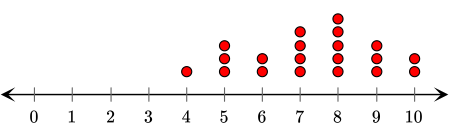
How many students are there in the class?
{"type":"text","form":{"type":"math","options":{"comparison":"1","nofractofloat":false,"keypad":{"simple":true,"useShortLog":false,"variables":[],"constants":[]},"rendered":false},"text":" "},"formTextBefore":null,"formTextAfter":null,"answer":{"text":["20"]}}
Hint
Each dot represents the performance of one student on the test.
Solution
Each dot represents the performance of a student on the test. For example, since there is one dot above the number 4, it means that one student answered four questions correctly. The rest of the dot plot can be interpreted similarly.
| Number | Dots Above the Number | Conclusion |
|---|---|---|
| 0,1,2,3 | 0 | There are no students who answered fewer than four questions correctly. |
| 4 | 1 | One student answered four questions correctly. |
| 5 | 3 | Three students answered five questions correctly. |
| 6 | 2 | Two students answered six questions correctly. |
| 7 | 4 | Four students answered seven questions correctly. |
| 8 | 5 | Five students answered eight questions correctly. |
| 9 | 3 | Three students answered nine questions correctly. |
| 10 | 2 | Two students answered all ten questions correctly. |
The number of students in the class is equal to the number of dots in the diagram. 1+3+2+4+5+3+2=20 There are 20 students in the class who took this test.
Pop Quiz
Share
Report error
Dot Plots and Goals Scored
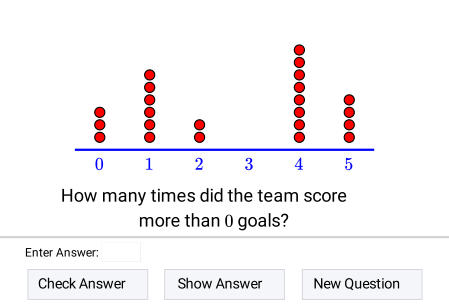
A college hockey team played 23 games during a season. An enthusiastic fan made a dot plot of the number of goals the team scored in each game.
Example
Share
Report error
Drawing a Histogram
The following data set shows the ages of the first 45 presidents of the United States when their presidencies began. The president's name and presidential period can be displayed by clicking on and holding down each point.
![Ages=[57,61,57,57,58,57,61,54,68,51,49,64,50,48,65,52,56,46,54,49,51,47,55,55,54,42,51,56,55,51,54,51,60,62,43,55,56,61,52,69,64,46,54,47,70]. Points with the age of each president. When clicked, the president's name is displayed along with its presidential period](/mediawiki/images/a/a6/Mljsx_Slide_A1_U4_C1_Example3_0.svg) Starting at age 40, group the data into 5-year intervals and draw a histogram of the results.
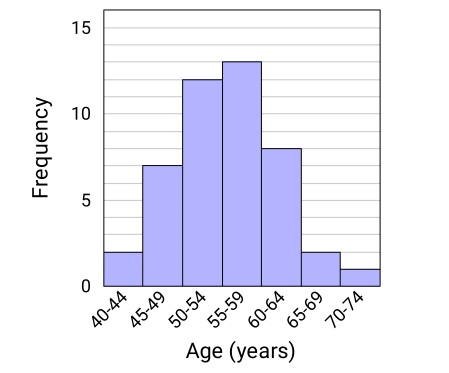
Starting at age 40, group the data into 5-year intervals and draw a histogram of the results.
Answer
Hint
Group the data in a frequency table using the intervals asked in the prompt. The first interval will be the ages 40--44.
Solution
The frequency table below shows the grouping of the data starting at 40 and using 5-year intervals.
| Interval | Frequency |
|---|---|
| 40--44 | 2 |
| 45--49 | 7 |
| 50--54 | 12 |
| 55--59 | 13 |
| 60--64 | 8 |
| 65--69 | 2 |
| 70--74 | 1 |
Use these intervals and frequencies to draw the histogram.
Example
Share
Report error
Analyzing a Histogram
In 1936, Sir Ronald Aymler Fisher published a paper entitled The Use of Multiple Measurements in Taxonomic Problems.
Fisher investigated several measurements of three species of flowers.

The histogram below shows the summary of the data about the sepal length of the Iris virginica flowers.
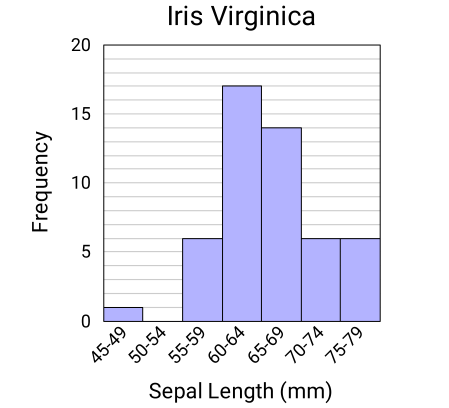
How many Iris Virginica flowers did Fisher investigate in this paper?
{"type":"text","form":{"type":"math","options":{"comparison":"1","nofractofloat":false,"keypad":{"simple":true,"useShortLog":false,"variables":[],"constants":[]},"rendered":false},"text":" "},"formTextBefore":null,"formTextAfter":null,"answer":{"text":["50"]}}
Hint
Consider the height of the rectangles in the histogram.
Solution
In a histogram, the height of the rectangles shows the frequency of the data elements in the corresponding interval.
- There is one flower with a sepal length between 45 and 49 millimeters.
- There are no flowers with a sepal length between 50 and 54 millimeters.
- There are six flowers with a sepal length between 55 and 59 millimeters.
- There are seventeen flowers with a sepal length between 60 and 64 millimeters.
- There are fourteen flowers with a sepal length between 65 and 69 millimeters.
- There are six flowers with a sepal length between 70 and 74 millimeters.
- There are six flowers with a sepal length between 75 and 79 millimeters.
The total number of flowers in the experiment is the sum of these counts. 1+0+6+17+14+6+6=50 Fisher investigated the data of about 50 Iris virginica flowers.
Pop Quiz
Share
Report error
Histograms and Tree Heights
A ranger is surveying a forest. He randomly selected 40 loblolly pines (Pinus taeda) and measured their heights. The histogram below is the summary of the data.
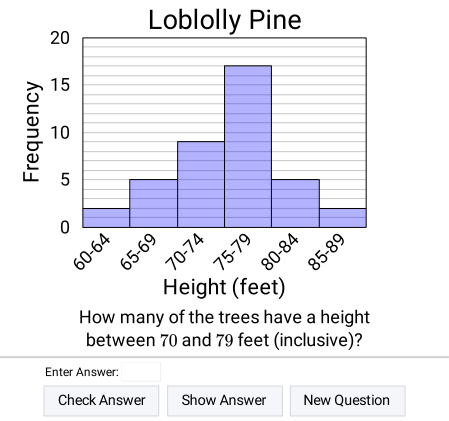
Example
Share
Report error
Drawing a Box Plot
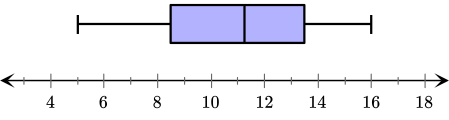
The following table shows the test scores of a class of 26 students. 8.5 & 11 & 16 & 12.5 & 11 15.5 & 12 & 7 & 13 & 10.5 5 & 15 & 8 & 9 & 8 8.5 & 6 & 12 & 15 & 15.5 13.5 & 7.5 & 13 & 10.5 & 11.5 13.5 Draw a box plot of the data.
Answer
Hint
Rearrange the data in increasing order and find the five-number summary.
Solution
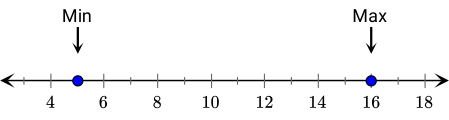
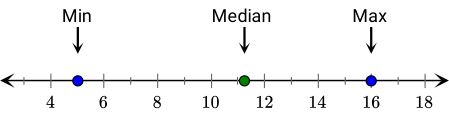
A box plot is a visual representation of the five-number summary of data. It is a scaled diagram that shows the relative positions of the minimum and maximum values, the median, and the first and third quartiles. The first step in finding these values is to arrange the data in increasing order. 5 & 6 & 7 & 7.5 & 8 8 & 8.5 & 8.5 & 9 & 10.5 10.5 & 11 & 11 & 11.5 & 12 12 & 12.5 & 13 & 13 & 13.5 13.5 & 15 & 15 & 15.5 & 15.5 16 With an ordered data set, the minimum and maximum are easily identifiable. Here, the minimum is 5 and the maximum is 16. These are marked on a number line.
Since there are 26 values, the median is the mean of the numbers at the 13th and 14th positions. 5 & 6 & 7 & 7.5 & 8 8 & 8.5 & 8.5 & 9 & 10.5 10.5 & 11 & 11 & 11.5 & 12 12 & 12.5 & 13 & 13 & 13.5 13.5 & 15 & 15 & 15.5 & 15.5 16 Now, the median can be determined by calculating the average of 11 and 11.5. 11+11.5/2=11.25 The median is 11.25. This is also marked on the number line.
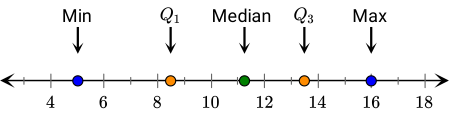
The first quartile is the median of the first half of the data. 5 & 6 & 7 & 7.5 & 8 8 & 8.5 & 8.5 & 9 & 10.5 10.5 & 11 & 11 The third quartile is the median of the second half of the data. & & & 11.5 & 12 12 & 12.5 & 13 & 13 & 13.5 13.5 & 15 & 15 & 15.5 & 15.5 16 The first quartile is 8.5 and the third quartile is 13.5. These are also marked on the number line.
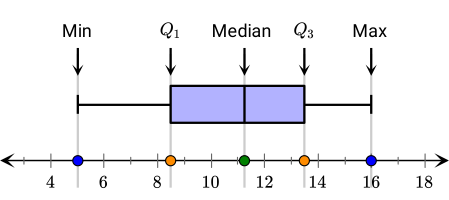
The box-plot is built using these points.
- The quartiles mark the boundaries of the box.
- The minimum and maximum values mark the end of the whiskers.
- The median marks the position of the line that divides the box.
Putting all this together gives the box plot.
Example
Share
Report error
Examining a Box Plot
In the 1994 report The Population Biology of Abalone (Haliotis species) in Tasmania,
the authors presented and investigated the measurements of 4177 blacklip abalones.

The lengths of the shells in millimeters are summarized in the box plot below.
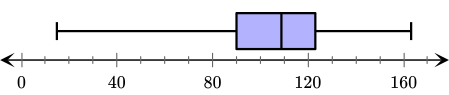
How many blacklip abalones' lengths were shorter than 90 millimeters in this experiment?
{"type":"choice","form":{"alts":["1007","1045","1067"],"noSort":true},"formTextBefore":"","formTextAfter":"","answer":0}
Hint
Which part of the box plot is at 90?
Solution
The left side of the box is at 90, so the first quartile of the lengths is 90 millimeters.
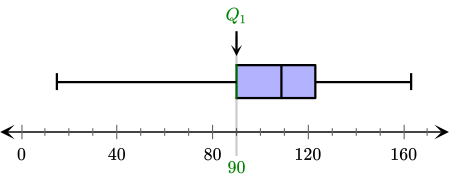
The problem is now to find out how many data points are less than the first quartile. The first quartile is the median of the lower half of the data set. In this experiment there are 4177 data points, so by dividing this by 2, the number of data points in the lower half can be found. 4177/2=2088.5 This means that in the lower half, there are 2088 data points. Now, by dividing 2088 by 2, the placement of the lower quartile can be found. 2088/2=1044 The lower quartile is the average of the 1044th and the 1045th data points. Since the lower quartile is 90, the 1045th data point is not less than 90. Therefore, the number of blacklip abalones that are shorter than 90 millimeters is less than 1045. The only option that meets this condition is 1007.
Extra
Note that from the box plot, the only conclusion we can make is that the number of blacklip abalones shorter than 90 millimeters is less than 1045.
- It is possible for the 1044th data to be 89, in which case the answer to the question would be 1044.
- It is possible for the 1044th data to be 90, in which case the answer to the question would be less than 1044.
In fact, there were 60 blacklip abalones with a length of 90 millimeters in the experiment. The answer option 1007 reflects the actual answer to the question, but to get this value, the full data is needed — the box plot is not enough.
Pop Quiz
Share
Report error
Analyzing Box Plots
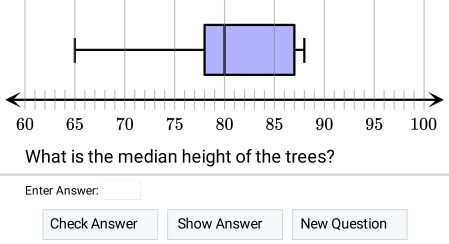
The heights, in feet, of red alder (Alnus rubra) trees in a forest are summarized in the following box plot.
Closure
Share
Report error
Stacked Histograms
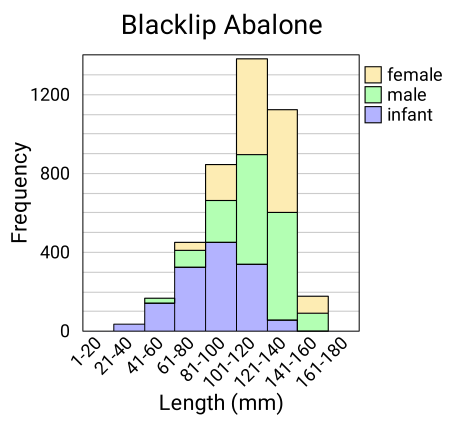
In some cases, scientists use visual representations that go beyond the three types of plots discussed in this lesson. For example, the report about the blacklip abalones also contains data about their sex. This can be used to present a summary of the length in a stacked histogram.
Representing One Variable Data
Exercises
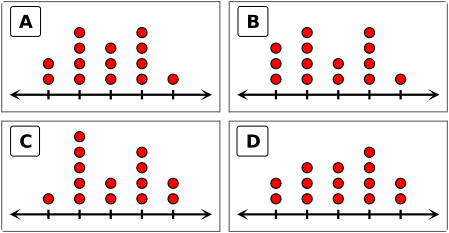
Ignacio is a math teacher. On Friday, he gave a pop quiz to each of his classes and plans to give the results to each class on Monday. On Friday night, he wrote the results for each class on different paper slips that look like the following image. He also made dot plots to match each paper slip.
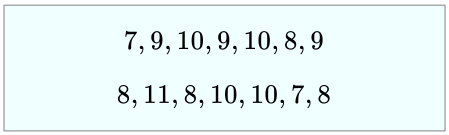
He ran into a huge problem over the weekend — he left the paper slips in his pocket while doing laundry! The box plots are safe, but only the paper slip above still shows the results. That sole surviving paper slip matches one of the following box plots.
{"type":"choice","form":{"alts":["A","B","C","D"],"noSort":true},"formTextBefore":"","formTextAfter":"","answer":0}
security
report
code
security
report
code
To draw the dot plot, we must count the number of times each observation occurs. To make this easier, we can start by arranging the data set in ascending order. 7,7,8,8,8,8,9,9,9,10,10,10,10,11 Now we will count how many times each observation occurs. |c|c| Value & # of Observations 7 & 2 8 & 4 9 & 3 10 & 4 11& 1 The number of observations of a value is represented by the number of dots over that value. For example, over the value 7, there should be 2 dots.
Compare this dot plot to the options. It matches with A.
security
report
code
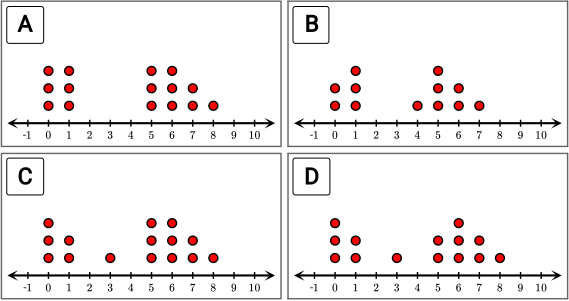
Consider the following data set. 8,6,0, 1, 5, 3,7,5 1,6,0,6,5,7,0 Which dot plot corresponds to the data set?
{"type":"choice","form":{"alts":["A","B","C","D"],"noSort":true},"formTextBefore":"","formTextAfter":"","answer":2}
security
report
code
security
report
code
To determine which is the correct dot plot, let's draw the one corresponding to the given data. To do so, we will count the number of times that each observation occurs. |c|c| Value & # of observations 0 & 3 1 & 2 3 & 1 5& 3 6& 3 7& 2 8& 1 When we draw the dot plot, we will let the number of observations of a certain value be represented by the number of dots over that value. For example, over the value 0 we place 3 dots.
If we compare this dot plot to the alternatives, we see that it matches with C.
security
report
code
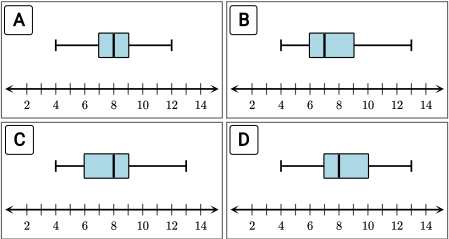
Ignacio's students wrote the lengths of earthworms in centimeters written in ascending order. 4.0,5.2,6.0,7.0,7.1, 8.0,8.2,8.8,9.0,12.0,13.0 Which of the following box plots represents this data set?
{"type":"choice","form":{"alts":["A","B","C","D"],"noSort":true},"formTextBefore":"","formTextAfter":"","answer":2}
security
report
code
security
report
code
To determine which is the correct box plot, let's draw the one corresponding to the given data set. Find the following information. Minimum Value Lower Quartile Median Upper Quartile Maximum Value These values are more clear to find when the set is written in ascending order. Luckily, it already is. Let's begin and determine the median. This is the middle value of the data set.
Median
Since the data set has 11 observations, which is an odd number, the 6^(th) observation must be the median. We will then have an equal number of observations on the left and right sides of the median.
It helps to organize the values in a table. |c|c| [-0.8em] Observation(s) & Data [0.3em] [-0.8em] 1^(st) - 5^(th) & 4.0, 5.2, 6.0, 7.0, 7.1 [0.3em] [-0.8em] Median & 8.0 [0.3em] [-0.8em] 7^(th) - 11^(th) & 8.2, 8.8, 9.0, 12.0, 13.0 [0.3em]
Quartiles
Next, determine the lower and upper quartile by finding the middle observation of the values that are to the left and right of the median. Since the number of observations in each half is odd, the quartiles will be the third and ninth observations, respectively.
Reorganize the table to show the quartiles. This table also shows the minimum and maximum values. |c|c| [-0.8em] Observation(s) & Data [0.3em] [-0.8em] Minimum Value & 4.0 [0.3em] [-0.8em] 2^(nd) & 5.2 [0.3em] [-0.8em] Lower Quartile & 6.0 [0.3em] [-0.8em] 4^(th) and 5^(th) & 7.0, 7.1 [0.3em] [-0.8em] Median & 8.0 [0.3em] [-0.8em] 7^(th) and 8^(th) & 8.2, 8.8 [0.3em] [-0.8em] Upper Quartile & 9.0 [0.3em] [-0.8em] 10^(th) & 12.0 [0.3em] [-0.8em] Maximum Value & 13.0 [0.3em]
Drawing the Box Plot
Use the values in the table to draw the box plot.
Finally, compare this box plot with the four given ones. The correct option is C.
security
report
code
A chain of restaurants called Wing Wings is known for their tasty chicken wings, of course. It is their secret sauce that makes them both super tasty and have a high calorie count. A dietitian, who wants to bring down the chain, analyzed one wing every day for 31 consecutive days.
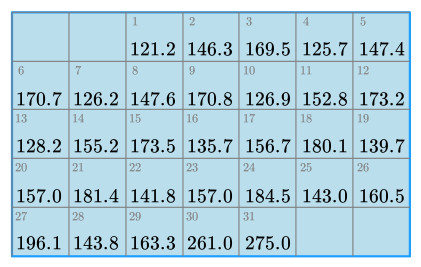
Which of the following histograms represents the data collected by the dietitian?
![Four different histograms. The bottom labels are [120-140,140-160,160-180,180-200,200-220,220-240,240-260,260-280]. The heights of the bars are: Option A = [8,10,7,4,0,0,1,2], OptionB = [7,11,7,4,0,0,0,2], OptionC = [7,11,7,4,0,0,0,3], and OptionD = [7,10,7,5,0,1,0,2].](/mediawiki/images/4/43/Mljsx_Exercise_2566_00.svg)
{"type":"choice","form":{"alts":["A","B","C","D"],"noSort":true},"formTextBefore":"","formTextAfter":"","answer":1}
security
report
code
security
report
code
To determine which is the correct histogram, let's draw the one representing the data collected by the dietitian. To do this, first, let's organize the data in a table starting at 120 and with intervals of 20.
| Interval | Observations | Count |
|---|---|---|
| 120-140 | 121.2, 125.7, 126.2, 126.9, 128.2, 135.7, 139.7 |
7 |
| 140-160 | 141.8, 143.0, 143.8, 146.3, 147.4, 147.6, 152.8, 155.2, 156.7, 157.0, 157.0 |
11 |
| 160-180 | 160.5, 163.3, 169.5, 170.7, 170.8, 173.2, 173.5 |
7 |
| 180-200 | 180.1, 181.4, 184.5, 196.1 | 4 |
| 200-220 | 0 | |
| 220-240 | 0 | |
| 240-260 | 0 | |
| 260-280 | 261.0, 275.0 | 2 |
Now that we know the number of observations in each interval, we can draw the histogram.
Comparing this histogram with the given options, the correct choice is B.
security
report
code
Consider the following box plot.
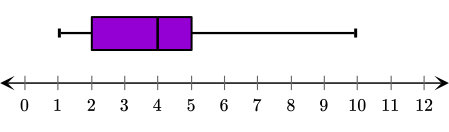
Use the box plot to find the required measure.
{"type":"text","form":{"type":"math","options":{"comparison":"1","nofractofloat":false,"keypad":{"simple":true,"useShortLog":false,"variables":["x"],"constants":["PI"]},"rendered":false},"text":" "},"formTextBefore":null,"formTextAfter":null,"answer":{"text":["1"]}}
{"type":"text","form":{"type":"math","options":{"comparison":"1","nofractofloat":false,"keypad":{"simple":true,"useShortLog":false,"variables":["x"],"constants":["PI"]},"rendered":false},"text":" "},"formTextBefore":null,"formTextAfter":null,"answer":{"text":["10"]}}
{"type":"text","form":{"type":"math","options":{"comparison":"1","nofractofloat":false,"keypad":{"simple":true,"useShortLog":false,"variables":["x"],"constants":["PI"]},"rendered":false},"text":" "},"formTextBefore":null,"formTextAfter":null,"answer":{"text":["5"]}}
{"type":"text","form":{"type":"math","options":{"comparison":"1","nofractofloat":false,"keypad":{"simple":true,"useShortLog":false,"variables":["x"],"constants":["PI"]},"rendered":false},"text":" "},"formTextBefore":null,"formTextAfter":null,"answer":{"text":["2"]}}
{"type":"text","form":{"type":"math","options":{"comparison":"1","nofractofloat":false,"keypad":{"simple":true,"useShortLog":false,"variables":["x"],"constants":["PI"]},"rendered":false},"text":" "},"formTextBefore":null,"formTextAfter":null,"answer":{"text":["4"]}}
security
report
code
security
report
code
The least value, or minimum value, of a box plot is given by the end of the left whisker.
As we can see, the minimum value is 1.
The greatest value, or maximum value, is given by the end of the right whisker of the box plot.
The maximum value is 10.
The third quartile in a box plot is marked by the end of the box. The third quartile is also written as Q_3.
As we can see, the third quartile is 5.
The first quartile of a box plot is marked by the start of the box. The first quartile can also be written as Q_1.
The first quartile is 2.
The median of a box plot is given by the vertical line that is found inside of the box.
The median is 4.
security
report
code
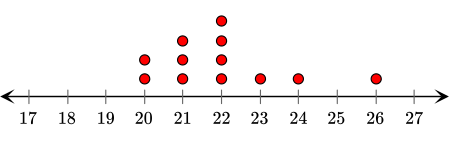
Kris is a high school student who is thinking about which classes to take. The boxplot below represents the number of students in each class.
{"type":"text","form":{"type":"math","options":{"comparison":"1","nofractofloat":false,"keypad":{"simple":true,"useShortLog":false,"variables":["x"],"constants":["PI"]},"rendered":false},"text":" "},"formTextBefore":null,"formTextAfter":null,"answer":{"text":["12"]}}
{"type":"text","form":{"type":"math","options":{"comparison":"1","nofractofloat":false,"keypad":{"simple":true,"useShortLog":false,"variables":["x"],"constants":["PI"]},"rendered":false},"text":" "},"formTextBefore":null,"formTextAfter":null,"answer":{"text":["26"]}}
{"type":"text","form":{"type":"math","options":{"comparison":"1","nofractofloat":false,"keypad":{"simple":true,"useShortLog":false,"variables":["x"],"constants":["PI"]},"rendered":false},"text":" "},"formTextBefore":null,"formTextAfter":null,"answer":{"text":["22"]}}
{"type":"text","form":{"type":"math","options":{"comparison":"1","nofractofloat":false,"keypad":{"simple":true,"useShortLog":false,"variables":["x"],"constants":["PI"]},"rendered":false},"text":" "},"formTextBefore":null,"formTextAfter":null,"answer":{"text":["22"]}}
security
report
code
security
report
code
The number of classes that Kriz is taking is given by the number of dots in the dot plot. Let's count them.
By adding the number of observations, we can determine how many classes Kriz is taking. 2+3+4+1+1+1=12 Kriz is taking 12 classes.
The greatest number of students is given by the observation we find furthest to the right in the dot plot.
The greatest number of students is 26.
The most common number of students in the classes is the value with the greatest number of observations in the dot plot.
The most common number of students is 22.
To calculate the average number of students per class we must divide the total number of students in all of his classes with the number of classes. Average=Number of students/Number of classes Therefore, we must first add up the number of students.
Now we can calculate the average.
The average number of students per class is 22.
security
report
code
Representing One Variable Data
Recommended exercises
To get personalized recommended exercises, please login first.
Loading content
≤
>
■2
■▢
e▢
7
8
9
×
÷■1
=
=
√▢
▢√
∫▢▢
4
5
6
+
−
≤
<
log
ln
log▢
1
2
3
()
∣
sin
cos
tan
0
.
π
x
y
Loading content