3. Percents
Sign In
An error ocurred, try again later!
Chapter 2
3.
Percents
Navigating the world of percents can seem daunting, but this lesson simplifies the subject by teaching how to convert between different forms of numbers and percents. The lesson delves into real-life applications, such as calculating discounts during sales or determining fat content in food. Whether one is a student aiming to excel in a math test or an individual looking to understand percentages in daily life, this lesson offers invaluable insights. It covers everything from the basics of what a percent is, to more complex conversions involving mixed numbers and fractions. By the end, individuals will be equipped to handle any percent-related challenge that comes their way.
Show less Show more expand_more 


Lesson Settings & Tools
| | 17 Theory slides |
| | 11 Exercises - Grade E - A |
| | Each lesson is meant to take 1-2 classroom sessions |
Percents
Slide of 17
Percents can be seen in numerous daily situations all over the world because they are an easy way to express and relate data. This lesson will focus on converting different forms of numbers into percents and vice versa. The lesson will also show how percents appear in everyday life.
Catch-Up and Review
Here are a few recommended readings before getting started with this lesson.
Challenge
Share
Report error
Phone's Battery Level
A sudden loud sound coming from Paulina's phone wakes her up. It iss 6:00 AM and time to start getting ready for school. When she looks at her phone, Paulina realizes that she forgot to charge it the night before. The battery is at only 14 %!
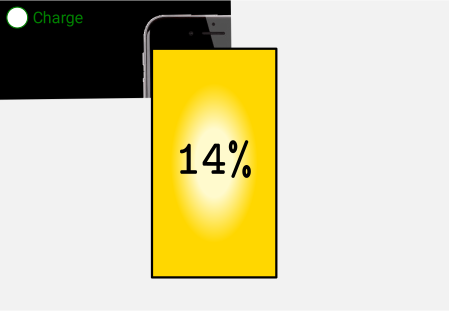 She connects her phone to a charger and starts getting ready.
External credits: @jannoon028
a What fraction in its simplest form expresses the current battery level?
{"type":"text","form":{"type":"math","options":{"comparison":"1","nofractofloat":false,"keypad":{"simple":true,"useShortLog":false,"variables":[],"constants":[]},"rendered":false},"text":" "},"formTextBefore":null,"formTextAfter":null,"answer":{"text":["\\dfrac{7}{50}"]}}
b Paulina disconnects her phone as soon as she is ready to go to school. The battery is charged up to 56 of its capacity. What percent does Paulina see on the screen?
{"type":"text","form":{"type":"math","options":{"comparison":"1","nofractofloat":false,"keypad":{"simple":true,"useShortLog":false,"variables":[],"constants":[]},"rendered":false},"text":" "},"formTextBefore":null,"formTextAfter":"%","answer":{"text":["83"]}}
Discussion
Share
Report error
Percents
A percent is the ratio of a number to 100. Percents are usually denoted by the symbol %.
p% = p/100
For example, five percent is the ratio of 5 to 100. This number can also be written as 5%. 5% = 5/100 Percentages are often used in real-life situations. For example, saline is a mixture of salt and water used to clean and store contact lenses. Saline contains 0.9 % salt. This means that every 100 grams of saline contains 0.9 grams of salt. 0.9 % = 0.9/100 Another situation in which percentages can be used is sales. For example, if a jacket is on sale, a store may advertise that it is 20 % off. Then, the price has been lowered by 20 %. If the jacket originally cost $100, then the price was lowered by $ 20.
20 % = 20/100Discussion
Share
Report error
Converting Fractions Into Percents
It is possible to convert a fraction into a percent and vice versa. Consider the following fraction.
14/87
This fraction can be rewritten as a percent by following two steps.
Note that the order of these two steps can be reversed. In other words, the fraction can be multiplied by 100 first, before calculating the quotient of the numerator by the denominator.
1
Divide the Numerator by the Denominator
expand_more First, divide the numerator by the denominator. In this case, the numerator is 14 and the denominator is 87. The procedure of long division can be used to divide up to four decimal places.
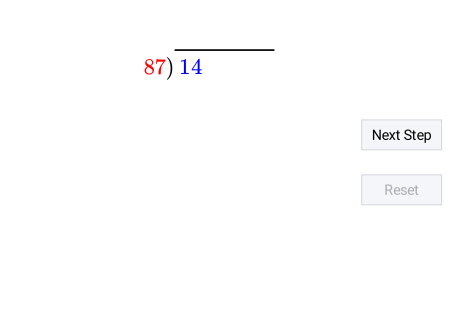 The quotient is 0.1609. This is the decimal equivalent of the fraction.
2
Multiply by 100
expand_more Next, multiply the result by 100 to convert it to percent. Note that multiplying a decimal number by 100 comes down to moving the decimal point two places to the right.
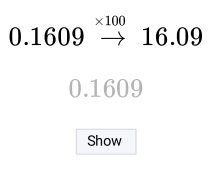 The result is 16.09, which can be rounded to 16.1. Finally, add a percent sign after the number. 14/87≈ 16.1 %
Therefore, the fraction represents about 16.1 %.
The result is 16.09, which can be rounded to 16.1. Finally, add a percent sign after the number. 14/87≈ 16.1 %
Therefore, the fraction represents about 16.1 %.
Extra
Converting Different FractionsInput a fraction whose numerator and denominator are less than 100. Then, click 
Submit and Convertto see how it can be converted into a percent. In this applet, the fraction will be multiplied by 100 first.
Example
Share
Report error
Getting the Test Score
Paulina's first class is math. The teacher gives everyone back their graded papers from last Thursday's test. Paulina is thrilled to see that she got 23 answers correctly.
{"type":"text","form":{"type":"math","options":{"comparison":"1","nofractofloat":false,"keypad":{"simple":true,"useShortLog":false,"variables":[],"constants":[]},"rendered":false},"text":" "},"formTextBefore":null,"formTextAfter":"%","answer":{"text":["92"]}}
Hint
Which number is the total and which is the part of the total? Use the definition of a percent.
Solution
It is given that Paulina answered 23 out of 25 questions correctly. This information will be used to first write a fraction. Since the total number of questions is 25, this is the denominator. The number of answers Paulina got correct is 23, which represents a part of 25, so it is the numerator.
23/25
Now this fraction can be expressed as a percent. Start by writing it as a fraction with a denominator of 100. Note that 25 is a factor of 100.
25* 4=100
This means that multiplying the numerator and denominator by 4 will result in an equivalent fraction with a denominator of 100.
Recall the definition of a percent — the ratio of a number to 100.
n % =n/100
This means that the fraction represents 92 %.
92/100=92 %
Therefore, Paulina did score more than 90 % on the math test. Great job!
Alternative Solution
Fraction 2325 represents the number of correct answers Paulina got on the test. This number can be rewritten as a percent by following two steps. First, divide the numerator by the denominator by using long division.
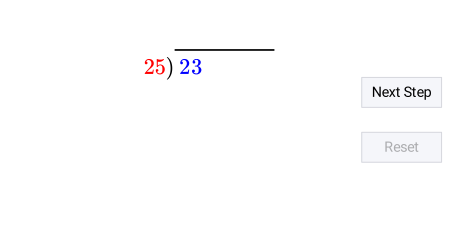 The quotient is 0.92. Next, multiply this decimal number by 100 to write it as a percent. This can be done by moving the decimal point two places to the right.
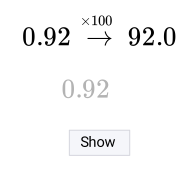 The product is 92.0, or 92. By adding a percent sign, it can be concluded that Paulina got 92 % of the answers correct on her math test.
Discussion
Share
Report error
Converting Percents Into Fractions
It is possible to convert a percent into a fraction and the other way around. Consider the following percent.
48 %
This percent can be written as a fraction by following two steps.
1
Write as a Fraction Whose Denominator Is 100
expand_more Since a percent is the ratio of a number to 100, write it as a fraction whose numerator is the number part of the percent and whose denominator is 100. 48 %=48/100
2
Simplify the Fraction
expand_more Next, check whether the fraction can be simplified. First, split the numerator and denominator into prime factors. This process is shown below for 48100. 48 & = 2* 2* 2* 2* 3 100 & = 2* 2* 5* 5
The numbers share two common factors. Their product is the greatest common factor (GCF) of 48 and 100.
GCF(48,100)=2* 2=4
Finally, divide both the numerator and denominator by 4.
The fractions 1225 and 48100 are equivalent and they both correspond to 48 %.
Extra
Converting Different Percents Between 1 and 100Input a percent that is an integer between 1 and 100. The process of converting this percent into a fraction will be demonstrated.
Example
Share
Report error
Choosing Between Two Lunch Options
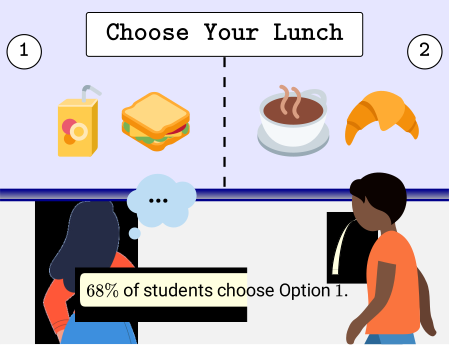
It is lunch time! Paulina and her friends go to the school cafeteria. She is trying to decide between juice and a sandwich or soda and a taco. What a hard decision! Her good know-it-all friend Davontay interrupts her thoughts with an interesting fact.
External credits: @pch.vector
Paulina is curious about how many students out of 25 would choose different options, if this statistic were in fact true.
a What fraction in simplest form corresponds to the percent of students choosing Option 2?
{"type":"text","form":{"type":"math","options":{"comparison":"1","nofractofloat":false,"keypad":{"simple":true,"useShortLog":false,"variables":[],"constants":[]},"rendered":false},"text":" "},"formTextBefore":null,"formTextAfter":null,"answer":{"text":["\\dfrac{8}{25}"]}}
b How many students out of 25 would choose Option 1?
{"type":"text","form":{"type":"math","options":{"comparison":"1","nofractofloat":false,"keypad":{"simple":true,"useShortLog":false,"variables":[],"constants":[]},"rendered":false},"text":" "},"formTextBefore":null,"formTextAfter":"students","answer":{"text":["17"]}}
Hint
a Calculate what percent corresponds to the number of students choosing Option 2. Use the definition of a percent.
b Think about what the numerator and denominator of the fraction represent.
Solution
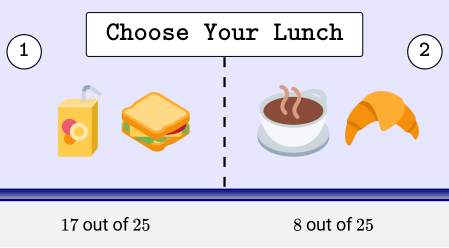
a Davontay said that 68 % of students choose Option 1 for lunch. Let 100 % represent all students in their school. Subtract 68 % from 100 % to find how many students choose Option 2.
b In Part A, it was found that 825 students prefer Option 2 for lunch. This fraction means that 8 students out of 25 would choose the soda and taco. This leaves 25-8=17 students who prefer Option 1.
External credits: @pch.vector
After realizing this, Paulina decides to go for Option 2. Gotta show some love to the soda and taco! 😄
Pop Quiz
Share
Report error
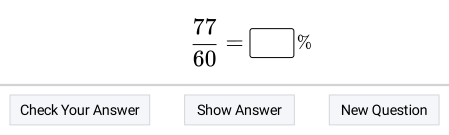
Converting Between Percents and Simplified Fractions
Discussion
Share
Report error
Converting Mixed Numbers Into Percents
It is possible to convert a mixed number into a percent and the other way around. Consider the following mixed number.
7 29
This mixed number can be rewritten into a percent by following three steps.
1
Convert the Fraction Part to a Decimal
expand_more The fraction part of 7 29 is 29. To rewrite it as a decimal, divide the numerator 2 by the denominator 9 by using long division.
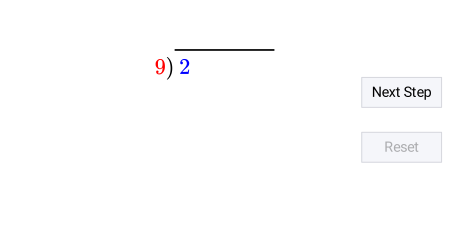 The quotient is approximately 0.22. Note that it is often enough to divide to two decimal places.
2
Add the Decimal to the Integer Part
expand_more The integer part of the mixed number is 7. In the previous step, the fraction part 29 was rewritten as the decimal number 0.22. Add the integer part and the decimal part. 7+0.22=7.22 The mixed number can be written as the decimal number 7.22.
3
Convert the Decimal to a Percent
expand_more Rewrite the decimal as a percent by multiplying it by 100 and adding a percent sign. 7.22* 100=722 % Therefore, 7 29 corresponds to 722 %.
Discussion
Share
Report error
Converting Percents Into Mixed Numbers
It is possible to convert a percent into a mixed number and the other way around. Keep in mind that if a percent less than 100 % is converted into a fraction, then the result is a proper fraction. This means that it only makes sense to convert percents greater than 100 % into mixed numbers. Consider the following percent.
234 %
This percent can be rewritten into a mixed number by following three steps.
1
Write the Percent as a Fraction With 100 as Denominator
expand_more Recall that a percent is the ratio of a number to 100. Start by writing the percent as a fraction whose numerator is the number part of the percent and whose denominator is 100. 234 % = 234/100
2
Divide the Numerator by the Denominator
expand_more Divide the numerator by the denominator to rewrite the improper fraction 234100 as a mixed number. Use long division to find the quotient and remainder.
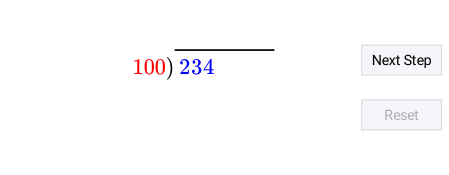 The quotient is 2 and the remainder is 34. Write the quotient 2 as the integer part of the mixed number and the remainder 34 as the numerator of the fraction part. Remember that the denominator of the fraction part is the same as the denominator of the improper fraction, 100.
234/100= 2 34 100
The quotient is 2 and the remainder is 34. Write the quotient 2 as the integer part of the mixed number and the remainder 34 as the numerator of the fraction part. Remember that the denominator of the fraction part is the same as the denominator of the improper fraction, 100.
234/100= 2 34 100
3
Simplify the Fraction Part
expand_more The final step is to simplify the fraction part. Find the gretest common factor (GCF) of the numerator and denominator by splitting 34 and 100 into prime factors.
34 &= 2* 17 100 &= 2* 2* 5* 5
The numbers share only one common factor, 2. This means that 2 is the GCF of 34 and 100. Divide the numerator and the denominator by 2.
Finally, the mixed number that corresponds to 234 % can be written.
234 % =2 1750
Example
Share
Report error
Learning a New Dance Routine
After school, Paulina goes to her dance class. She and her partner learn a couple of new moves that keep them on their toes!
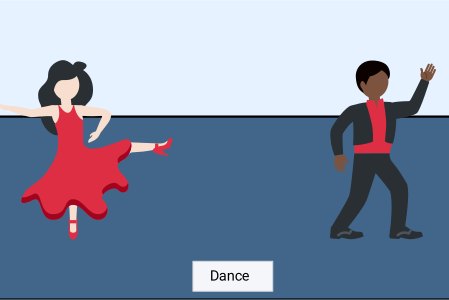 At the end of the lesson, Paulina checks her fitness tracker and discovers that she completed 235 % of her daily activity goal.
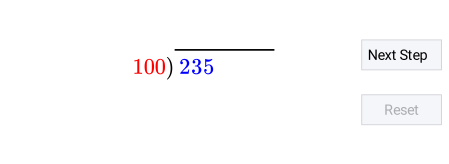 The quotient is 2, so this is the integer part of the mixed number. The remainder is 35, which makes it the numerator of the fraction part. The denominator of the fraction part of the mixed number is the same as the denominator of the fraction.
235/100= 2 35 100
Finally, simplify the fraction part. Begin by splitting the numerator and denominator into prime factors.
35&= 5* 7 100&=2* 2* 5* 5
The numbers share only one common factor, 5. This means that this is their greatest common factor (GCF). Simplify the fraction by dividing its numerator and denominator by their GCF.
The percent of 235 corresponds to the mixed number of 2 720.
The quotient is 2, so this is the integer part of the mixed number. The remainder is 35, which makes it the numerator of the fraction part. The denominator of the fraction part of the mixed number is the same as the denominator of the fraction.
235/100= 2 35 100
Finally, simplify the fraction part. Begin by splitting the numerator and denominator into prime factors.
35&= 5* 7 100&=2* 2* 5* 5
The numbers share only one common factor, 5. This means that this is their greatest common factor (GCF). Simplify the fraction by dividing its numerator and denominator by their GCF.
The percent of 235 corresponds to the mixed number of 2 720.
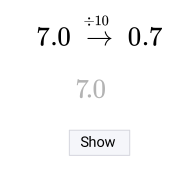 Now, add the integer part 1 and the decimal part 0.7. This gives the decimal number 1.7.
1 710=1.7
Finally, multiply the number by 100 to rewrite it as a percent. Remember to include a percent sign!
1.7* 100=170 %
Therefore, the mixed number 1 710 is equivalent to 170 %.
Now, add the integer part 1 and the decimal part 0.7. This gives the decimal number 1.7.
1 710=1.7
Finally, multiply the number by 100 to rewrite it as a percent. Remember to include a percent sign!
1.7* 100=170 %
Therefore, the mixed number 1 710 is equivalent to 170 %.
a What mixed number corresponds to this percent?
{"type":"text","form":{"type":"math","options":{"comparison":"1","nofractofloat":false,"keypad":{"simple":true,"useShortLog":false,"variables":[],"constants":[]},"rendered":false},"text":" "},"formTextBefore":null,"formTextAfter":null,"answer":{"text":["2\\frac{7}{20}"]}}
b Paulina's partner has completed 1 710 of his daily activity goal. What percent corresponds to this mixed number?
{"type":"text","form":{"type":"math","options":{"comparison":"1","nofractofloat":false,"keypad":{"simple":true,"useShortLog":false,"variables":[],"constants":[]},"rendered":false},"text":" "},"formTextBefore":null,"formTextAfter":"%","answer":{"text":["170"]}}
Hint
a Rewrite the fraction as a mixed number by dividing the numerator by the denominator by using long division.
Solution
a In order to rewrite 235 % as a mixed number, start by recalling the definition of a percent. A percent is the ratio of a number to 100.
b This time the mixed number 1 710 should be written as a percent. The fraction part is 710. Divide the numerator by the denominator to write it as a decimal. Since the denominator is 10, move the decimal point one place to the left.
Pop Quiz
Share
Report error
Converting Between Percents and Mixed Numbers
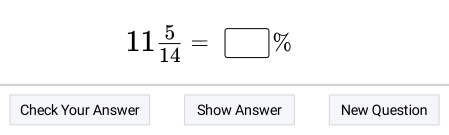
Convert the given percent into its equivalent mixed number or the given mixed number into a percent. Write the fraction part of a mixed number in simplest form. Round the percent to the nearest integer.
Discussion
Share
Report error
Converting Decimal Numbers Into Percents
It is possible to convert a decimal number into a percent and vice versa. Consider the following decimal number.
5.71
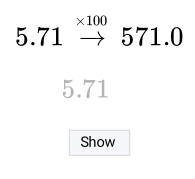
This decimal can be rewritten as a percent by multiplying it by 100 and adding the percent sign.
1
Multiply the Decimal Number by 100
expand_more The multiplication can be done by moving the decimal point two places to the right.
2
Add a Percent Sign
expand_more Once the decimal number has been multiplied by 100, the percent sign can be added.
 Therefore, the decimal number 5.71 is equivalent to 571 %.
Example
Share
Report error
Impressive Honey Harvest
After dance class — what a workout! — Paulina decides to stop by her granddad's house. She finds him in the garden collecting honey from his bee hives.
 Paulina likes watching how hard the bees work to make this delicacy. Her grandpa proudly tells her that he has already collected 1.58 times more honey than the same month last year.
 The decimal number 1.58 corresponds to 158 %. This number implies that Paulina's grandpa collected 158 % of the amount of honey he harvested in the same month last year.
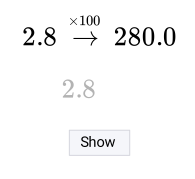 Therefore, the product is 280.0, or just 280.
 As shown, 2.8 is equivalent to 280 %. This number means that Paulina's grandpa collected 280 % of last year's harvest. Since the last year's harvest is represented by 100 %, this means that this year the harvest almost tripled. What an impressive result!
a Express 1.58 in percent form.
{"type":"text","form":{"type":"math","options":{"comparison":"1","nofractofloat":false,"keypad":{"simple":true,"useShortLog":false,"variables":[],"constants":[]},"rendered":false},"text":" "},"formTextBefore":null,"formTextAfter":"%","answer":{"text":["158"]}}
b When the year comes to an end, grandpa calculates that in total he collected 2.8 times more honey this year compared to the last year. What percent does this number correspond to?
{"type":"text","form":{"type":"math","options":{"comparison":"1","nofractofloat":false,"keypad":{"simple":true,"useShortLog":false,"variables":[],"constants":[]},"rendered":false},"text":" "},"formTextBefore":null,"formTextAfter":"%","answer":{"text":["280"]}}
Hint
a Multiply the decimal number by 100 and add a percent sign.
b Multiply the decimal number by 100 and add a percent sign.
Solution
a To rewrite the decimal number 1.58 as a percent, multiply the number by 100 and add a percent sign.
b Now the decimal number 2.8 will be rewritten as a percent. To do so, multiply by 100 and add a percent sign afterwards. An easy way to do this is by moving the decimal point two places to the right.
Discussion
Share
Report error
Converting Percents Into Decimal Numbers
It is possible to convert a percent into a decimal number and the other way around. Consider the following percent.
93 %
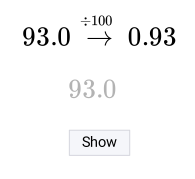
This percent can be rewritten as a decimal number by dividing it by 100 and removing the percent sign.
1
Divide the Percent by 100
expand_more To divide by 100, the decimal point can be moved two places to the left. Do not forget to write a 0 to the left of the decimal point if there is no number to its left after moving it.
2
Remove the Percent Sign
expand_more Once the number has been divided by 100, the percent sign has to be removed.
 Therefore, 93 % is equivalent to 0.93.
Example
Share
Report error
Foods Containing Percents
When Paulina comes home, she opens the fridge and starts to look for something to eat. She notices that some of the foods have percents written on them.
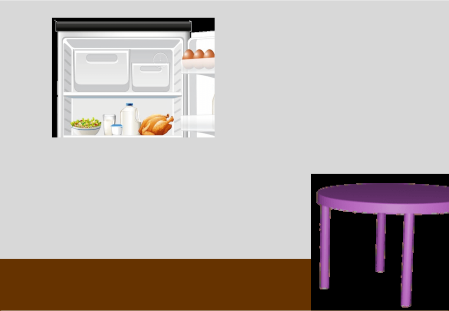
External credits: @brgfx
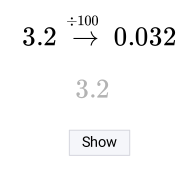
a The first thing that Paulina sees is a bottle of milk. The label says it is 3.2 % fat. What is the decimal form of this percent?
{"type":"text","form":{"type":"math","options":{"comparison":"1","nofractofloat":false,"keypad":{"simple":true,"useShortLog":false,"variables":[],"constants":[]},"rendered":false},"text":" "},"formTextBefore":null,"formTextAfter":null,"answer":{"text":["0.032"]}}
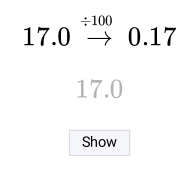
b Paulina is thinking about making some toast. As she pulls out the bread, she notices that it has 17 % fat. What decimal is equivalent to this percent?
{"type":"text","form":{"type":"math","options":{"comparison":"1","nofractofloat":false,"keypad":{"simple":true,"useShortLog":false,"variables":[],"constants":[]},"rendered":false},"text":" "},"formTextBefore":null,"formTextAfter":null,"answer":{"text":["0.17"]}}
Solution
a The bottle of milk in the fridge is 3.2 % fat. This number can be written as a decimal by dividing it by 100. Note that to divide a number by 100, the decimal point should be moved 2 places to the left.

b The bread is 17 % fat. To write it as a decimal, divide the number by 100 by moving its decimal point two places to the left.

Closure
Share
Report error
Calculating the Phone's Battery Level
Remember how the day started? A sudden loud music coming from Paulina's phone woke her up. It was 6:00 AM and time to start getting ready for school. When she looked at her phone, Paulina realized that she forgot to charge her phone. The battery was only at 14 %!
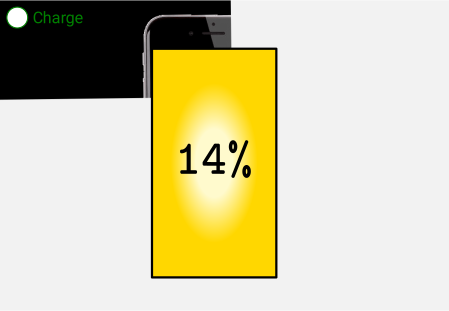 She connected her phone to a charger and started getting ready.
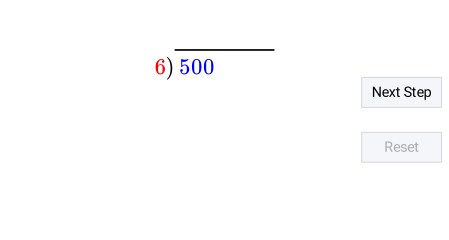 The result is 83.3, which can be rounded to 83. This means that 56 corresponds to about 83 %.
External credits: @jannoon028
a What fraction in its simplest form expresses the current battery level?
{"type":"text","form":{"type":"math","options":{"comparison":"1","nofractofloat":false,"keypad":{"simple":true,"useShortLog":false,"variables":[],"constants":[]},"rendered":false},"text":" "},"formTextBefore":null,"formTextAfter":null,"answer":{"text":["\\dfrac{7}{50}"]}}
b Paulina disconnected her phone as soon as she was ready to go to school. The battery was charged up to 56 of its capacity. What percent did Paulina see on the screen?
{"type":"text","form":{"type":"math","options":{"comparison":"1","nofractofloat":false,"keypad":{"simple":true,"useShortLog":false,"variables":[],"constants":[]},"rendered":false},"text":" "},"formTextBefore":null,"formTextAfter":"%","answer":{"text":["83"]}}
Hint
a Use the definition of a percent. Next, simplify the fraction by dividing its numerator and denominator by their greatest common factor (GCF).
b Multiply the fraction by 100 and then divide the numerator by the denominator by long division.
Solution
a Paulina's phone was at 14 % battery level when she woke up. To express this number as a fraction, recall the definition of a percent.
b Paulina's phone charged to 56 of its capacity. To determine what percent Paulina sees on the screen, express this fraction as a percent. First, multiply the fraction by 100.
Percents
Exercise 1.1
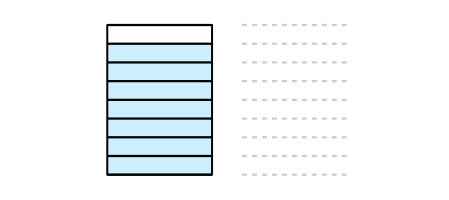
Consider a bar split into some number of parts.
{"type":"text","form":{"type":"math","options":{"comparison":"1","nofractofloat":false,"keypad":{"simple":true,"useShortLog":false,"variables":[],"constants":[]},"rendered":false},"text":" "},"formTextBefore":null,"formTextAfter":null,"answer":{"text":["\\dfrac{7}{8}"]}}
{"type":"text","form":{"type":"math","options":{"comparison":"1","nofractofloat":false,"keypad":{"simple":true,"useShortLog":false,"variables":[],"constants":[]},"rendered":false},"text":" "},"formTextBefore":null,"formTextAfter":"%","answer":{"text":["87.5"]}}
security
report
code
security
report
code
We are asked to express the diagram as a fraction. For this, we need to determine its numerator and denominator. We can find the denominator by counting the total number of parts in the bar.
There are 8 parts in total. This means that the denominator of the fraction is 8. ?/8 Now let's focus on the number of shaded parts to find the numerator. We can see that there are 7 shaded parts. This is the value of the numerator. 7/8 Therefore, we can represent the shaded part of the diagram as the fraction 78.
We found that the fraction 78 represents the given diagram. Let's find the corresponding percent. We can start by dividing the numerator by the denominator by using long division.
The quotient is 0.875. Next, multiply the decimal number by 100 %. For this, move its decimal point two places to the right. 0.875* 100 % =87.5 % This means that 78 is equivalent to 87.5 %. 7/8=87.5 %
security
report
code
Convert each fraction into a percent. Round the answer to one decimal place.
{"type":"text","form":{"type":"math","options":{"comparison":"1","nofractofloat":false,"keypad":{"simple":true,"useShortLog":false,"variables":[],"constants":[]},"rendered":false},"text":" "},"formTextBefore":null,"formTextAfter":"%","answer":{"text":["25.5"]}}
{"type":"text","form":{"type":"math","options":{"comparison":"1","nofractofloat":false,"keypad":{"simple":true,"useShortLog":false,"variables":[],"constants":[]},"rendered":false},"text":" "},"formTextBefore":null,"formTextAfter":"%","answer":{"text":["69.2"]}}
security
report
code
security
report
code
We need to rewrite 1455 as a percent. Let's start by dividing 14 by 55 by using long division. We will divide to four decimal places.
The quotient is 0.2545. Next, multiply this decimal number by 100 by moving the decimal point two places to the right. 0.2545* 100=25.45 Since the last digit is 5, we round the number up to 25.5. Therefore, 1455 is equivalent to about 25.5 %.
We want to rewrite 2739 as a percent. Let's start by dividing 27 by 39 to four decimal places using long division.
The quotient is 0.6923. Next, multiply this number by 100. Since 0.6923 is a decimal number, move the decimal point two places to the right to multiply it by 100. 0.6923* 100=69.23 We can round this number to 69.2. This means that 2739 is about 69.2 %.
security
report
code
Convert each percent into a fraction. Write the fraction in simplest form.
{"type":"text","form":{"type":"math","options":{"comparison":"1","nofractofloat":false,"keypad":{"simple":true,"useShortLog":false,"variables":[],"constants":[]},"rendered":false},"text":" "},"formTextBefore":null,"formTextAfter":null,"answer":{"text":["\\dfrac{21}{50}"]}}
{"type":"text","form":{"type":"math","options":{"comparison":"1","nofractofloat":false,"keypad":{"simple":true,"useShortLog":false,"variables":[],"constants":[]},"rendered":false},"text":" "},"formTextBefore":null,"formTextAfter":null,"answer":{"text":["\\dfrac{7}{25}"]}}
security
report
code
security
report
code
We are asked to rewrite 42 % as a fraction. Let's start by recalling the definition of a percent. It is the ratio of a number to 100. n % = n/100 Let's apply this formula to 42 %. 42 % = 42/100 Now we need to see if we can simplify the fraction. First, let's split the numerator and denominator into prime factors. 42 & = 2* 3* 7 100&= 2* 2* 5* 5 The numbers share only one factor, 2. This is their GCF. GCF(42,100)=2 We will divide the numerator and the denominator by 2 to simplify the fraction.
Therefore, 42 % corresponds to the fraction 2150.
Now let's rewrite 28 % as a fraction. We will start by recalling the definition of a percent again. n % = n/100 Let's apply this formula to 28 %. 28 % = 28/100 Next, we should simplify the fraction. We will start by splitting the numerator and denominator into prime factors. 28 & = 2* 2* 7 100&= 2* 2* 5* 5 The numbers share only two common factors. Their product is the GCF of 28 and 100. GCF(28,100)=2* 2=4 Finally, let's divide the numerator and the denominator by their GCF to simplify the fraction.
Therefore, 28 % is equivalent to the fraction 725.
security
report
code
Convert each decimal number into a percent.
{"type":"text","form":{"type":"math","options":{"comparison":"1","nofractofloat":false,"keypad":{"simple":true,"useShortLog":false,"variables":[],"constants":[]},"rendered":false},"text":" "},"formTextBefore":null,"formTextAfter":"%","answer":{"text":["211"]}}
{"type":"text","form":{"type":"math","options":{"comparison":"1","nofractofloat":false,"keypad":{"simple":true,"useShortLog":false,"variables":[],"constants":[]},"rendered":false},"text":" "},"formTextBefore":null,"formTextAfter":"%","answer":{"text":["50.4"]}}
security
report
code
security
report
code
We are given the decimal number 2.11. Let's rewrite it as a percent by multiplying it by 100. We can do this by moving the decimal point two places to the right.
Remember to add the percent sign at the end!
The decimal number 2.11 corresponds to 211 %.
We need to rewrite the decimal number 0.504 into a percent. Let's begin by multiplying the number by 100. We can do it by moving the decimal point two places to the right.
Then add a percent sign to the product.
Therefore, 0.504 is equivalent to 50.4 %.
security
report
code
Convert each percent into a decimal number.
{"type":"text","form":{"type":"math","options":{"comparison":"1","nofractofloat":false,"keypad":{"simple":true,"useShortLog":false,"variables":[],"constants":[]},"rendered":false},"text":" "},"formTextBefore":null,"formTextAfter":null,"answer":{"text":["0.124"]}}
{"type":"text","form":{"type":"math","options":{"comparison":"1","nofractofloat":false,"keypad":{"simple":true,"useShortLog":false,"variables":[],"constants":[]},"rendered":false},"text":" "},"formTextBefore":null,"formTextAfter":null,"answer":{"text":["6.07"]}}
security
report
code
security
report
code
We are given the percent 12.4 %. Let's rewrite it as a decimal by dividing the number by 100. Note that to divide by 100, we can move the decimal point two places to the left.
Now that we know the quotient, we can write the decimal number that is equivalent to 12.4 %.
Let's rewrite 607 % as a decimal number. We can do this by dividing the number by 100. Move the decimal point two places to the left.
The quotient is 6.07. Therefore, 6.07 is the decimal number that corresponds to 607 %.
security
report
code
Percents
Recommended exercises
To get personalized recommended exercises, please login first.
Loading content
≤
>
■2
■▢
e▢
7
8
9
×
÷■1
=
=
√▢
▢√
∫▢▢
4
5
6
+
−
≤
<
log
ln
log▢
1
2
3
()
∣
sin
cos
tan
0
.
π
x
y
Loading content