First, find the minimum and maximum possible dimensions. Then, find the minimum and maximum possible areas.
About 4.7 %
Practice makes perfect
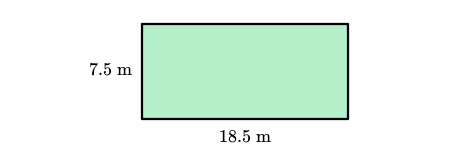
We know that the side lengths of the rectangle shown below have been measured to the nearest half of a meter. We need to find the greatest possible percent error when calculating its area.
When rounding measurements, the maximum error is equal to half of the lowest measuring unit. Thus, when measuring to the nearest half of a meter the maximum error is 0.25 meters. With this in mind, let's calculate the minimum possible dimensions of the rectangle.
Minimum Width:& 7.5-0.25 = 7.25
Minimum Length:& 18.5 -0.25 = 18.25
We can now calculate the minimum possible area by substituting w_(min)= 7.25 m and l_(min)= 18.25 m.
On the other hand, the maximum possible dimensions are as follows.
Maximum Width:& 7.5 +0.25 = 7.75
Maximum Length:& 18.5 +0.25 = 18.75
We can, similarly, calculate the maximum possible area.
We can see that the greater difference happens for the maximum possible area.
6.5625 m^2 > 6.4375 m^2
We will use that difference when calculating the greatest percent error.
Percent Error = ( Greater difference in area/Measured area ) * 100