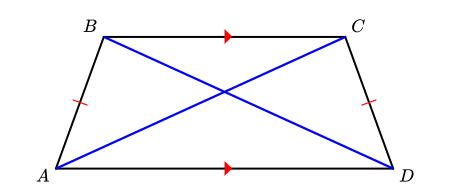
To prove a , the and its must be proven. Start by assuming that a trapezoid is isosceles.
If a Trapezoid Is Isosceles, Then Its Diagonals Are Congruent
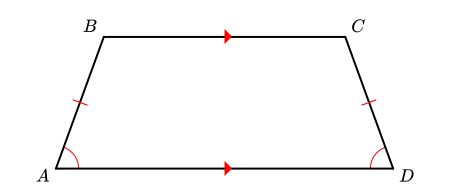
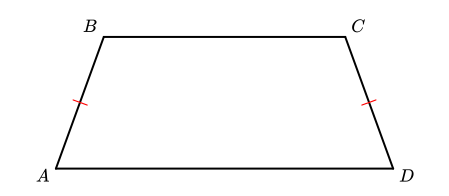
Let ABCD be an isosceles trapezoid with AB≅CD. By the , the base angles are congruent, that is, ∠A≅∠D.
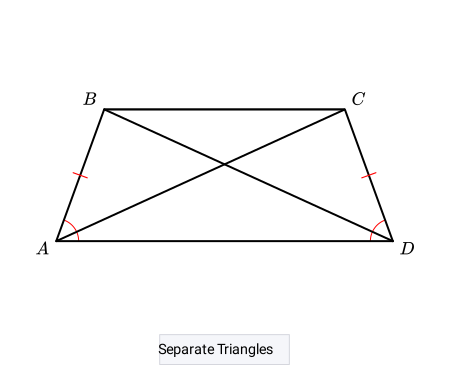
Next, draw the diagonals and separate the triangles
ABD and
DCA. The gives that
AD≅AD.
Notice that
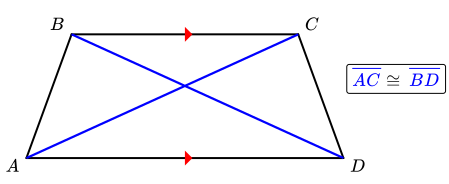
△ABD≅△DCA by the . As a result of that relationship,
AC≅BD. If the Diagonals of a Trapezoid Are Congruent, Then It Is Isosceles
For the converse, consider a trapezoid with congruent diagonals.
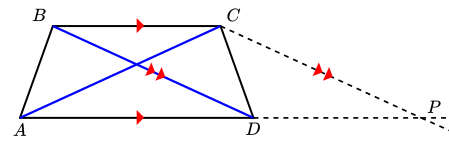
Next, draw a line to BD passing through C and let P be intersection point between this line and AD.
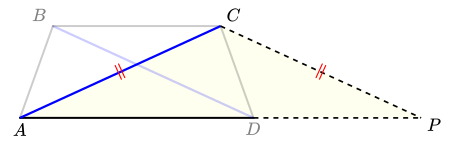
Since AD∥BC and BD∥CP, BCPD is a . Therefore, CP≅BD and then, by the , CP≅AC. This makes △ACP an .
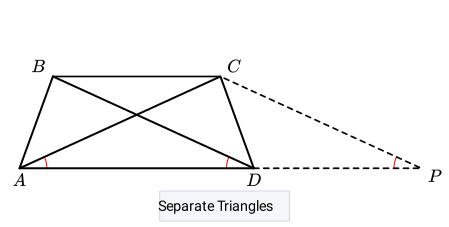
The leads to the conclusion that
∠CAD≅∠CPA. Additionally, the indicates that
∠CPA≅∠BDA. Next, separate triangles
ABD and
DCA.
By the Side-Angle-Side (SAS) Congruence Theorem,
△ABD≅△DCA. This implies that
AB≅CD which makes
ABCD an isosceles trapezoid.