Sign In
| x | y |
|---|---|
| 1 | 33.12 |
| 2 | 24.4 |
| 3 | 16.6 |
| 4 | 9.3 |
| 5 | 3.9 |
The line of best fit can be calculated following these 3 steps.
On a graphing calculator, begin by entering the data points. To do so, press the STAT button and select the option Edit.
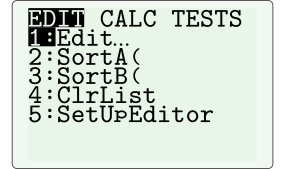
This gives a number of columns, labeled L_1, L_2, L_3, and so on.
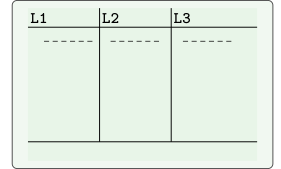
Use the arrow keys to choose where in the lists to fill in the data values. Enter the x-values of the data points in L_1 and press ENTER after each value. The same can be done for the the corresponding y-values in column L_2.
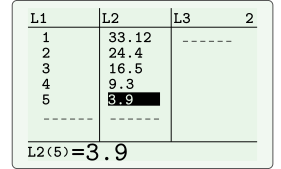
After entering the values, press the STAT button and select the menu item Calc.
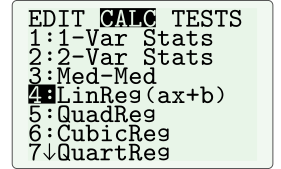
The option LinReg(ax+b)
gives the line of best fit, expressed as a linear function in slope-intercept form. Press the ENTER button until the parameters are given.
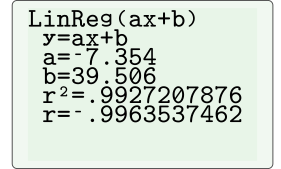
In this case, the line of best fit is described by the function y= - 7.354x + 39.506. The correlation coefficient r is less than - 0.99, indicating a strong negative correlation. If r does not appear, press 2ND and 0 to get to the CATALOG, then select DiagnosticOn
and enable it by pressing ENTER twice. Once more, find the line of best fit.
A graphing calculator can also be used to graph the line of best fit. After selecting the option LinReg(ax+b),
choose the option Store RegEQ.

Press VARS and move to the Y-VARS menu. Then, select the option FUNCTION
and press ENTER.
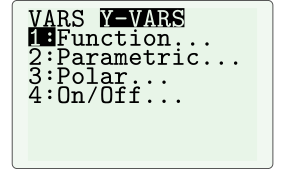
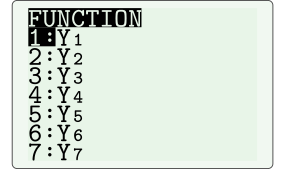
Press the ENTER button until the parameters are given. To graph the scatter plot, first push the buttons 2nd and Y=. Then, choose one of the plots in the list. Select the option ON,
choose the type to be a scatter plot, and assign L_1 and L_2 as XList
and Ylist,
respectively.


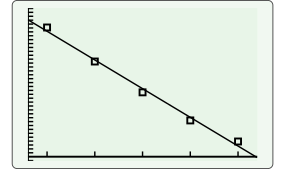
Then, the plot can be made by pressing the button GRAPH. It is possible that after drawing the plot the window-size is not large enough to see all of the information.
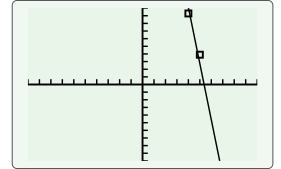
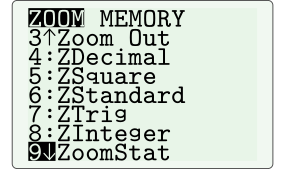
To fix this, press ZOOM and select the option ZoomStat.
After doing that, the window will resize to show the important information.