Sign In
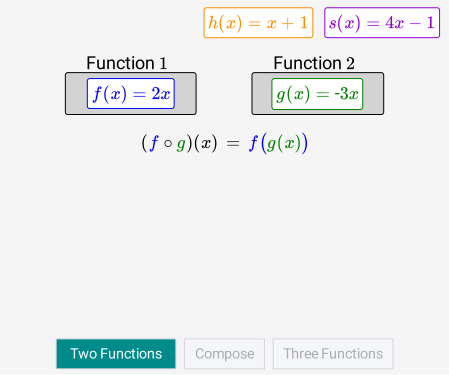
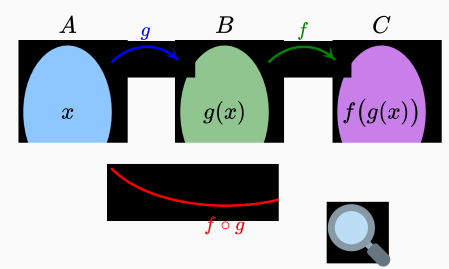
A composite function, or a composition of functions, combines two or more functions, which produces a new function. In a composition, the outputs produced by one function are the inputs of the other function. The composition of the functions f and g is denoted as f(g(x)) or (f∘ g)(x).
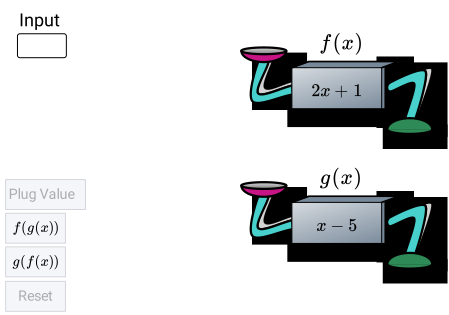
Performing the composition of two functions is similar to evaluating one function into the other. For example, let f(x)=2x+1 and g(x)=x-5. To find f(g(x)), the variable x in f(x)=2x+1 must be substituted with g(x).
x= g(x)
f(g(x))= h(x)
g(x)= x-5
Distribute 2
Add terms
Note that f(g(x)) makes sense only when the outputs of g belong to the domain of f. Also, be aware that the composition of functions is not commutative — that is, in general, f(g(x)) ≠ g(f(x)). This can be checked with the same two functions.
Just as changing the order of the machines in a factory could alter the final product, changing the order in which the functions are applied could produce different outputs. For example, here f(g(2)) and g(f(2)) are different values.