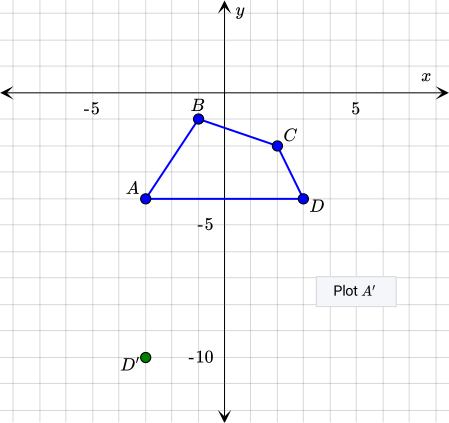
Let's start by plotting the given vertices A(- 3,- 4), B(- 1,- 1), C(2,- 2), and D(3,- 4). Then we will connect them with line segments to draw the quadrilateral.
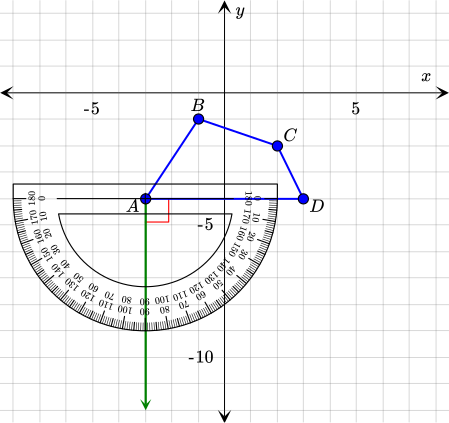
We will now draw the image of ABCD after a 90^(∘) clockwise rotation about vertex A. For simplicity, let's start by rotating only one point. We will use vertex D. To do so, we will use a protractor to draw a ray that makes a 90^(∘) angle with AD at A.
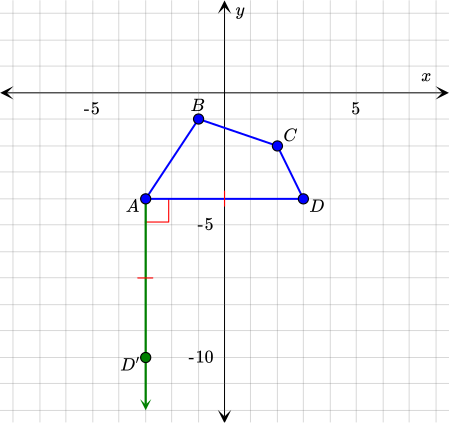
On this ray, we will mark a point D' so that AD' is the same length as AD. This is the image of D after the rotation.
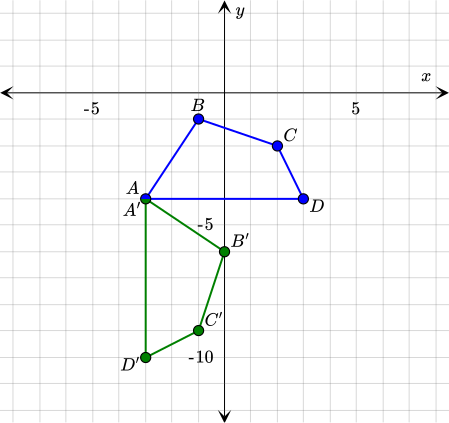
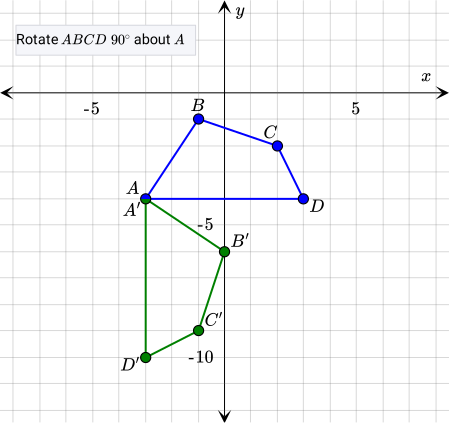
Next, we will repeat the same process for vertices B and C to find B' and C'. Since A is the point at which the quadrilateral is rotated, A' will be in the same position as A. The coordinates of the images of the vertices are A'(-3,-4), B'(0,-6), C'(-1,-9), and D'(-3,-10).
Finally, we will connect A', B', C', and D' to draw the image of ABCD.
Extra
Visualizing the Rotation
Let's rotate ABCD 90^(∘) clockwise about A so that we can see how it is mapped onto A'B'C'D'.