{{ tocSubheader }}
{{ 'ml-label-loading-course' | message }}
An error ocurred, try again later!
Chapter {{ article.chapter.number }}
{{ article.number }}.
{{ article.displayTitle }}
{{ article.intro.summary }}
Show less Show more expand_more Lesson Settings & Tools
| | {{ 'ml-lesson-number-slides' | message : article.intro.bblockCount }} |
| | {{ 'ml-lesson-number-exercises' | message : article.intro.exerciseCount }} |
| | {{ 'ml-lesson-time-estimation' | message }} |
If two quantities are related and one of them varies, then the other quantity will also vary. Depending on the type of relationship they have, the second quantity will vary in a specific way. This lesson will explore the ideas of direct variation and proportional relationships.
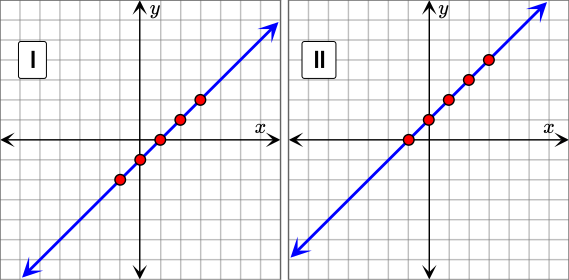
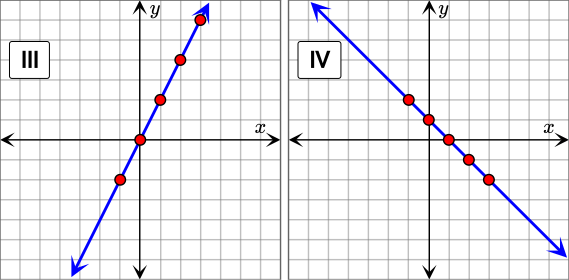 Which of the graphs corresponds to the table?
Catch-Up and Review
Here are a few recommended readings before getting started with this lesson.
- Table of Values
- Making a Table of Values
- Linear Relations
- Graphing a Linear Relation Using a Table of Values
Here are a few practice exercises before getting started with this lesson.
a Consider the table of values.
| x | y=2x+1 |
|---|---|
| 1 | 3 |
| 2 | A |
| 3 | B |
| 4 | 9 |
| 5 | C |
Find the values of A, B, and C.
{"type":"text","form":{"type":"math","options":{"comparison":"1","nofractofloat":false,"keypad":{"simple":true,"useShortLog":false,"variables":[],"constants":[]},"rendered":false},"text":"<span class=\"katex\"><span class=\"katex-html\" aria-hidden=\"true\"><\/span><\/span>"},"formTextBefore":"<b>A<\/b> <span class=\"katex\"><span class=\"katex-html\" aria-hidden=\"true\"><span class=\"base\"><span class=\"strut\" style=\"height:0.36687em;vertical-align:0em;\"><\/span><span class=\"mrel\">=<\/span><\/span><\/span><\/span>","formTextAfter":null,"answer":{"text":["5"]}}
{"type":"text","form":{"type":"math","options":{"comparison":"1","nofractofloat":false,"keypad":{"simple":true,"useShortLog":false,"variables":[],"constants":[]},"rendered":false},"text":"<span class=\"katex\"><span class=\"katex-html\" aria-hidden=\"true\"><\/span><\/span>"},"formTextBefore":"<b>B<\/b> <span class=\"katex\"><span class=\"katex-html\" aria-hidden=\"true\"><span class=\"base\"><span class=\"strut\" style=\"height:0.36687em;vertical-align:0em;\"><\/span><span class=\"mrel\">=<\/span><\/span><\/span><\/span>","formTextAfter":null,"answer":{"text":["7"]}}
{"type":"text","form":{"type":"math","options":{"comparison":"1","nofractofloat":false,"keypad":{"simple":true,"useShortLog":false,"variables":[],"constants":[]},"rendered":false},"text":"<span class=\"katex\"><span class=\"katex-html\" aria-hidden=\"true\"><\/span><\/span>"},"formTextBefore":"<b>C<\/b> <span class=\"katex\"><span class=\"katex-html\" aria-hidden=\"true\"><span class=\"base\"><span class=\"strut\" style=\"height:0.36687em;vertical-align:0em;\"><\/span><span class=\"mrel\">=<\/span><\/span><\/span><\/span>","formTextAfter":null,"answer":{"text":["11"]}}
b Consider the table of values.
| x | y=x+1 |
|---|---|
| -1 | 0 |
| 0 | 1 |
| 1 | 2 |
| 2 | 3 |
| 3 | 4 |
Consider now the following graphs.
{"type":"choice","form":{"alts":["Graph I","Graph II","Graph III","Graph IV"],"noSort":true},"formTextBefore":"","formTextAfter":"","answer":1}
Explore
Moving a Point Along a Line
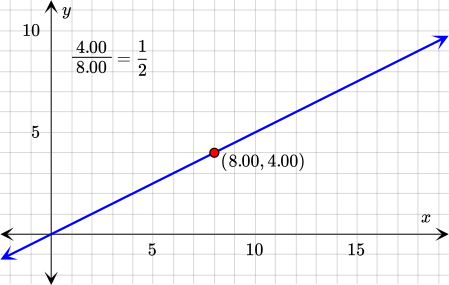
Discussion
Direct Variation
Direct variation, also known as direct proportionality or proportional relationship, occurs when two variables, x and y, have a relationship that forms a linear function passing through the origin.
y=kx
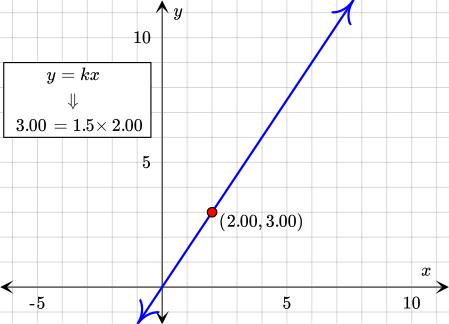
y=kx⇔xy=k
Example
Graphing a Direct Variation
Paulina is selling lemonade to save some money for her summer vacation. For each glass of lemonade she sells, Paulina makes a profit of $0.50. She models this situation with a direct variation.
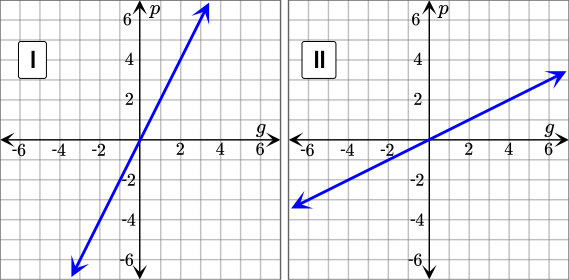
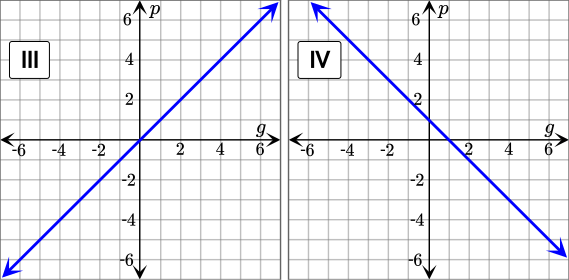 Which of the graphs corresponds to the given direct variation?
Now, the obtained points in the table will be plotted and connected with a straight line.
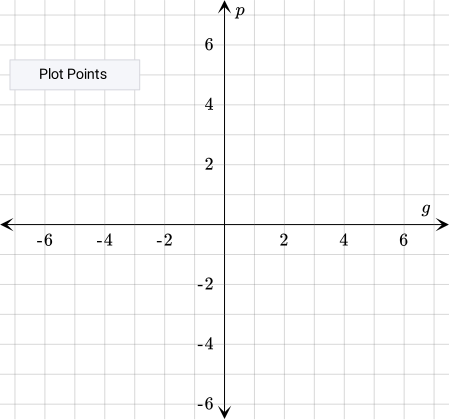 The obtained graph is the same as Graph II. Note that in the context of the situation, negative values of g do not make sense, since Paulina cannot sell a negative number of glasses of lemonade.
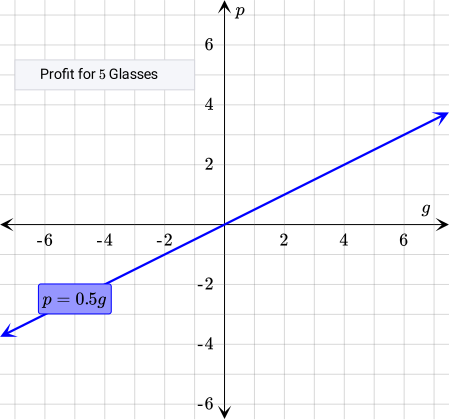 The profit for 5 glasses is $2.50. Note that this can be verified using the equation. To do so, 5 will be substituted for g.
p=0.5g
Here, p is the profit made when g glasses are sold. Also, 0.5 is the constant of variation. a Consider the following graphs.
{"type":"choice","form":{"alts":["Graph I","Graph II","Graph III","Graph IV"],"noSort":true},"formTextBefore":"","formTextAfter":"","answer":1}
b What is Paulina's profit if she sells 5 glasses?
{"type":"text","form":{"type":"math","options":{"comparison":"1","nofractofloat":false,"keypad":{"simple":true,"useShortLog":false,"variables":[],"constants":[]},"rendered":false},"text":"<span class=\"katex\"><span class=\"katex-html\" aria-hidden=\"true\"><\/span><\/span>"},"formTextBefore":"<span class=\"katex\"><span class=\"katex-html\" aria-hidden=\"true\"><span class=\"base\"><span class=\"strut\" style=\"height:0.80556em;vertical-align:-0.05556em;\"><\/span><span class=\"mord\">$<\/span><\/span><\/span><\/span>","formTextAfter":null,"answer":{"text":["2.5","2.50"]}}
Hint
a Draw the graph of the direct variation and compare it with the given graphs.
b Use the graph from Part A.
Solution
a To determine which of the four graphs represents the given direct variation, the graph of p=0.5g will be drawn by making a table of values.
| g | 0.5g | p=0.5g |
|---|---|---|
| 0 | 0.5(0) | 0 |
| 1 | 0.5(1) | 0.5 |
| 2 | 0.5(2) | 1 |
| 3 | 0.5(3) | 1.5 |
| 4 | 0.5(4) | 2 |
b To calculate Paulina's profit when selling 5 glasses of lemonade, the graph from Part A will be used.
p=0.5gsubstitutepp=0.5(5)=2.5 ✓
Example
Writing a Direct Variation
Tadeo is given the following math homework.
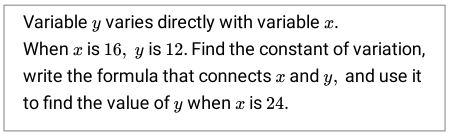
{"type":"text","form":{"type":"math","options":{"comparison":"1","nofractofloat":false,"keypad":{"simple":true,"useShortLog":false,"variables":[],"constants":[]},"rendered":false},"text":"<span class=\"katex\"><span class=\"katex-html\" aria-hidden=\"true\"><\/span><\/span>"},"formTextBefore":"Constant of variation:","formTextAfter":null,"answer":{"text":["0.75","\\dfrac{6}{8}","\\dfrac{3}{4}","\\dfrac{12}{16}"]}}
{"type":"text","form":{"type":"math","options":{"comparison":"1","nofractofloat":false,"keypad":{"simple":false,"useShortLog":false,"variables":["x","y"],"constants":[]},"rendered":false},"text":"<span class=\"katex\"><span class=\"katex-html\" aria-hidden=\"true\"><\/span><\/span>"},"formTextBefore":"Formula:","formTextAfter":null,"answer":{"text":["y=0.75x","y=\\dfrac{3}{4}x","y=3\/4x"]}}
{"type":"text","form":{"type":"math","options":{"comparison":"1","nofractofloat":false,"keypad":{"simple":true,"useShortLog":false,"variables":[],"constants":[]},"rendered":false},"text":"<span class=\"katex\"><span class=\"katex-html\" aria-hidden=\"true\"><\/span><\/span>"},"formTextBefore":"If <span class=\"katex\"><span class=\"katex-html\" aria-hidden=\"true\"><span class=\"base\"><span class=\"strut\" style=\"height:0.43056em;vertical-align:0em;\"><\/span><span class=\"mord mathdefault\">x<\/span><span class=\"mspace\" style=\"margin-right:0.2777777777777778em;\"><\/span><span class=\"mrel\">=<\/span><span class=\"mspace\" style=\"margin-right:0.2777777777777778em;\"><\/span><\/span><span class=\"base\"><span class=\"strut\" style=\"height:0.8388800000000001em;vertical-align:-0.19444em;\"><\/span><span class=\"mord\">2<\/span><span class=\"mord\">4<\/span><span class=\"mpunct\">,<\/span><\/span><\/span><\/span> then <span class=\"katex\"><span class=\"katex-html\" aria-hidden=\"true\"><span class=\"base\"><span class=\"strut\" style=\"height:0.625em;vertical-align:-0.19444em;\"><\/span><span class=\"mord mathdefault\" style=\"margin-right:0.03588em;\">y<\/span><span class=\"mspace\" style=\"margin-right:0.2777777777777778em;\"><\/span><span class=\"mrel\">=<\/span><\/span><\/span><\/span>","formTextAfter":null,"answer":{"text":["18"]}}
Hint
The general form of a direct variation is y=kx, where k is the constant of variation.
Solution
Start by writing the general form of a direct variation.
y=kx
Here, k is the constant of variation. To find its value, x=16 and y=12 will be substituted into the equation.
The constant of variation is 43. With this information, the equation can be written.
y=kxsubstitutey=43x
Finally, this equation can be used to find the value of y when x=24.
When x=24, the value of y is 18.
Example
Writing a Direct Variation Knowing a Point
Tearrik is given the graph of a direct variation and one of its points.
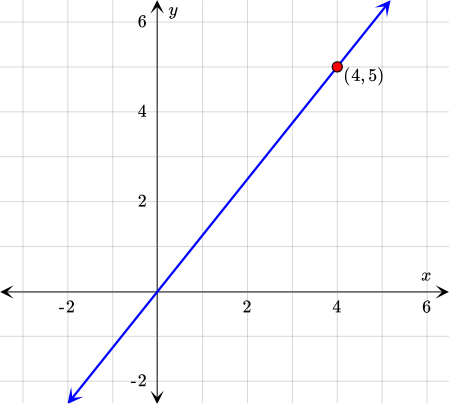
{"type":"text","form":{"type":"math","options":{"comparison":"1","nofractofloat":false,"keypad":{"simple":false,"useShortLog":false,"variables":["x","y"],"constants":[]},"rendered":false},"text":"<span class=\"katex\"><span class=\"katex-html\" aria-hidden=\"true\"><\/span><\/span>"},"formTextBefore":null,"formTextAfter":null,"answer":{"text":["y=1.25x","y=5\/4x","y=\\dfrac{5}{4}x"]}}
Hint
The equation of a direct variation is y=kx, where k is the constant of variation.
Solution
Start by recalling the general form of a direct variation.
y=kx
Here, k is the constant of variation. To find its value, the point (4,5) will be used. To do this, x=4 and y=5 will be substituted into the above equation.
The constant of variation is 1.25. With this information, the formula can be written.
y=kxsubstitutey=1.25x
Example
Writing a Direct Variation Knowing Its Graph
This time, Tearrik is given the graph of a direct variation, but none of its points are plotted.
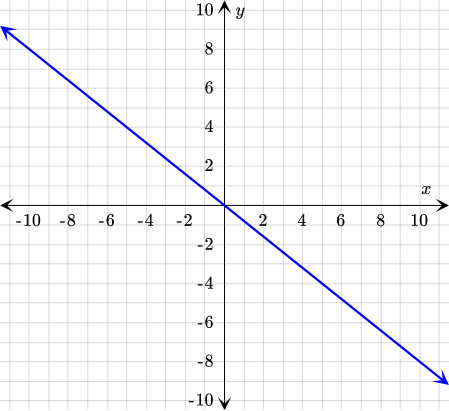
{"type":"text","form":{"type":"math","options":{"comparison":"1","nofractofloat":false,"keypad":{"simple":false,"useShortLog":false,"variables":["x","y"],"constants":[]},"rendered":false},"text":"<span class=\"katex\"><span class=\"katex-html\" aria-hidden=\"true\"><\/span><\/span>"},"formTextBefore":null,"formTextAfter":null,"answer":{"text":["y=-0.8x","y=-8\/10x","y=-4\/5x","y=-\\dfrac{8}{10}x","y=-\\dfrac{4}{5}x"]}}
Hint
Use any point on the line.
Solution
Recall the general form of a direct variation.
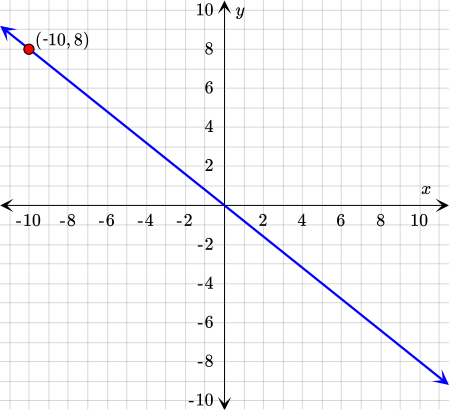 To find the constant of variation, x=-10 and y=8 will be substituted into the general formula.
The constant of variation is -0.8. With this information, the equation of the direct variation of the given graph can be written.
To find the constant of variation, x=-10 and y=8 will be substituted into the general formula.
The constant of variation is -0.8. With this information, the equation of the direct variation of the given graph can be written.
y=kx
Here, k is the constant of variation. To find its value, any point on the given graph can be used. For simplicity, the point (-10,8) will be considered. y=kx
SubstituteII
x=-10, y=8
8=k(-10)
▼
Solve for k
DivEqn
LHS/(-10)=RHS/(-10)
-108=k
MoveNegDenomToFrac
Put minus sign in front of fraction
-108=k
CalcQuot
Calculate quotient
-0.8=k
RearrangeEqn
Rearrange equation
k=-0.8
y=kxsubstitutey=-0.8x
Pop Quiz
Finding the Constant of Variation
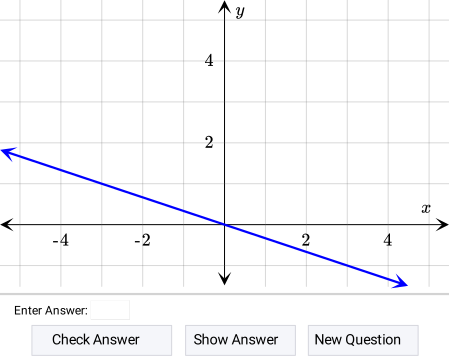
Find the constant of variation of the direct variation whose graph is given. If the answer is not an integer, write it as a decimal rounded to one decimal place.
Example
Modeling With Direct Variation
Tiffaniqua is jogging on Saturday morning. As she jogs, Tiffaniqua keeps a constant speed of 8 km/h.
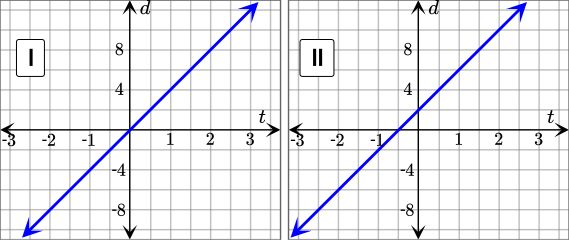
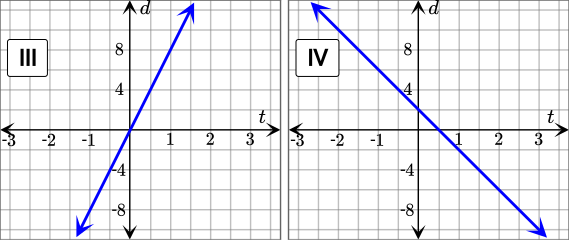 Which of these is the graph of the direct variation from Part A?
How many hours would it take her to travel 12 kilometers?
How many hours will it take her to travel 44 kilometers? 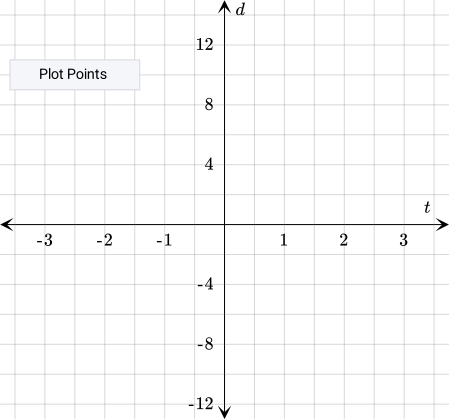 This graph corresponds to Graph III. Note that in the context of the situation, a negative value of t does not make sense, since Tiffaniqua cannot run for a negative amount of hours.
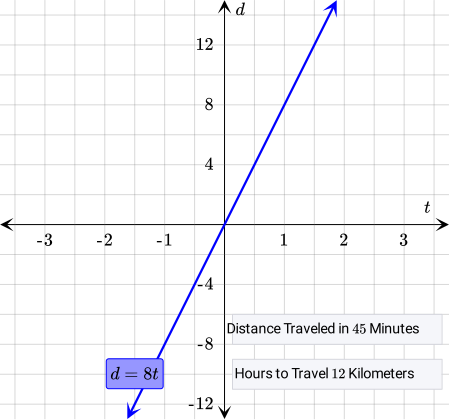 It can be seen that, if Tiffaniqua jogged at a constant speed of 8 kilometers per hour, she would travel 6 kilometers in 45 minutes. Similarly, it would take her one and a half hours to travel 12 kilometers.
a Let d represent the distance in kilometers and t the time in hours. Write a direct variation in terms of d and t to represent this situation.
{"type":"text","form":{"type":"math","options":{"comparison":"1","nofractofloat":false,"keypad":{"simple":false,"useShortLog":false,"variables":["d","t"],"constants":[]},"rendered":false},"text":"<span class=\"katex\"><span class=\"katex-html\" aria-hidden=\"true\"><\/span><\/span>"},"formTextBefore":null,"formTextAfter":null,"answer":{"text":["d=8t"]}}
b Consider the following graphs.
{"type":"choice","form":{"alts":["Graph I","Graph II","Graph III","Graph IV"],"noSort":true},"formTextBefore":"","formTextAfter":"","answer":2}
c How many kilometers would Tiffaniqua travel in 45 minutes?
{"type":"text","form":{"type":"math","options":{"comparison":"1","nofractofloat":false,"keypad":{"simple":true,"useShortLog":false,"variables":[],"constants":[]},"rendered":false},"text":"<span class=\"katex\"><span class=\"katex-html\" aria-hidden=\"true\"><\/span><\/span>"},"formTextBefore":null,"formTextAfter":"kilometers","answer":{"text":["6"]}}
{"type":"text","form":{"type":"math","options":{"comparison":"1","nofractofloat":false,"keypad":{"simple":true,"useShortLog":false,"variables":[],"constants":[]},"rendered":false},"text":"<span class=\"katex\"><span class=\"katex-html\" aria-hidden=\"true\"><\/span><\/span>"},"formTextBefore":null,"formTextAfter":"hours","answer":{"text":["1.5"]}}
d How many kilometers would Tiffaniqua travel in 6 hours and 45 minutes?
{"type":"text","form":{"type":"math","options":{"comparison":"1","nofractofloat":false,"keypad":{"simple":true,"useShortLog":false,"variables":[],"constants":[]},"rendered":false},"text":"<span class=\"katex\"><span class=\"katex-html\" aria-hidden=\"true\"><\/span><\/span>"},"formTextBefore":null,"formTextAfter":"kilometers","answer":{"text":["54"]}}
{"type":"text","form":{"type":"math","options":{"comparison":"1","nofractofloat":false,"keypad":{"simple":true,"useShortLog":false,"variables":[],"constants":[]},"rendered":false},"text":"<span class=\"katex\"><span class=\"katex-html\" aria-hidden=\"true\"><\/span><\/span>"},"formTextBefore":null,"formTextAfter":"hours","answer":{"text":["5.5"]}}
Hint
a What is the constant of variation?
b If Tiffaniqua's speed is 8 km/h, then she travels 8 kilometers in one hour.
c Use the graph from Part B.
d Use the formula from Part A.
Solution
a The distance traveled d varies directly with the time t. Since Tiffaniqua's speed is 8 km/h, the constant of variation is 8.
d=ktsubstituted=8t
b The graph of a direct variation passes through the origin. Therefore, the point (0,0) is on the graph of d=8t. To find another point on the line, any value can be substituted for t in the formula. For simplicity, t=1 will be used.
d=8tsubstitutedd=8(1)=8
It has been found that the point (1,8) is also on the line. To draw the graph, these two points will be plotted and the line through them will be drawn.
c To find how many kilometers Tiffaniqua would travel in 45 minutes and how many hours it would take her to travel 12 kilometers, the graph from Part B will be used.
d Since these two values are too large to be seen in the graph, the formula from Part A will be used.
d=8t
Recall that d is the distance in kilometers and t the time in hours. To find how many kilometers Tiffaniqua would travel in 6 hours and 45 minutes, 45 minutes need to be expressed in hours.
45 minconvert6045 h=0.75 h
Therefore, 6 hours and 45 minutes are 6.75 hours. This value can be substituted for t in the equation.
d=8tsubstitutedd=8(6.75)=54
In 6 hours and 45 minutes, Tiffaniqua would travel 54 kilometers. Finally, to calculate how many hours it would take her to travel 44 kilometers at this speed, 44 will be substituted for d in the formula.
If she kept her constant speed, it would take Tiffaniqua 5.5 hours to travel 44 kilometers.
Closure
Inverse Variation
Another type of variation is inverse variation. Here, one variable is the quotient of the constant of variation and the other variable, which cannot be zero.
Next, the points found in the table will be plotted and connected.
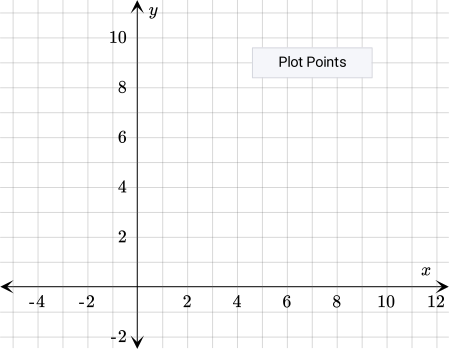 The graph of an inverse variation is not a straight line.
y=xk, x=0
Inverse variation occurs when the product of the variables is constant.
y=xk⇔xy=k
As in direct variation, the constant of variation cannot be zero. For example, let the constant of variation of an inverse variation be 10. To draw its graph, a table of values will be first made. Only positive values will be considered for the x-variable. | x | x10 | y=x10 |
|---|---|---|
| 1 | 110 | 10 |
| 2 | 210 | 5 |
| 3 | 310 | ≈3.3 |
| 4 | 410 | 2.5 |
| 5 | 510 | 2 |
| 6 | 610 | ≈1.7 |
| 7 | 710 | ≈1.4 |
| 8 | 810 | 1.25 |
| 9 | 910 | ≈1.1 |
| 10 | 1010 | 1 |
Loading content