It is given that the car had no alarm. How large a percentage does this represent?
C
c
Mutually exclusive means that there is no overlap between the cars having the Green Fang and the alarm system.
D
d
What is the probability of having the Green Fang given that the car also has the alarm? How does this compare to cars having the Green Fang in general?
A
a
30 %
B
b
About 58 %
C
c
No.
D
d
They are associated.
Practice makes perfect
a
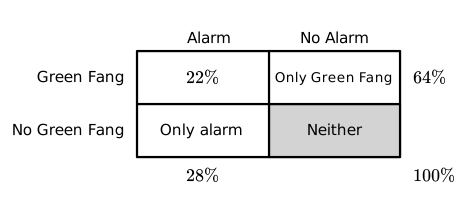
Let's draw a two-way table including the given statistics. The highlighted region holds the percentage we want to determine.
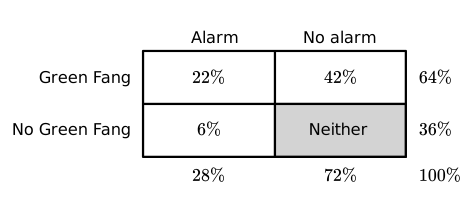
Using these statistics we can calculate the percentages of people that only have a Green Fang, only an alarm, no alarm, and no Green Fang. r|rl
Only alarm& 28 % - 22 % = 6 %
Only Green Fang& 64 % - 22 % = 42 %
No alarm& 100 % - 28 % = 72 %
No Green Fang& 100 % - 64 % = 36 %
Let's add these probabilities to the diagram.
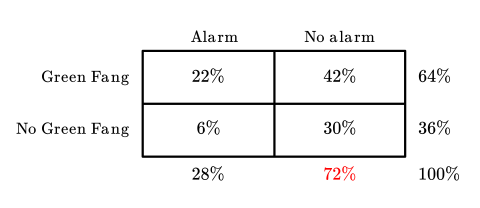
Now we have enough information to determine the probability of a randomly selected person having neither an alarm nor a Green Fang.
Neither: 36 % -6 % = 30 %
We could also calculate the probability of neither by subtracting the percentage of cars with the Green Fang installed from the percentage of cars with no alarm.
b
In this case, it is given that the car was not protected by an alarm system. From the exercise we know that this makes up 72 % of all cars.
Of these, 42 % had a Green Fang installed. With this information, we can calculate the probability of a car having a Green Fang installed given that it has no alarm system.
P(Green Fang|No alarm)=42/72≈ 58 %
c
If they are mutually exclusive events, there can be no cars with an alarm system that also has a Green Fang. This is not true, as we know that 22 % of the cars have both.
d
If having a Green Fang is associated with having an alarm system, the probability of having a Green Fang given that you have an alarm should be different from the overall probability of having a Green Fang.
P(Green Fang)&=64 % [1em]
P(Green Fang|Alarm)&=22/28=74 %
As we can see, a greater percentage of cars with an alarm system also has the Green Fang installed. Therefore, the events are associated.