
Chapter Closure
Sign In
Pay attention to how the similarity statement is written.
To bisect
means to cut in half.
△ WQY is an isosceles triangle.
What angle pair does ∠ B and ∠ C form?
DV≅ RS, m∠ RYS ≅ m∠ DNV
∠ DAB≅ ∠ CAB
WY ≅ QY
m∠ C=32^(∘)
We know that the triangles are similar. Also, from how the similarity statement is written we can determine which sides are corresponding. △ Y SR ~ △ N VD Y → N S → V R → D
Let's illustrate the two triangles.
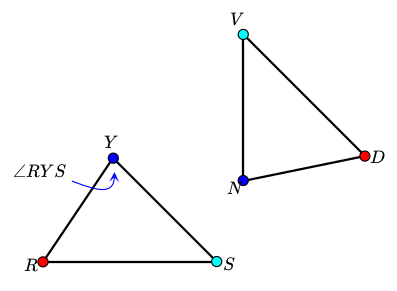
With this information we can identify the corresponding side and angle to DV and ∠ RYS respectively.
|
If △ YSR ≅ △ NVF, then DV≅ RS and m∠ RYS ≅ m∠ DNV. |
If AB bisects ∠ DAC, it cuts the angle between AD and AC into two equal halves.
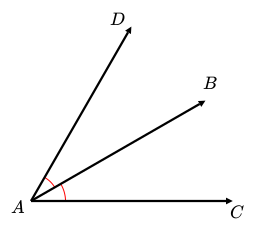
With this information we can complete the statement.
|
If AB bisects ∠ DAC, then ∠ DAB ≅ ∠ CAB. |
The statement tells us that ∠ WQY and ∠ QWY are congruent, which means that the triangle is an isosceles triangle. By the Converse of the Base Angles Theorem, we know that the opposite sides to these angles are congruent.
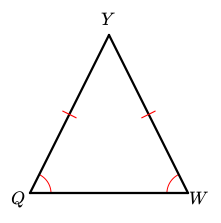
With this information, we can complete the statement.
|
In △ WQY if ∠ WQY ≅ ∠ QWY, then WY ≅ QY. |
A parallelogram is a quadrilateral with two pairs of parallel sides. Let's illustrate this shape.
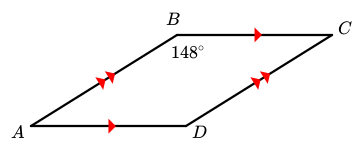
If we view BC as a transversal to AB and DC, we know that ∠ B and ∠ C are consecutive interior angles. Additionally, because AB∥ DC, the consecutive interior angles are supplementary.
|
148 + m∠ C=180^(∘) ⇔ m∠ C=32^(∘). |