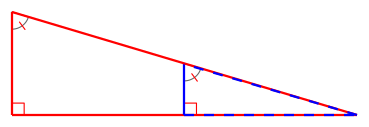
The triangles that are being referred to are the blue and red triangle below.
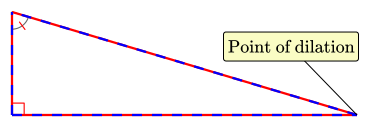
Since two pairs of angles in the triangles have equal measures, we know the triangles are similar by the AA Triangle Similarity condition. We can map the blue triangle to the red triangle by performing a dilation of the smaller triangle of some unknown factor using the shared vertex as the point of dilation.
Note that we could also perform a dilation of the red triangle using the shared vertex as the point of dilation, but with a factor between 1 and 0.
b
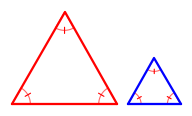
Equilateral triangles are also equiangular. This means that they have three identical angles, each with a measure of 60^(∘).
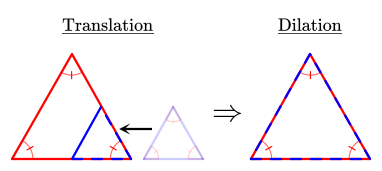
Since the triangles have at least two angles with equal measures, they must be similar by the AA Triangle Similarity condition. We can map the blue triangle to the red triangle by first performing a translation of the smaller blue triangle so that two of their vertices lie on top of each other. Finally, we dilate the blue triangle to make all vertices line up.
c
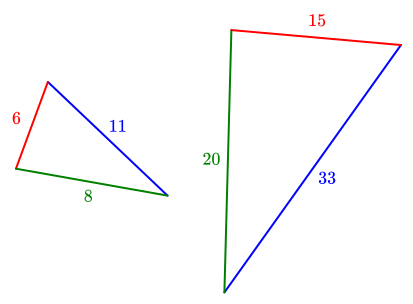
Similar figures preserves ratios of length. Therefore, if we divide corresponding sides, all of these ratios should be the same if the triangles are similar. Notice that in similar figures, the shortest sides are corresponding, the longest sides are corresponding and so on. With this, we can identify corresponding sides.
Having identified corresponding sides we can write an equation.
6/15? =8/20? =11/33
By calculating the three ratios, we can determine if the triangles are similar
0.4= 0.4≠ 0.33...
Since the ratio of the longest sides isn't equal to the ratio of the two other sides, these cannot be similar triangles.
d
Two triangles are similar if at least two pairs of angles are identical. Since this isn't the case with the given triangles, we know for a fact that they are not similar.