How do you calculate the length of horizontal and vertical sides?
B
b
Multiply the coordinates of the points by the dilation factor.
C
c
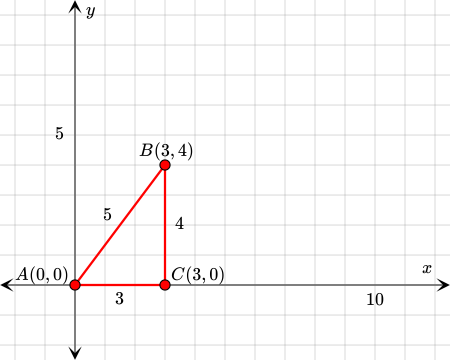
Note that this is a right triangle which means it's legs are the triangle's base and height.
A
a
3, 4 and 5
B
b
6, 8 and 10
C
c
Perimeter: 24
Area: 24
Practice makes perfect
a
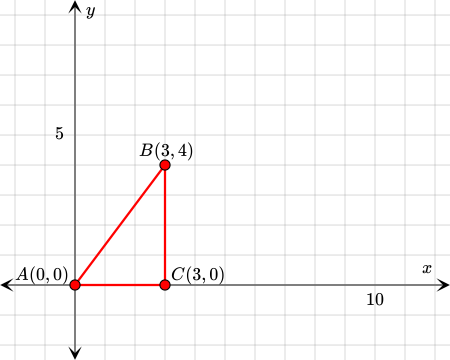
Let's first plot the three points.
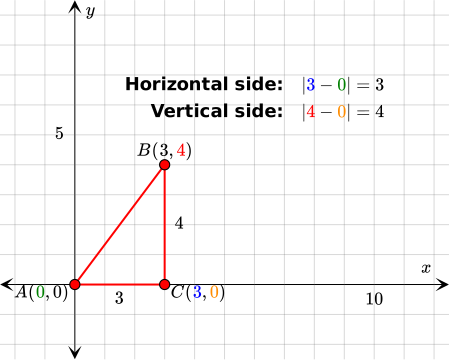
Note that one of the triangle's sides is vertical and another is horizontal. The length of a horizontal side can be calculated as the absolute value of the points x-coordinates. Also, the length of a vertical side can be calculated as the absolute value of the points y-coordinates.
Horizontal side:& d= |x_2-x_1|
Vertical side:& d= |y_2-y_1|
With this, we can calculate the distance of the horizontal and vertical side.
To calculate the length of the third side, we have to use the Distance Formula.
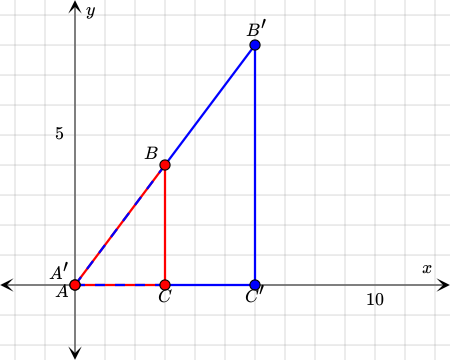
To enlarge the triangle by a factor of 2 from the origin, we have to double the distance of the points from the origin and in the same direction. Note that A(0,0) is at the origin which means it will stay where it is.
Dilating B and C
To dilate the remaining points by a factor of 2 from the origin, we have to multiply the coordinates of each point by 2.
B( 2(3), 2(4)) ⇒ B'(6,8)
C( 2(3), 2(0)) ⇒ C'(6,0)
Let's plot the dilated triangle.
When we dilate something by a certain factor, we are increasing the lengths of all its sides by that factor. With this, we can find the side lengths of the dilated triangle.
&A'B'=2* AB=10
&A'C'=2* AC=6
&B'C'=2* BC=8
c
From Part B, we know the lengths of A'B', A'C', and B'C'. By adding these together, we get the perimeter of △ A'B'C'.
10+ 6+ 8=24To calculate the area of a triangle, we have to multiply its base and height.
A=1/2bh
Since one side is horizontal and another is vertical, this is a right triangle which means it's legs represents the triangle's height and base.