
Sign In
To solve the equation ax^2+bx+c=0, use the Quadratic Formula.
(- 3,8) and (1, - 12)
We will solve the given system of equations using the Substitution Method. y=- 5x-7 & (I) y=x^2-3x-10 & (II) Notice that the y-variable is isolated in both equations. Since the expression equal to y in Equation (I) is simpler, we will substitute its value - 5x-7 for y in Equation (II).
(II): y= - 5x-7
(II): LHS+7=RHS+7
(II): LHS+5x=RHS+5x
(II): Rearrange equation
Notice that in Equation (II) we have a quadratic equation in terms of only the x-variable. x^2+2x-3=0 ⇕ 1x^2+ 2x+( - 3)=0
Substitute values
Calculate power
Identity Property of Multiplication
- a(- b)=a* b
Add terms
Calculate root
Calculate quotient
This result tells us that we have two solutions for x. One of them will use the positive sign and the other one will use the negative sign.
| x=- 1± 2 | |
|---|---|
| x_1=- 1+ 2 | x_2=- 1- 2 |
| x_1=1 | x_2=- 3 |
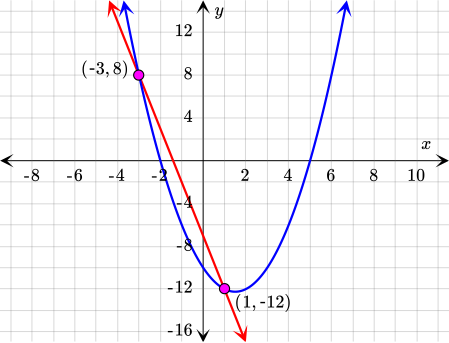
Now, consider Equation (I). y=- 5x-7 We can substitute x=- 3 and x=1 into the above equation to find the values for y. Let's start with x=- 3.
We found that y=8 when x=- 3. One solution of the system, which is a point of intersection of the parabola and the line, is (- 3,8). To find the other solution we will substitute 1 for x in Equation (I) again.
We found that y=- 12 when x=1. Therefore, our second solution, which is the other point of intersection of the parabola and the line, is (1,- 12).