|c|c|c|
Function & m & b
[-0.8em]
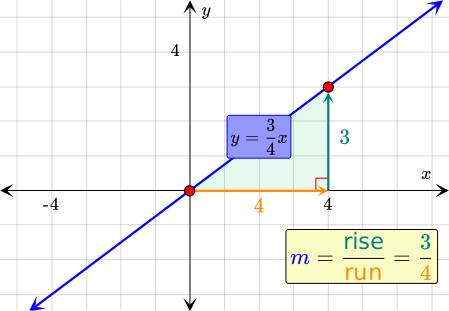
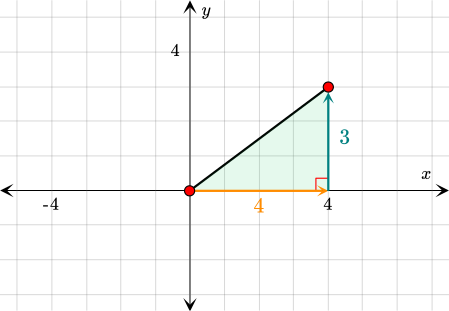
y= 3/4x& 3/4 & 0 [0.8em]To graph the line we need to know at least two points through which it passes. We know that it's y-intercept is 0. Therefore, it passes through the origin. Using the slope, we can find one more point on the line and then draw it.
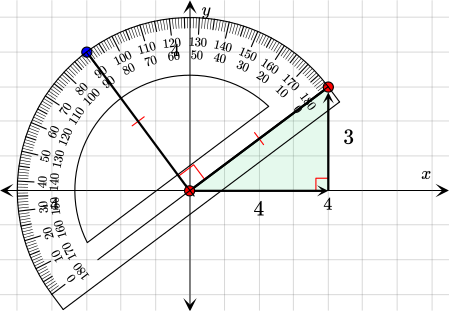
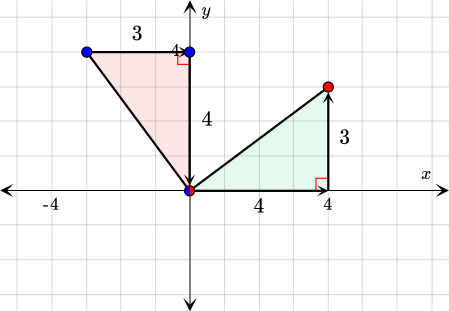
To rotate the slope triangle about the origin, we place a protractor along the hypotenuse of the slope triangle and then draw a second segment along the 90^(∘) mark that is congruent with the hypotenuse.
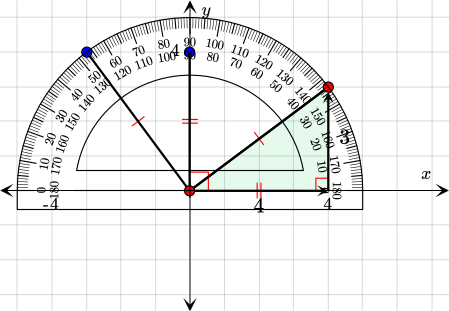
We also have to rotate the vertex at the 90^(∘) angle.
Now we can draw the rotated slope triangle and mark the side's length.
As we can see, the new slope is m= -43.
c
A line perpendicular to y= 43x has to have a slope that is the negative reciprocal of 43. This means the product of their slopes equals -1.
m_1 m_2=-1By substituting m_1= 43 into the formula, we can find the slope of the perpendicular line.
The slope of the perpendicular line to y= 43x is m=- 34 Notice that we are free to choose whatever y-intercept we want. Therefore, we will keep it simple and choose the origin.
y=- 3/4x+0 ⇔ y=- 3/4x