{{ tocSubheader }}
{{ 'ml-label-loading-course' | message }}
An error ocurred, try again later!
Chapter {{ article.chapter.number }}
{{ article.number }}.
{{ article.displayTitle }}
{{ article.intro.summary }}
Show less Show more expand_more Lesson Settings & Tools
| | {{ 'ml-lesson-number-slides' | message : article.intro.bblockCount }} |
| | {{ 'ml-lesson-number-exercises' | message : article.intro.exerciseCount }} |
| | {{ 'ml-lesson-time-estimation' | message }} |
The physical world is full of figures with similar shapes. Actually, even the exact same shapes are found! These figures have a few specific mathematical properties that are used in different situations. This lesson introduces the concepts of congruence and similarity and how they are applied in such cases.
Catch-Up and Review
Here are a few recommended readings before getting started with this lesson.
Explore
Different Formats of Paper
Paulina loves art class. She paints any chance she gets which is why she has a lot of paper in different formats at home. Take a look at the relationship between two of those sheets of paper.
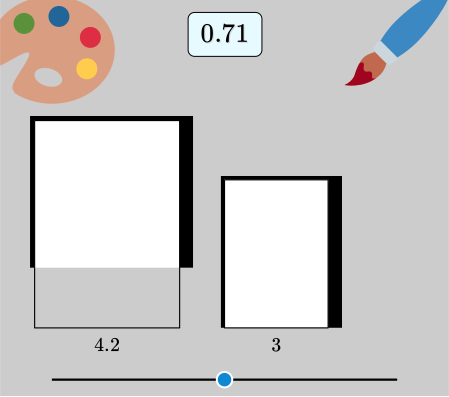 What is the relation between the number shown at the top and the quotient of the side lengths of the two sheets of paper?
Discussion
Introducing Rigid Motions
A rigid motion, or isometry, is a transformation that preserves the distance between any two points on the preimage.
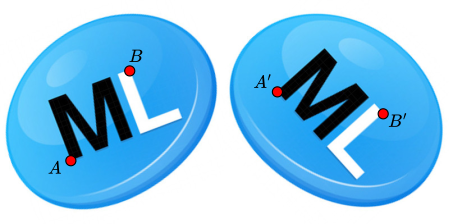
AB=A′B′
The following diagram displays two logos. The logo with the points A and B is the preimage, and the logo with the points A′ and B′ is the image. The image is the result of a rigid motion because the distances between all points are preserved. Rigid motions are also called congruence transformations. That is because the preimage and its image under a rigid motion are congruent figures. Some examples of rigid motions are translations, reflections, and rotations.
Extra
A Composition of Rigid MotionsA composition of a translation, a rotation, and a reflection is also a rigid motion because it preserves the distance between any two points on the preimage.
 Notice that this type of transformation also preserves the angle measures of the figure. However, its position and orientation can sometimes be affected.
Discussion
Congruent Figures
Two figures are congruent figures if there is a rigid motion or sequence of rigid motions that maps one of the figures onto the other. As a result, congruent figures have the same size and shape. To denote algebraically that two figures are congruent, the symbol 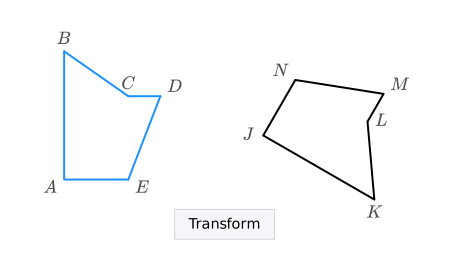 When stating that two polygons are congruent, the corresponding vertices must be listed in the same order. For the polygons above, two of the possible congruence statements can be written as follows.
≅is used.
ABCDE≅JKLMNorCDEAB≅LMNJK
Pop Quiz
Identifying Congruent Figures
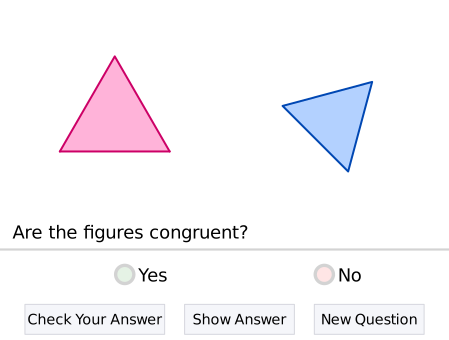
Consider different pairs of figures. Are they congruent figures or not?
Discussion
Introducing Similarity Transformation
There is also a type of transformation that creates an image that is not identical, but very similar to its preimage.
Concept
Similarity Transformation
A combination of rigid motions and dilations is called a similarity transformation. The scale factor of a similarity transformation is the product of the scale factors of the dilations. 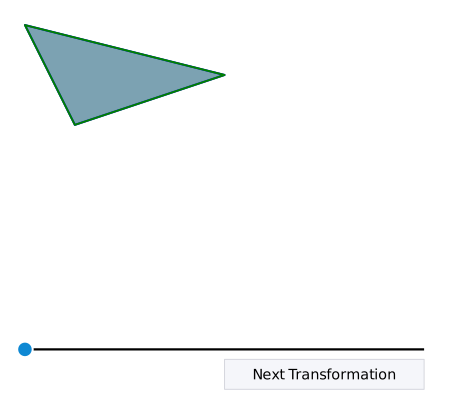 Move the slider to create a similarity transformation by combining rigid motions and dilations.
Discussion
Similar Figures
Two figures are similar figures if there is a composition of similarity transformations that maps one figure onto the other. In other words, two figures are similar if they have the same shape and the ratios of their corresponding linear measures are equal. The symbol 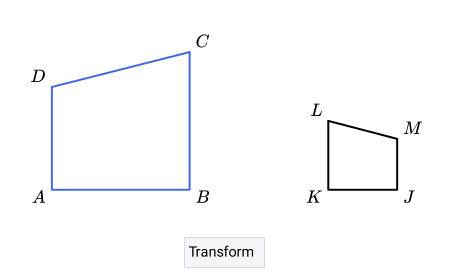 When writing a similarity statement, the corresponding vertices must be listed in the same order as they appear. The relationship between the two given polygons has multiple similarity statements. Consider two of them.
The same definition applies to three-dimensional shapes.
When writing a similarity statement, the corresponding vertices must be listed in the same order as they appear. The relationship between the two given polygons has multiple similarity statements. Consider two of them.
The same definition applies to three-dimensional shapes.
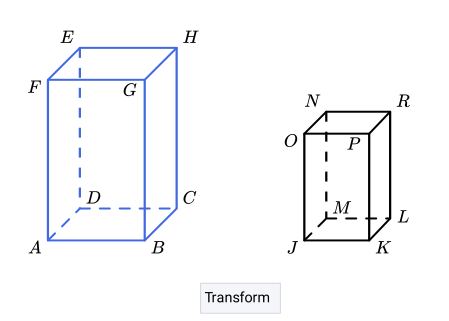 Now, consider one of the possible similarity statements for the given polyhedrons.
Note that for two-dimensional figures, all squares are similar and all circles are similar. Similarly, for 3D figures, all cubes are similar and all spheres are similar.
Now, consider one of the possible similarity statements for the given polyhedrons.
Note that for two-dimensional figures, all squares are similar and all circles are similar. Similarly, for 3D figures, all cubes are similar and all spheres are similar.
∼indicates that two figures are similar.
ABCD∼JKLMorCDAB∼LMJK
ABCDEFGH∼JKLMNOPR
Discussion
Corresponding Parts
Consider two figures. One figure is the image of the other under a transformation. The pairs formed by a part of the preimage — a side, angle, or vertex — and the image of that part are called corresponding parts. For example, in the following applet, A and P are corresponding vertices.
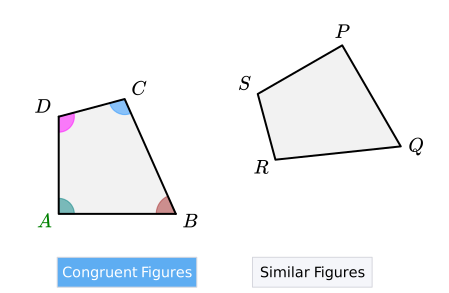 By clicking on each part of ABCD, the corresponding part on PQRS will be highlighted. Note that the figures and their corresponding parts can either be congruent or similar.
| Congruent or Similar? | Relationship |
|---|---|
| Congruent | The corresponding sides and angles of the figures are congruent. |
| Similar | The corresponding sides of the figures are proportional.
The corresponding angles of the figures are also congruent. |
Discussion
Properties of Similar Polygons
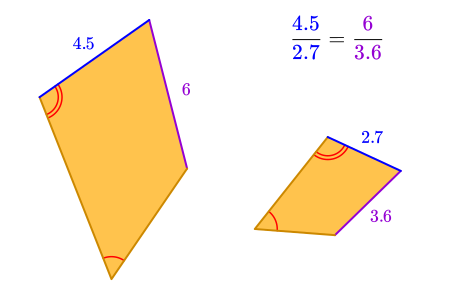
Two polygons are similar if and only if both of the following two properties hold.
- The corresponding angles are congruent.
- The corresponding sides are proportional.
Consider a pair of similar polygons. Notice how both of these properties hold for these polygons.
Example
Admiring Snowflakes
As Paula walked home from art school, snow began to calmly fall. She became giddy with excitement and hoped to catch snowflakes on her gloves. She noticed two large ones.
 Although it is believed that there are no two identical snowflakes, these two snowflakes on Paulina's gloves have congruent shapes. The length of a snowflake is measured from tip to tip.
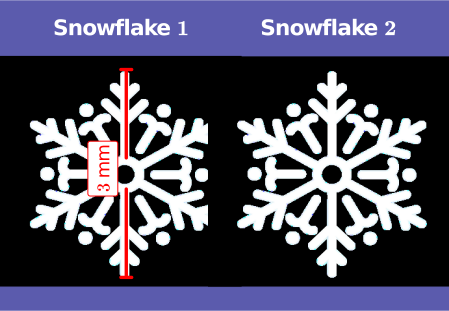
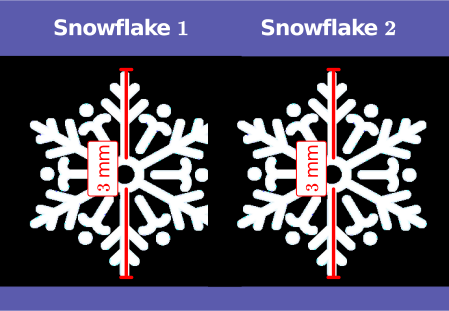
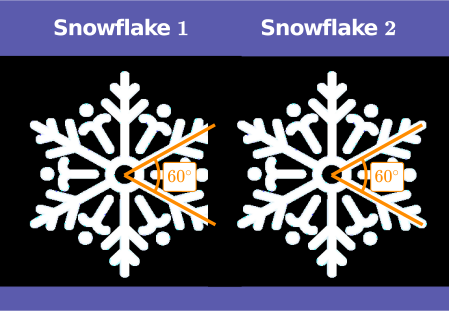
a The length of the first snowflake is 3 millimeters. What is the length of the second snowflake?
{"type":"text","form":{"type":"math","options":{"comparison":"1","nofractofloat":false,"keypad":{"simple":true,"useShortLog":false,"variables":[],"constants":[]},"rendered":false},"text":"<span class=\"katex\"><span class=\"katex-html\" aria-hidden=\"true\"><\/span><\/span>"},"formTextBefore":null,"formTextAfter":"mm","answer":{"text":["3"]}}
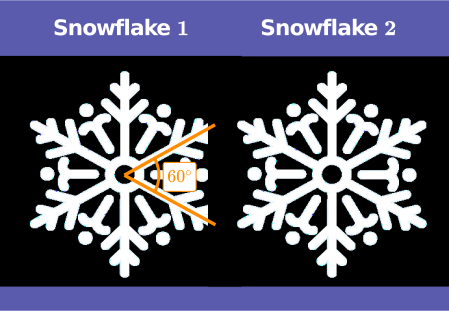
b The angle between two adjacent tips on the first snowflake is 60∘. What is the measure of the corresponding angle on the second snowflake?
{"type":"text","form":{"type":"math","options":{"comparison":"1","nofractofloat":false,"keypad":{"simple":true,"useShortLog":false,"variables":[],"constants":[]},"rendered":false},"text":"<span class=\"katex\"><span class=\"katex-html\" aria-hidden=\"true\"><\/span><\/span>"},"formTextBefore":null,"formTextAfter":"<span class=\"katex\"><span class=\"katex-html\" aria-hidden=\"true\"><span class=\"base\"><span class=\"strut\" style=\"height:0.674115em;vertical-align:0em;\"><\/span><span class=\"mord\"><span><\/span><span class=\"msupsub\"><span class=\"vlist-t\"><span class=\"vlist-r\"><span class=\"vlist\" style=\"height:0.674115em;\"><span style=\"top:-3.063em;margin-right:0.05em;\"><span class=\"pstrut\" style=\"height:2.7em;\"><\/span><span class=\"sizing reset-size6 size3 mtight\"><span class=\"mbin mtight\">\u2218<\/span><\/span><\/span><\/span><\/span><\/span><\/span><\/span><\/span><\/span><\/span>","answer":{"text":["60"]}}
Hint
a Use the definition of congruent figures.
b Congruent figures have the same size and shape.
Solution
a It is a given that the two snowflakes on Paulina's gloves are congruent. Recall that congruent figures have the same size and shape. That fact is proven by the diagram that shows two identical looking snowflakes.
External credits: @rawpixel.com
It is given that the length of the first snowflake is 3 millimeters. Since the snowflakes are congruent, the length of the second snowflake must also be 3 millimeters.
External credits: @rawpixel.com
b This time the measure of an angle on the second snowflake must be found. Once again, start by analyzing the appearance of both snowflakes.
External credits: @rawpixel.com
The congruence of the snowflakes indicates that they are identical and have the same lengths and angle measures. That means the corresponding angle on the second snowflake has the same measure of 60∘.
External credits: @rawpixel.com
Example
Visiting a Gallery
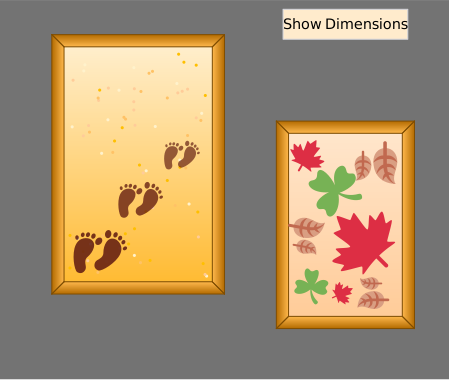
On the weekend, Paulina went to the Mathimartical Gallery, which presents pieces of art that are in some way related to math. One room was dedicated to similar and congruent forms.
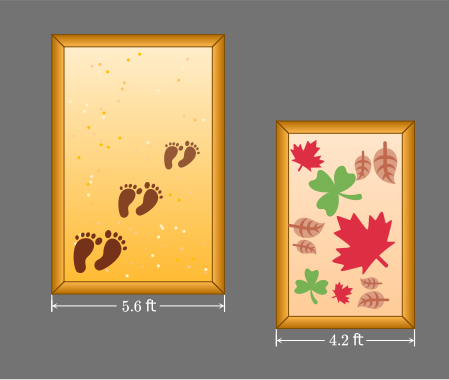 To find the scale factor from the smaller frame to the larger one, divide 4.2 by 5.6 and simplify the quotient.
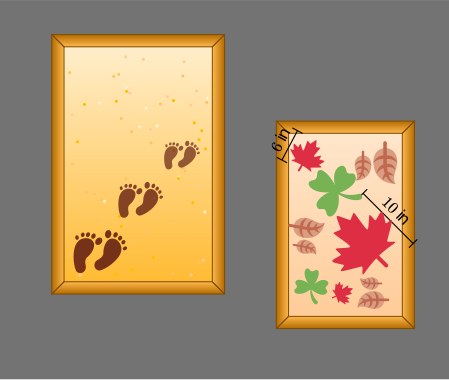 Calculate the scale factor by dividing 6 inches by 10 inches and simplify.
a The two picture frames showing the footprints and leaves have similar shapes. The width of the larger frame is 5.6 feet and the width of the smaller frame is 4.2 feet. What is the scale factor from the smaller frame to the larger one?
{"type":"text","form":{"type":"math","options":{"comparison":"1","nofractofloat":false,"keypad":{"simple":true,"useShortLog":false,"variables":[],"constants":[]},"rendered":false},"text":"<span class=\"katex\"><span class=\"katex-html\" aria-hidden=\"true\"><\/span><\/span>"},"formTextBefore":null,"formTextAfter":null,"answer":{"text":["0.75"]}}
b Some leaves on the picture in the smaller frame also have similar shapes. The length of the left smaller red leaf is 6 inches and the length of a larger red leaf is 10 inches. What is the scale factor from the smaller leaf to the larger leaf?
{"type":"text","form":{"type":"math","options":{"comparison":"1","nofractofloat":false,"keypad":{"simple":true,"useShortLog":false,"variables":[],"constants":[]},"rendered":false},"text":"<span class=\"katex\"><span class=\"katex-html\" aria-hidden=\"true\"><\/span><\/span>"},"formTextBefore":null,"formTextAfter":null,"answer":{"text":["0.6"]}}
Hint
a Use the definition of a scale factor.
b Divide the length of one leaf by the length of the other leaf.
Solution
a Begin by recalling the definition of a scale factor.
|
Scale Factor |
|
A scale factor of two similar figures is the quotient of the measure of one figure and the measure of the other figure. |
The width of the larger frame is measured to be 5.6 feet and the width of the smaller frame is 4.2 feet.
Scale Factor=5.64.2=0.75
Therefore, the scale factor between the smaller and larger frame is 0.75.
b The scale factor from the larger leaf to the smaller leaf needs to be found. The smaller leaf is 6 inches long and the larger leaf is 10 inches long.
Scale Factor=106=0.6
The scale factor from the smaller leaf to the larger leaf equals 0.6.
Example
The Room of Games
Paulina goes on to enter The Room of Games! She notices beautifully crafted chess sets and playing cards. Their details are different sizes depending on the piece and card. The purpose of the room is clear to her — similarities and congruence in shapes are being displayed across various games.
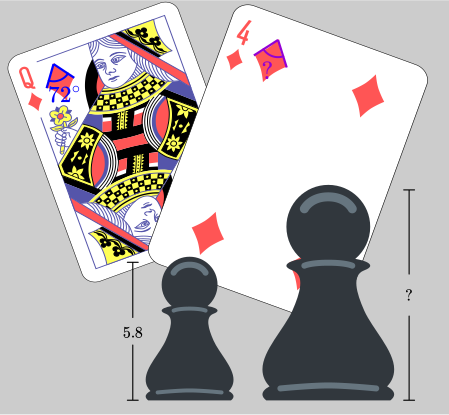
a The two pawns are similar figures with a scale factor from the smaller to the greater pawn of 1.5. If the height of the smaller pawn is 5.8 centimeters, what is the height of the bigger pawn?
{"type":"text","form":{"type":"math","options":{"comparison":"1","nofractofloat":false,"keypad":{"simple":true,"useShortLog":false,"variables":[],"constants":[]},"rendered":false},"text":"<span class=\"katex\"><span class=\"katex-html\" aria-hidden=\"true\"><\/span><\/span>"},"formTextBefore":null,"formTextAfter":"cm","answer":{"text":["8.7"]}}
b The two cards — the Queen of Diamonds and the Four of Diamonds — have similar shapes with the scale factor from the bigger card to the smaller card of 0.9. If the top angle on the diamond on the smaller card is 72∘, what is the top angle on the diamond on the bigger card?
{"type":"text","form":{"type":"math","options":{"comparison":"1","nofractofloat":false,"keypad":{"simple":true,"useShortLog":false,"variables":[],"constants":[]},"rendered":false},"text":"<span class=\"katex\"><span class=\"katex-html\" aria-hidden=\"true\"><\/span><\/span>"},"formTextBefore":null,"formTextAfter":"<span class=\"katex\"><span class=\"katex-html\" aria-hidden=\"true\"><span class=\"base\"><span class=\"strut\" style=\"height:0.674115em;vertical-align:0em;\"><\/span><span class=\"mord\"><span><\/span><span class=\"msupsub\"><span class=\"vlist-t\"><span class=\"vlist-r\"><span class=\"vlist\" style=\"height:0.674115em;\"><span style=\"top:-3.063em;margin-right:0.05em;\"><span class=\"pstrut\" style=\"height:2.7em;\"><\/span><span class=\"sizing reset-size6 size3 mtight\"><span class=\"mbin mtight\">\u2218<\/span><\/span><\/span><\/span><\/span><\/span><\/span><\/span><\/span><\/span><\/span>","answer":{"text":["72"]}}
Hint
a Multiply the scale factor by the height of the smaller pawn.
b The angle measures of similar figures are congruent.
Solution
a It is known that the two pawns are similar figures. This means that their dimensions have the same ratio and are related to each other by a scale factor. In this case, it equals 1.5.
Scale Factor=1.5
The height of the smaller pawn is 5.8 centimeters. Find the height of the bigger pawn by multiplying 5.8 by the scale factor of 1.5.
5.8⋅1.5=8.7 cm
The height of the bigger pawn is 8.7 centimeters.
b The two cards are said to be similar figures where the Queen of Diamonds is a smaller card and Four of Diamonds is a bigger card. Recall that similar figures have congruent angles. The measure of the top angle of the diamond on the smaller card is 72∘.
Top Angle=72∘
This means that the measure of the top angle of the diamond on the bigger card is also 72∘.
Pop Quiz
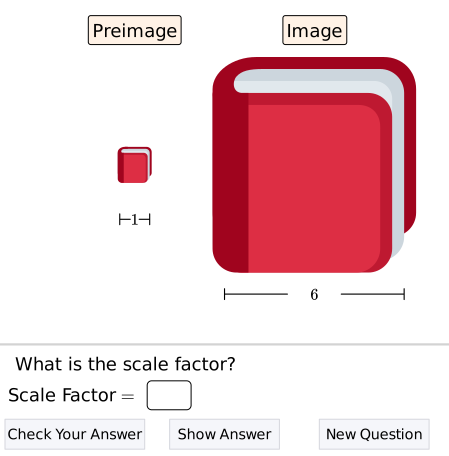
Finding or Using the Scale Factor
Consider two similar figures. Using the given information, find the scale factor rounded to two decimal places or the length of either of the figures rounded to the closest integer.
Closure
Comparing Ratios of Congruent Triangles
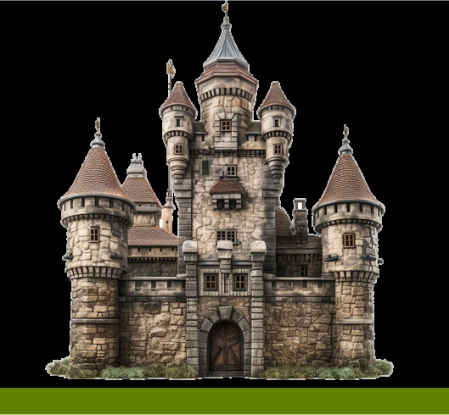
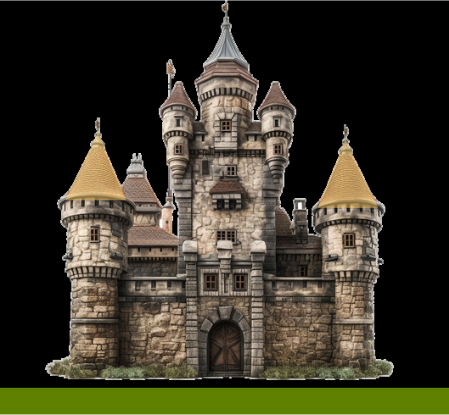
Paulina entered the final room of the gallery. It is dedicated to congruent and similar figures in architecture. There is a model of an old castle with two towers with congruent shapes.
External credits: @tohamina
Notice that the roofs of the towers in front of the castle look like congruent triangles.
External credits: @tohamina
Ratio of Left Tower Roof=810=1.25
Since the towers have congruent shapes, the height of the roof of the right tower is also 10 feet and its base is 8 feet wide. Find the ratio of the height to the base of the right tower's roof as well.
Ratio of Right Tower Roof=810=1.25
The calculations show that the ratio of the height to the base is the same for both triangles. This means that ratios of congruent polygons side lengths are equal.
Loading content