4. Compare and Order Fractions, Decimals, and Percents
Sign In
An error ocurred, try again later!
Chapter 2
4.
Compare and Order Fractions, Decimals, and Percents
This lesson delves into the fundamental skill of comparing and ordering numbers, specifically focusing on fractions, decimals, and percents. This skill is not just for academic purposes; it has practical applications in everyday life. For example, when shopping for groceries, you might need to compare prices that are listed as fractions, decimals, or percentages to get the best deal. Similarly, in finance, understanding how to order these types of numbers can help you make smarter investment choices. In the realm of data analysis, being able to compare numbers in various formats is crucial for drawing accurate conclusions. Overall, mastering this skill can significantly improve your problem-solving abilities in a wide range of situations.
Show less Show more expand_more 


Lesson Settings & Tools
| | 12 Theory slides |
| | 9 Exercises - Grade E - A |
| | Each lesson is meant to take 1-2 classroom sessions |
Compare and Order Fractions, Decimals, and Percents
Slide of 12
Numbers appear in different forms from whole numbers to fractions and percents. What is more, numbers are often connected and need to be analyzed in comparison to each other. This is why it is useful to know how to compare and order different forms of numbers. This topic will be covered and practiced in this lesson.
Catch-Up and Review
Here are a few recommended readings before getting started with this lesson.
Background to Help Understand Numbers
Background to Help Understand Multiples
Challenge
Share
Report error
Comparing Math Homework Progress
Tiffaniqua, LaShay, and Kevin are really good friends. They spend most of their free time together. On Wednesday evening, LaShay called Tiffaniqua and asked her how much of her math homework she completed.
 Tiffaniqua said that she did about 60 % of the homework. LaShay replied that she had completed 0.55 of the homework. Together they called Kevin, who told that he had finished 3150 of all the exercises. Who has completed the greatest part of the homework?
{"type":"choice","form":{"alts":["Tiffaniqua","LaShay","Kevin"],"noSort":true},"formTextBefore":"","formTextAfter":"","answer":2}
Discussion
Share
Report error
Can Any Two Numbers Be Compared?
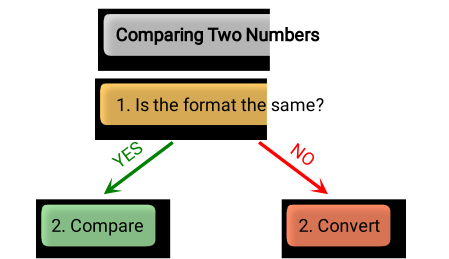
Imagine that two numbers need to be compared. Consider this pair of numbers. 15 % and 0.32 Which one is greater? Which is less? The first thing to check is whether the numbers have the same form. In this case, the first number is a percent, while the second is a decimal number. ccc Percent & & Decimal ↓ & & ↓ 15 % & & 0.32 They do not have the same form, so they cannot be directly compared. It is like comparing strawberries and dogs — they are just not comparable because they belong to totally different categories and have drastically different features.

It is the same way with numbers. Numbers can only be compared if they are written in the same format. cccc Percents: & 15 % & vs. & 54 % Decimals: & 0.32 & vs. & 2.19 Therefore, to compare two numbers, always begin by making sure that they have the same form. If they do, go ahead and compare them! If they do not, first convert one or both numbers such that they are written in the same format.
Discussion
Share
Report error
Comparing Two Numbers in the Same Form
Consider two numbers in the same form. The good news is that they can totally be compared! But how? First, take a look at two decimal numbers.
0.285 and 0.281
The numbers look pretty similar. To determine which is greater, compare their digits one by one moving from left to right until a greater one is found. Remember, it is important to compare the corresponding digits — tenths versus tenths, hundredths versus hundredths, and so on.
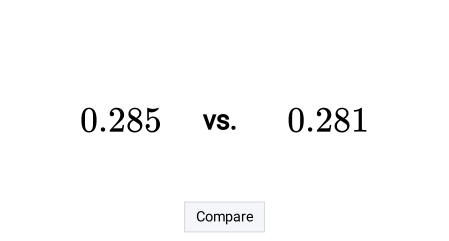 Since the last digit of 0.285 is greater, the first number is greater than the second one.
0.285 > 0.281
What about a pair of percents?
65 % and 67.3 %
The same method can be used to determine which one is greater. Compare the numbers digit by digit, ignoring the % sign. The second digit 7 is greater than 5, so the second percent is greater. 65 % < 67.3 %
Since the last digit of 0.285 is greater, the first number is greater than the second one.
0.285 > 0.281
What about a pair of percents?
65 % and 67.3 %
The same method can be used to determine which one is greater. Compare the numbers digit by digit, ignoring the % sign. The second digit 7 is greater than 5, so the second percent is greater. 65 % < 67.3 %
Pop Quiz
Share
Report error
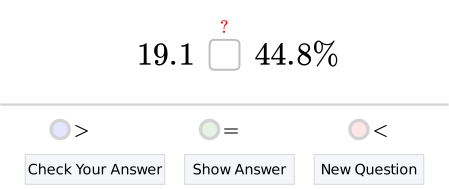
Comparing Two Numbers in Decimal and Percent Forms
Example
Share
Report error
Ordering Decimals and Percents From Least to Greatest
Tiffaniqua, LaShay, and Kevin, along with a couple of their friends, are mastering the skill of blind typing. After finishing their homework, they held a little competition to figure out who types the fastest at the moment.
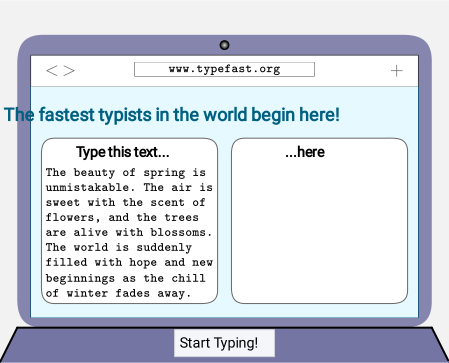 Tiffaniqua said that her typing speed is 254.6 characters per minute. LaShay said that her result is 279.5 characters per minute. Kevin's speed is 252 characters per minute.
125 %, 1.03, 98 %, 1.17
Order their results from least to greatest, too. 

a Order their speeds from least to greatest.
{"type":"sort","form":{"alts":[{"id":0,"text":"Tiffaniqua: 254.6"},{"id":1,"text":"LaShay: 279.5"},{"id":2,"text":"Kevin: 252"}]},"formTextBefore":"","formTextAfter":"","answer":[2,0,1]}
b Their friends told them that their results were given as percents or decimals that represent their speeds compared to the average speed of typing 250 characters.
{"type":"sort","form":{"alts":[{"id":0,"text":"98 %"},{"id":1,"text":"1.03"},{"id":2,"text":"1.17"},{"id":3,"text":"125 %"}]},"formTextBefore":"","formTextAfter":"","answer":[0,1,2,3]}
Hint
a Compare the decimals digit by digit, or compare their locations on a number line.
b Start by rewriting the numbers so that they are in the same form.
Solution
a Start by considering the typing speeds of Tiffaniqua, LaShay, and Kevin.
Tiffaniqua:& 254.6 LaShay:& 279.5 Kevin:& 252 All these speeds are given as decimal numbers. One way to order these numbers from least to greatest is to compare them digit by digit. Another method is to plot them as points on a number line. On a number line, the farther to the right the number is, the greater it is.
Notice that point K, which represents Kevin's speed, is the least because it is farthest to the left. Next comes the point T, Tiffaniqua's speed. Finally, point L is the farthest to the right, meaning that LaShay's speed is the greatest. ccccc K & & T && L ↓ & &↓ && ↓ 252&<& 254.6&<&279.5 Therefore, Kevin is the slowest typist at the moment, Tiffaniqua is in the middle, and LaShay is the fastest. Not to worry — Kevin still has time to practice and beat Tiffaniqua and LaShay.
b Start by considering the given typing speeds. Some of them are percents and some are decimal numbers.
125 %, 1.03, 98 %, 1.17 To be able to compare the numbers, they should be written in the same form — either all as percents or all as decimal numbers. Rewrite the decimals as percents by multiplying them by 100 and adding the percent sign. 1.03* 100=103 % 1.17* 100=117 % Now all the numbers are written as percents! 125 %, 103 %, 98 %, 117 % Compare the numbers by plotting them on a number line.
Finally, the percents can be ordered from least to greatest. cccc 98 %, & 103 %, &117 %, &125 % [0.1cm] ↓ & ↓ & ↓ & ↓ [0.1cm] 98 %, & 1.03, & 1.17, & 125 %
Discussion
Share
Report error
Comparing Fractions
Consider a pair of fractions. How can the fractions be compared when they have different numerators and denominators? 4/7 and 5/8 Both fractions represent a part of a whole, but it is difficult to say which one is greater straight away. The best way to compare these fractions would be to convert them to equivalent fractions that have the same denominator. 4/7 → ?/New Denom. and ?/New Denom. ← 5/8 When two fractions have the same denominator, they are said to have a common denominator.
Concept
Share
Report error
Common Denominator
A common denominator is a denominator that is shared between two or more fractions. Consider a few examples.
| Pair of Fractions | Common Denominator |
|---|---|
| 2/3 and 5/3 | 3 |
| 8/10 and 5/10 | 10 |
| 11/17 and 6/17 | 17 |
Fractions can always be rewritten to all have a common denominator. This process requires writing equivalent fractions by expanding or simplifying the fractions. As an example, take a look at a pair of fractions with different denominators. 1/3 and 1/2 These fractions are in their simplest form, which means that they can only be expanded. Write the multiples of their denominators, 3 and 2, to find the factor of expansion. Multiples of3:& 3, 6, 9, 12, 15, 18, ... Multiples of2:& 2, 4, 6, 8, 10, 12, 14, ... There are two potential common denominators in these lists. Expand the first fraction by 123= 4 and the second fraction by 122= 6 to make them have a common denominator of 12. 1 * 4/3 * 4&=4/12 [0.3cm] 1 * 6/2 * 6&=6/12 Now the fractions share a common denominator.
4/12 and 6/12Discussion
Share
Report error
The Most Convenient Common Denominator
There are a lot of possible common denominators that fractions can have. However, it is almost always easier to deal with smaller numbers. This is when the least common denominator comes in handy!
Concept
Share
Report error
Least Common Denominator
The least common denominator (LCD) of two fractions is the least common multiple (LCM) of the denominators of the fractions. In other words, the least common denominator is the smallest of all the common denominators. Some examples are provided in the table below.
| Fractions | Denominators | Multiples of Denominators | Common Denominators | LCM of Denominators (LCD) |
|---|---|---|---|---|
| 2/3 and 1/2 | 3 and 2 | Multiples of3:& 3, 6, 9, 12, 15, ... Multiples of2:& 2, 4, 6, 8, 10, 12, ... | 6, 12 | 6 |
| 5/6 and 1/4 | 6 and 4 | Multiples of6:& 6, 12, 18, 24, 30, ... Multiples of4:& 4, 8, 12, 16, 20, 24, ... | 12, 24 | 12 |
| 1/4 and 5/2 | 4 and 2 | Multiples of4:& 4, 8, 12, ... Multiples of2:& 2, 4, 6, 8, 10, 12, ... | 4, 8, 12 | 4 |
The least common denominator is used when adding or subtracting fractions with different denominators.
2/10 - 1/11 = 22/110_(LCD) - 10/110_(LCD)To sum up, finding the least common denominator is the same as finding the least common multiple of the denominators. When fractions have a common denominator, which is most often the LCD, they are ready to be compared by comparing their numerators.
| Fractions | 4/11 and 9/11 |
|---|---|
| Numerators | 4<9 |
| Conclusion | 4/11<9/11 |
Extra
Comparing Fractions With Common NumeratorsThere are cases when two fractions share the same numerator. In this case, the fractions can be compared based on their denominators. Consider a pair of fractions. 5/7 and 5/16 When fractions have the same denominator, the fraction with the greater numerator is greater. However, when fractions have the same numerator, it is the opposite — the fraction with the smaller denominator is greater.
| Same Denominator | Same Numerator |
|---|---|
| The greater numerator, the greater the fraction. | The smaller denominator, the greater the fraction. |
Since 7 is less than 16, the first fraction must be greater. 5/7> 5/16 To understand why this is true, think of a whole represented by 1. The denominators indicate how many pieces this whole is split into. Here, it is split into 7 pieces for the first fraction and 16 pieces for the second fraction.
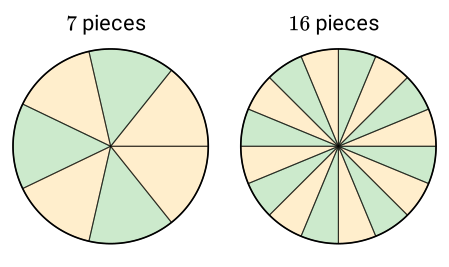
Notice that the 7 pieces of the first fraction are much larger than the 16 pieces of the second. The numerator of each fraction indicates how many pieces get picked. Since the numerators are the same, 5 pieces are selected from each whole. Which fraction has a larger selected section?
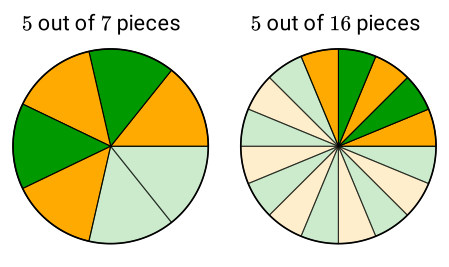
The total selected area is greater in the first fraction than in the second because each of the pieces is bigger. This is why the fraction with the smaller denominator is greater if the numerators are the same.
Pop Quiz
Share
Report error
Comparing Two Fractions
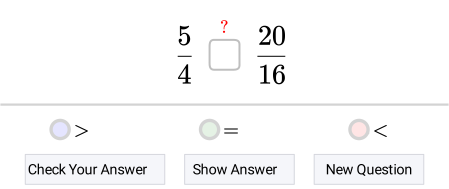
Consider the given pair of fractions. Which one is greater? Choose the correct sign to complete the expression. If necessary, rewrite the fractions such that they have a common denominator.
Example
Share
Report error
It All Started With a Ball
The next day, Kevin, LaShay, and Tiffaniqua excitedly discussed the details of a local story published in the morning newspaper.
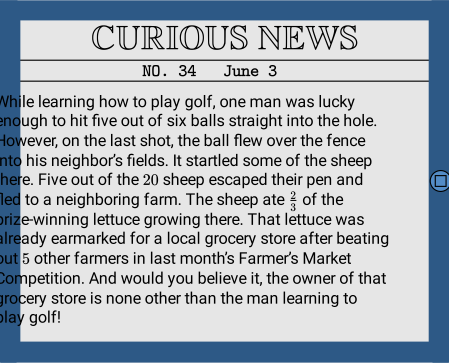 Four fractions were mentioned in the article.
5/6, 5/20, 2/3, 1/5
Order them from greatest to least.
Four fractions were mentioned in the article.
5/6, 5/20, 2/3, 1/5
Order them from greatest to least.
Now that the expansions have been found, they can be used to rewrite the fractions into equivalent fractions with a common denominator of 60. Begin with the first fraction of 56.
The rest of the fractions can be similarly expanded.
{"type":"sort","form":{"alts":[{"id":0,"text":"56"},{"id":1,"text":"23"},{"id":2,"text":"520"},{"id":3,"text":"15"}]},"formTextBefore":"","formTextAfter":"","answer":[0,1,2,3]}
Hint
Rewrite the fractions so that they have a common denominator. Find it by determining the LCM of the denominators.
Solution
Four fractions need to be ordered from greatest to least. 5/6, 5/20, 2/3, 1/5 They have different numerators and denominators. Rewrite them such that they have a common denominator to be able to compare them. Start by finding the LCM of the denominators of the fractions to find a candidate for a common denominator. Denominators 6, 20, 3, 5 First, list the multiples of all the numbers and try to find the least common one. Multiples of6:& 6, 12, 18, ..., 54, 60, ... Multiples of20:& 20, 40, 60, 80, 100 ... Multiples of3:& 3, 6, 9, 12, ..., 57, 60 ... Multiples of5:& 5, 10, 15, 20, ..., 55, 60 ... The LCM of the numbers is 60. Next, divide 60 by each of the numbers to find by which factor each fraction should be expanded.
| Denominator | Calculating the Quotient | Factor |
|---|---|---|
| 6 | 60/6 | 10 |
| 20 | 60/20 | 3 |
| 3 | 60/3 | 20 |
| 5 | 60/5 | 12 |
| Fraction | Equivalent Fraction |
|---|---|
| 5/6 | 50/60 |
| 5/20 | 15/60 |
| 2/3 | 40/60 |
| 1/5 | 12/60 |
Finally, the fractions with the same denominator can be compared by looking at their numerators and ordering them from greatest to least. ccccccc 50/60&>& 40/60&>&15/60&>&12/60 [0.3cm] ↓ & &↓ & & ↓ & & ↓ [0.3cm] 5/6 & &2/3 & &5/20 & &1/5
Example
Share
Report error
Analyzing Facts About Flowers
Tiffaniqua, LaShay, Kevin, and one of their classmates are working on a biology project comparing four different flowers. Each of them was assigned a specific flower. After some research time, they met up to discuss what they found out.
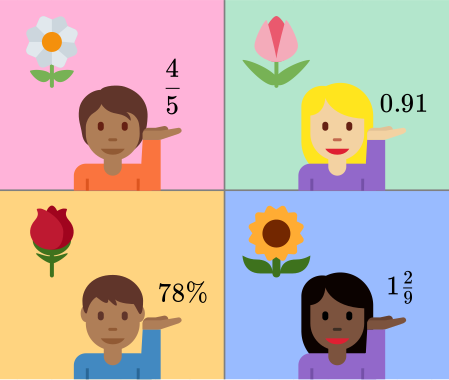
{"type":"sort","form":{"alts":[{"id":0,"text":"78 %"},{"id":1,"text":"45"},{"id":2,"text":"0.91"},{"id":3,"text":"1 29"}]},"formTextBefore":"","formTextAfter":"","answer":[0,1,2,3]}
Hint
Rewrite the numbers so that they are in the same form. Then, plot the numbers on a number line to help place them in order.
Solution
Consider the numbers found by the students during their research about different flowers. One number is a fraction, one is a decimal number, one is a mixed number, and one is a percent. 4/5, 0.91, 1 29, 78 % To compare the numbers, they need to be written in the same form. It does not matter which format is chosen, but all numbers will be rewritten as percents in this solution.
Fraction
Start by rewriting the fraction 45 as a percent. This can be done by multiplying the fraction by 100, then dividing the new numerator by the denominator. Start with the multiplication. Next, divide the numerator by the denominator and add a percent sign. 400/5=80 % Therefore, 45 corresponds to 80 %.Decimal Number
Now consider the decimal number 0.91. Rewrite it as a percent by multiplying it by 100 and adding a percent sign. Remember that a number can be easily multiplied by 100 by moving its decimal point two places to the right.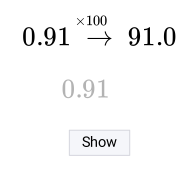
Mixed Number
Consider the mixed number 1 29. It consists of the integer 1 and the fraction part 29. Begin by rewriting the fraction part as a decimal. Divide the numerator by the denominator to two decimal places by using long division.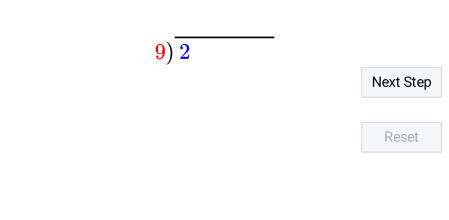
Comparison
Gather all the numbers and their corresponding percent forms. cccc 4/5 & 0.91 & 1 29 & 78 % ↓ & ↓ & ↓ & ↓ [0.2cm] 80 % & 91 % & 122 % & 78 % To compare the percents, ignore the percent signs and plot the numbers on a number line.

The given numbers can finally be ordered from least to greatest. ccccccc 78 % & & 80 % & & 91 % & & 122 % [0.2cm] ↓ & & ↓ & & ↓ & & ↓ [0.2cm] 78 % & < & 4/5 & < & 0.91 & < &1 29
Closure
Share
Report error
Who Is Closer to Finishing Their Homework?
It was said earlier that on Wednesday evening, LaShay called Tiffaniqua and asked her how much of her math homework she completed.
 Tiffaniqua said that she had completed about 60 % of the homework. LaShay replied that she had done 0.55 of the homework. Together they called Kevin, who told them that he had finished 3150 of all the exercises. Who has completed the greatest part of the homework?
{"type":"choice","form":{"alts":["Tiffaniqua","LaShay","Kevin"],"noSort":true},"formTextBefore":"","formTextAfter":"","answer":2}
Solution
Compare the given numbers to determine who has completed the greatest amount of the homework.
60 %, 0.55, 31/50
These numbers are in different forms — a percent, a decimal number, and a fraction. The first step when comparing numbers is to have them all in the same form. This solution will write all the numbers in their decimal form. Divide the percentage of 60 % by 100 % to get its decimal form. 60 %/100 %=0.6
The decimal form of 60 % is 0.6. Next, rewrite the fraction 3150 as a decimal. Begin by converting this fraction to an equivalent fraction whose denominator is 100. Since 50* 2=100, the equivalent fraction can be found by multiplying the numerator and denominator of 3150 by 2.
31* 2/50* 2=62/100
The last step to write the fraction in its decimal form is to divide the numerator by the denominator. Since the denominator is 100, the division can be performed simply by moving the decimal point of 62.0 two places to the left.
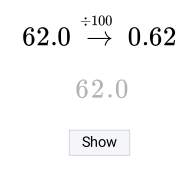 The decimal that corresponds to 3150 is 0.62. Finally, the found decimal forms of the numbers can be compared.
0.6, 0.55, 0.62
Compare the numbers digit by digit to determine the greatest number. First, consider the pair of 0.6 and 0.55. Note that 0.6 is the same as 0.60.
The decimal that corresponds to 3150 is 0.62. Finally, the found decimal forms of the numbers can be compared.
0.6, 0.55, 0.62
Compare the numbers digit by digit to determine the greatest number. First, consider the pair of 0.6 and 0.55. Note that 0.6 is the same as 0.60.
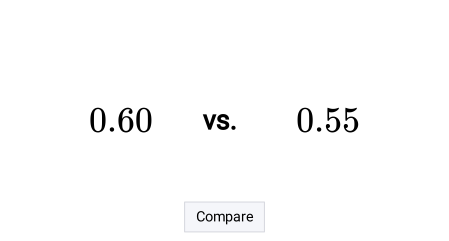 The decimal 0.6 is greater than 0.55. Next, compare 0.6 and 0.62. Again, a zero will be written after 6 for convenience.
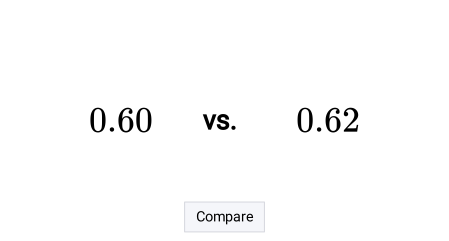 The decimal 0.62 is greater than 0.6. Consequently, it is also greater than 0.55. 0.55 < 0.6 <0.62
Recall which initial numbers these decimals correspond to.
ccccc
0.55 &<& 0.6 &<& 0.62 [0.2cm] ↓ & &↓ & &↓ [0.2cm] 0.55 & & 60 % & & 31/50 [0.3cm] ↑ & &↑ & &↑ [0.2cm] LaShay & & Tiffaniqua & & Kevin
Therefore, Kevin, who has finished 3150 of the homework, has completed the greatest part of the homework.
The decimal 0.62 is greater than 0.6. Consequently, it is also greater than 0.55. 0.55 < 0.6 <0.62
Recall which initial numbers these decimals correspond to.
ccccc
0.55 &<& 0.6 &<& 0.62 [0.2cm] ↓ & &↓ & &↓ [0.2cm] 0.55 & & 60 % & & 31/50 [0.3cm] ↑ & &↑ & &↑ [0.2cm] LaShay & & Tiffaniqua & & Kevin
Therefore, Kevin, who has finished 3150 of the homework, has completed the greatest part of the homework.
Compare and Order Fractions, Decimals, and Percents
Exercise 3.1
Ali has many different dreams about his future. One day he sat down and started researching about different careers, such as becoming a pilot, an astronaut, a computer programmer, and a firefighter.
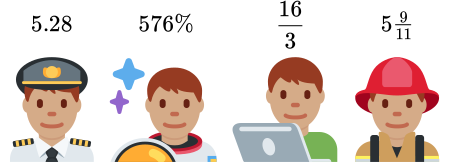
{"type":"sort","form":{"alts":[{"id":0,"text":"5.28"},{"id":1,"text":"163"},{"id":2,"text":"576 %"},{"id":3,"text":"5 911"}]},"formTextBefore":"","formTextAfter":"","answer":[0,1,2,3]}
security
report
code
security
report
code
We are given four numbers in different forms. 5.28, 576 %, 16/3, 5 911 We can only compare them if they are in the same form. Let's rewrite all the numbers as percents, one by one.
Decimal Number
The first number 5.28 is a decimal number. Let's multiply it by 100 to convert it to a percent. We can do this by moving the decimal point two places to the right.
We need now to add the percent sign to this number. 5.28* 100=528 % As we can see, 5.28 is equivalent to 528 %.
Fraction
Now let's consider the fraction 163. First, we divide the numerator by the denominator using long division.
Next, we multiply the decimal number by 100. Also, we will add a percent sign. 5.333* 100=533.3 % We have found that 163 corresponds to about 533.3 %.
Mixed Number
Finally, consider the mixed number 5 911. We will start by rewriting it as an improper fraction using this formula. a bc=a* c+b/c Let's apply it to our mixed number.
Next, divide 64 by 11 by using the long division.
Also, multiply the decimal number by 100 and add a percent sign. 5.818* 100=581.8 % The mixed number in percent form is about 581.8 %.
Comparison
The corresponding percent forms of the numbers can now be compared to order the numbers from least to greatest. ccccccc 528 % & < & 533.3 % &< & 576 % & < & 581.8 % [0.2cm] ↓ & & ↓ & & ↓ & & ↓ [0.2cm] 5.28 & & 16/3 & & 576 % & & 5 911
security
report
code
Compare and Order Fractions, Decimals, and Percents
Recommended exercises
To get personalized recommended exercises, please login first.
Loading content
≤
>
■2
■▢
e▢
7
8
9
×
÷■1
=
=
√▢
▢√
∫▢▢
4
5
6
+
−
≤
<
log
ln
log▢
1
2
3
()
∣
sin
cos
tan
0
.
π
x
y
Loading content