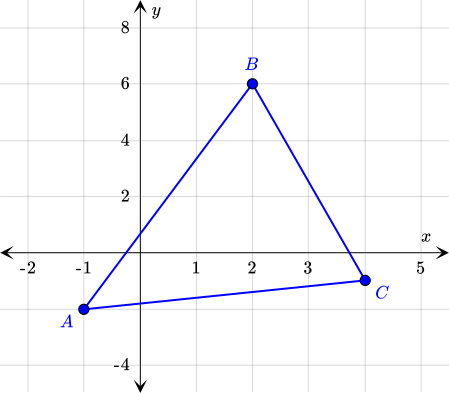
To determine whether the given points form a right triangle, we will start by plotting and labeling the points. Then, we will connect them on a coordinate plane.
Now that we can see the triangle, we will need to measure the side lengths and then use the Converse of the Pythagorean Theorem to check whether the lengths create a right triangle.
Measuring the Side Lengths
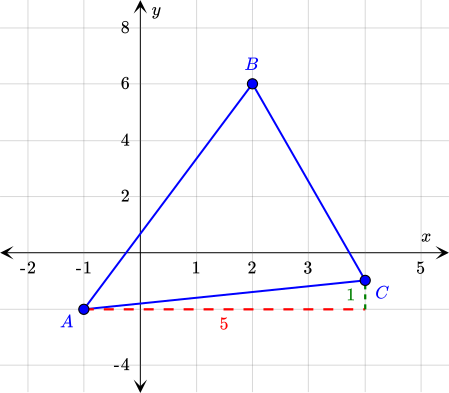
First, let's measure the horizontal and vertical distances between the points A and C.
Knowing the horizontal and vertical distances, we are able to find the distance d_(AC) between A and C by using the Pythagorean Theorem. Keep in mind that segment AC is the hypotenuse of the triangle that we created, so its value must be substituted for c in the theorem.
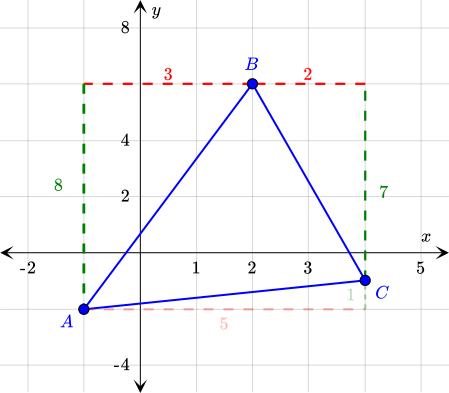
The distance between A and C is sqrt(26). Let's now measure the horizontal and vertical distance between C and B as well as between B and A.
With these values, we can calculate the distances.
Distance
Pythagorean Theorem
Solve
Between C and B
2^2+ 7^2=( d_(CB))^2
d_(CB)= sqrt(53)
Between B and A
3^2+ 8^2=( d_(BA))^2
d_(BA)= sqrt(73)
Using the Converse of the Pythagorean Theorem
Finally, let's recall the Converse of the Pythagorean Theorem.
Converse of the Pythagorean Theorem
If the Pythagorean Theorem is true for the side lengths of a triangle, then the triangle is a right triangle.
We will use this to determine whether our triangle, which has the sides lengths sqrt(26), sqrt(53), and sqrt(73), is a right triangle. It is important to make sure that the longest side length is substituted as c in this equation or it will not work properly!
The Pythagorean Theorem proved false for the obtained side lengths. Therefore, we can conclude that the triangle formed by the given points is not a right triangle.