Begin by determining the transformation of the given graph.
Function: g(x)=(x-1)^2-2 Verification: See solution.
Practice makes perfect
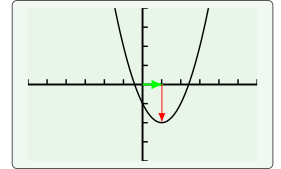
We will write the equation of the quadratic function that has the following graph.
The above graph is the transformation of the graph of the parent quadratic function. It is represented by the following function.
Parent Function &Transformation
f(x)=x^2 &g(x)= a(x- h)^2+ kTo determine the constants a, h, and k, we should first understand how they affect the function.
Transformations of f(x)=x^2
Vertical Translations
Translation up k units, k>0
y=x^2+ k
Translation down k units, k<0
y=x^2+ k
Horizontal Translations
Translation right h units, h>0
y=(x- h)^2
Translation left h units, h<0
y=(x- h)^2
Vertical Stretch or Shrink
Vertical stretch, a>1
y= ax^2
Vertical shrink, 0< a< 1
y= ax^2
Now, with this table, let's examine the given graph.
As we can see, the graph of the parent function has been translated 1 unit to the right and 2 units down.
g(x)= a(x- 1)^2+( -2)
⇕
g(x)= a(x-1)^2-2
Next, we will determine the value of a. Notice that the y-intercept of the graph is the point (0,-1). By substituting x=0 and y=g(x)=-1 into the above equation, we can find a.
Now that we found the value of a, we can complete the equation.
g(x)= 1(x-1)^2-2
⇕
g(x)=(x-1)^2-2
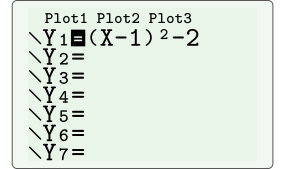
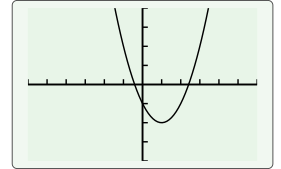
Finally, we will graph the above function using a graphing calculator to verify it. To draw a graph on a calculator, we first press the Y= button and type the function in one of the rows. Having written the function, we can push GRAPH to draw it.
Because the graph of our equation matches the given graph, it is correct.