5. Add and Subtract Integers
Sign In
An error ocurred, try again later!
Chapter 1
5.
Add and Subtract Integers
This lesson explores the fundamentals of adding and subtracting integers, particularly focusing on positive and negative integers. It uses relatable scenarios, like Tadeo and Magdalena's adventures in spending their allowances and playing board games, to illustrate the concepts. For example, the material explains how to add or subtract money amounts and temperatures, making it relevant for everyday calculations. It also discusses the importance of understanding the number line for these operations. The lesson aims to make you adept at integer operations through engaging examples and clear, step-by-step explanations.
Show less Show more expand_more 


Lesson Settings & Tools
| | 12 Theory slides |
| | 9 Exercises - Grade E - A |
| | Each lesson is meant to take 1-2 classroom sessions |
Add and Subtract Integers
Slide of 12
Using a positive integer is a good way to represent the savings in a piggy bank. Adding to this number will give the final amount after adding money to the bank. On the other hand, subtracting it will give the final amount after withdrawing money from the savings. Throughout this lesson, a variety of examples like this will be used to show the process of adding and subtracting integers.
Catch-Up and Review
Here are a few recommended readings before getting started with this lesson.
Challenge
Share
Report error
Discovering What Is Inside the Mystery Box
Siblings Tadeo and Magdalena bought a mystery box online. A curious board game inside caught their attention.
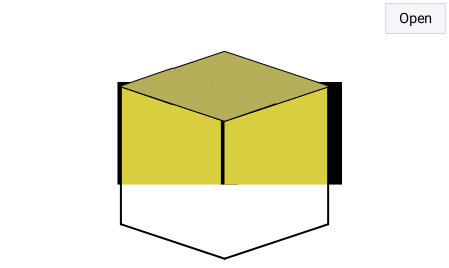 In this game, each player starts at 0. Players take turns rolling a die 🎲 and moving backward or forward based on the outcome of the roll. The rules for each roll outcome are shown in the table.
| Outcome | Action |
|---|---|
| 1 | Move 1 step forward |
| 2 | Move 2 steps backward |
| 3 | Move 3 steps forward |
| 4 | Move 4 steps backward |
| 5 | Move 5 steps backward |
| 6 | Move 6 steps forward |
The first player to reach 36 is the winner.
a Magdalena rolls the die three times and gets 3, 5, and 1, respectively. What is the final position of her game piece on the board?
{"type":"text","form":{"type":"math","options":{"comparison":"1","nofractofloat":false,"keypad":{"simple":true,"useShortLog":false,"variables":[],"constants":[]},"rendered":false},"text":" "},"formTextBefore":null,"formTextAfter":null,"answer":{"text":["-1"]}}
b Tadeo got 1, 1, and 4 in his three rolls. What is the final position of his game piece on the board?
{"type":"text","form":{"type":"math","options":{"comparison":"1","nofractofloat":false,"keypad":{"simple":true,"useShortLog":false,"variables":[],"constants":[]},"rendered":false},"text":" "},"formTextBefore":null,"formTextAfter":null,"answer":{"text":["-2"]}}
Discussion
Share
Report error
Adding and Subtracting Integers
Addition and subtraction are two primary operations performed between two or more integers to increase or decrease their values.
Adding a Positive Integer
To add a positive integer b to an integer a, move b units to the right-hand side of a on a number line. Consider a= 3 and b= 7. a= 3, b= 7 ⇓ 3+ 7=?
The process of adding a and b will be illustrated using these values.
1
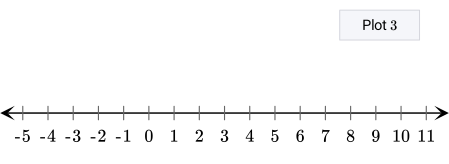
Plot a on a Number Line
expand_more Begin by graphing a on a number line. In this case, the value of a= 3. Move 3 units to the right side of 0 to plot 3.
2
Move b Units to the Right-Hand Side of a
expand_more Starting from a, move b units to the right to add b units to a. For this example, move seven units to the right of 3 to add 7 to 3.
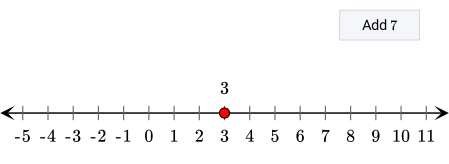 The point is now at 10. This means that the sum of 3 and 7 is 10.
3+ 7=10
The point is now at 10. This means that the sum of 3 and 7 is 10.
3+ 7=10
Discussion
Share
Report error
Subtracting a Positive Integer
Subtracting a positive integer b from a is similar. In this case, move b units to the left-hand side of a on a number line. Consider the subtraction of b from a using the same example values.
a= 3, b= 7 ⇓ 3- 7=?
This process can be performed on the number line. 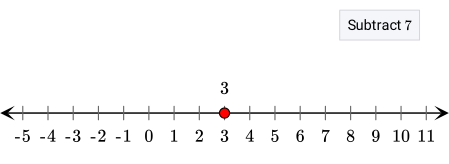 Now the point is at -4. The result of subtracting 7 from 3 is -4.
3- 7=-4 This process applies to adding or subtracting any positive integer b from a positive or negative integer a. The result can be a negative integer, a positive integer, or 0.
Now the point is at -4. The result of subtracting 7 from 3 is -4.
3- 7=-4 This process applies to adding or subtracting any positive integer b from a positive or negative integer a. The result can be a negative integer, a positive integer, or 0.
Example
Share
Report error
Money Spent on the Mystery Box
Tadeo and Magdalena bought the mystery box by combining their monthly allowances. Tadeo paid $10 out of the total cost of the box and Magdalena paid only $6.

a What is the total cost of the box?
{"type":"text","form":{"type":"math","options":{"comparison":"1","nofractofloat":false,"keypad":{"simple":true,"useShortLog":false,"variables":[],"constants":[]},"rendered":false},"text":" "},"formTextBefore":"$","formTextAfter":null,"answer":{"text":["16"]}}
b Tadeo had $12 before they purchased the box. How much does he have left after the purchase?
{"type":"text","form":{"type":"math","options":{"comparison":"1","nofractofloat":false,"keypad":{"simple":true,"useShortLog":false,"variables":[],"constants":[]},"rendered":false},"text":" "},"formTextBefore":"$","formTextAfter":null,"answer":{"text":["2"]}}
c Magdalena had -$1 of her allowance left after the purchase. How much money did she receive for her allowance?
{"type":"text","form":{"type":"math","options":{"comparison":"1","nofractofloat":false,"keypad":{"simple":true,"useShortLog":false,"variables":[],"constants":[]},"rendered":false},"text":" "},"formTextBefore":"$","formTextAfter":null,"answer":{"text":["5"]}}
Hint
a Plot the amount Tadeo paid out of the total cost of the box as a point on a number line. Move six units to the right-hand side of the point to add the $6 that Magdalena paid. The end point represents the total cost of the box.
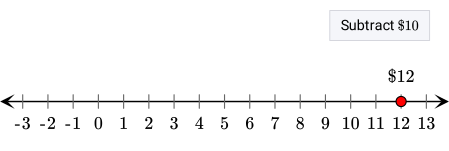
b Graph the starting amount of money that Tadeo had as a point on a number line. Move ten units to the left-hand side of the point to subtract the amount he paid for the box. The end point represents the amount of allowance he has left after the purchase.
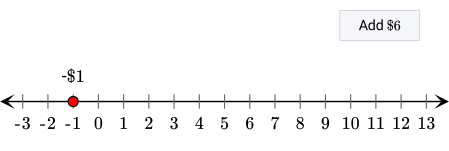
c Start with the remaining amount of money that Magdalena has. Add the amount of money she paid for the box to this amount.
Solution
a The sum of the amount of money paid by Tadeo and by Magdalena gives the total cost of the box. Remember that that Tadeo paid $10 and Magdalena $6.
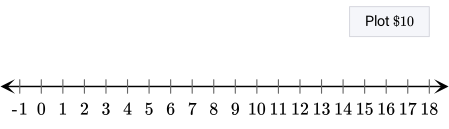
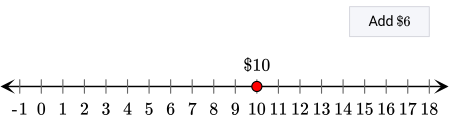
b Tadeo's started with $12 of allowance.
c Begin by writing how much of her allowance Magdalena has left.
Example
Share
Report error
Watch a TV Show or Play Soccer?
Tadeo and Magdalena take a break from unpacking the box. They are now deciding whether to play soccer or stay in the house to watch a movie in the afternoon. The kids agree that they will stay inside if the weather is colder than 62^(∘) F (degrees Fahrenheit) in the afternoon. The current temperature is 67^(∘) F.

{"type":"text","form":{"type":"math","options":{"comparison":"1","nofractofloat":false,"keypad":{"simple":true,"useShortLog":false,"variables":[],"constants":[]},"rendered":false},"text":" "},"formTextBefore":null,"formTextAfter":"^(∘) F","answer":{"text":["58"]}}
{"type":"choice","form":{"alts":["Stay inside and watch a movie.","Go outside and play soccer."],"noSort":false},"formTextBefore":"","formTextAfter":"","answer":0}
Hint
Cool down
suggests a subtraction. Subtract 9 from 67 to find the expected temperature for the afternoon.
Solution
Tadeo and Magdalena know that the current temperature is 67^(∘) F.
Current Temperature 67^(∘) F
They want to know the temperature later in the afternoon, given that it is expected to cool down by 9^(∘)F. 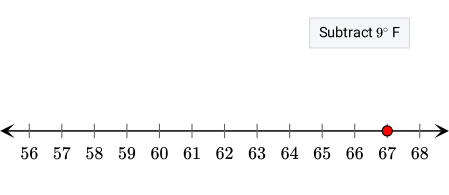 This means that the predicted temperature for later in the afternoon is 58^(∘) F.
Afternoon Temperature 67^(∘) F- 9^(∘) F=58^(∘) F
Since the temperature for the afternoon is expected to be less than 62^(∘) F, the kids will most likely stay inside to watch a movie. Pass the popcorn!
This means that the predicted temperature for later in the afternoon is 58^(∘) F.
Afternoon Temperature 67^(∘) F- 9^(∘) F=58^(∘) F
Since the temperature for the afternoon is expected to be less than 62^(∘) F, the kids will most likely stay inside to watch a movie. Pass the popcorn!
Cool downimplies subtraction — in other words, subtracting 9 degrees from the current temperature will give the temperature for later in the afternoon. Afternoon Temperature 67^(∘) F- 9^(∘) F=? This expression is a subtraction of a positive integer from another integer. This can be represented on a number line. Start by locating the current temperature on the line. Next, move 9 units to the left-hand side of 67 to subtract the 9 degrees from the current temperature.
Discussion
Share
Report error
Adding a Negative Integer
Adding a negative integer - b to an integer a requires changing the addition sign to a subtraction sign and changing - b to its additive inverse, b. To illustrate this, consider a= 4 and - b= - 5.
a= 4, - b= - 5 ⇓ 4+( -5)=?
Next, this process is shown with these pair of integers.
1
Change the Addition Sign to a Subtraction Sign and Change - b to b
expand_more Change the addition sign to a subtraction sign and then change - b to its opposite b. In this example, - b = -5 and its opposite is 5. 4 + ( -5) ⇔ 4 - 5 The addition of an integer and a negative integer is now turned into a subtraction of an integer and a positive integer.
2
Plot a on a Number Line
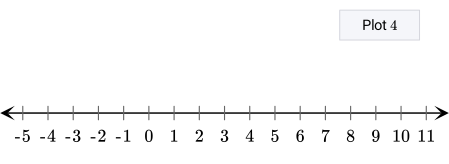
expand_more The process now is similar to subtracting one positive integer from another. First, plot a on a number line. The value of a, in this case, is 4.
3
Move b Units to the Left-Hand Side of a
expand_more Now move b units to the left-hand side of a to subtract b from a. In this example, move 5 units to the left of 4 to subtract 5 from 4.
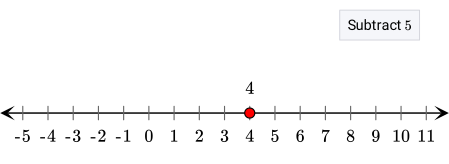 The point is now at -1. This means that the subtraction of 5 from 4 is -1. This is also the result of adding -5 to 4.
4+( -5)=-1
The point is now at -1. This means that the subtraction of 5 from 4 is -1. This is also the result of adding -5 to 4.
4+( -5)=-1
Discussion
Share
Report error
Subtracting a Negative Integer
Subtracting a negative integer - b from an integer a requires changing the subtraction sign to an addition sign and changing - b to its additive inverse. To illustrate this, consider a= -2 and - b= - 6
a - ( - b) ⇔ a + b -2 - ( -6) ⇔ -2 + 6
The result is the sum of an integer and a positive integer. 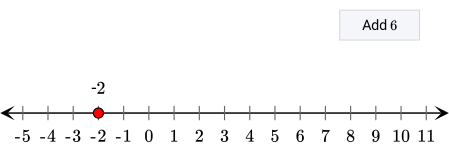 The point is now at 4. The result of subtracting - 6 from -2 is 4.
-2 - ( -6)=4 ⇔ -2 + 6=4 This process applies to adding or subtracting any netative integer - b from a positive or negative integer a. The result can be a negative integer, a positive integer, or 0.
The point is now at 4. The result of subtracting - 6 from -2 is 4.
-2 - ( -6)=4 ⇔ -2 + 6=4 This process applies to adding or subtracting any netative integer - b from a positive or negative integer a. The result can be a negative integer, a positive integer, or 0.
Example
Share
Report error
Rescuing the Dolphin
Magdalena and Tadeo spend the rest of the day watching a fantastic movie together. The movie is about a dolphin stuck in a net in the ocean. The siblings are intrigued because the main character, a kid like them, wants to save the dolphin. The kid swims 10 feet below sea level, but the dolphin is 7 feet deeper.
The siblings want to figure out how deep the dolphin is below the surface. Help them find the answer.
{"type":"text","form":{"type":"math","options":{"comparison":"1","nofractofloat":false,"keypad":{"simple":true,"useShortLog":false,"variables":[],"constants":[]},"rendered":false},"text":" "},"formTextBefore":null,"formTextAfter":"feet","answer":{"text":["-17"]}}
Hint
Start by representing the main character's depth as a negative value. The seven feet further down to reach the dolphin is also negative. When adding a negative integer to another integer, change the addition sign to a subtraction sign and the negative integer added to its opposite.
Solution
Negative values usually represent elevations below sea level, or depths below sea level. It is given that the kid is 10 feet below sea level. His depth would then be -10.
Kid's Depth -10 ft
Now, the dolphin is deeper down than the kid is, which means that this extra depth must be added to the kid's depth to find how far down the dolphin is. The dolphin is seven feet deeper than the main character, so this depth can be written as written as -7.
Dolphin's Depth -10 ft + ( -7) ft = ?
The resulting expression is an addition of a negative integer to another integer. The first step to find this sum is to change the addition sign to a subtraction sign. At the same time, -7 must be changed to its opposite, 7.
Dolphin's Depth -10 ft + ( -7) ft = ? ⇕ -10 ft - 7 ft = ?
The expression is now a subtraction of a positive integer from another integer. This can be solved on a number line by plotting -10 on a vertical number line, then moving 7 units down from this position. The ending value will be the depth of the dolphin.
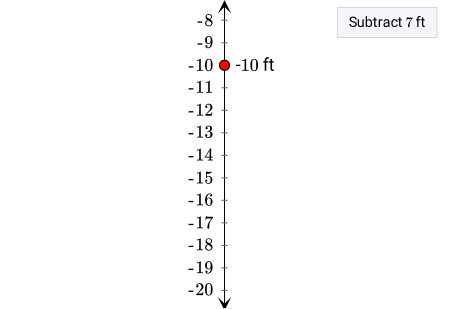 The dolphin's depth is -17. This means that the dolphin is 17 feet below sea level. Dolphin's Depth -10 ft + ( -7) ft = -17ft ⇕ -10 ft - 7 ft = -17ft
The siblings are happy because the main character saved the dolphin. The movie had a great lesson for everyone — avoid throwing trash away irresponsibly, especially in the ocean, because it is hazardous for all living beings.
The dolphin's depth is -17. This means that the dolphin is 17 feet below sea level. Dolphin's Depth -10 ft + ( -7) ft = -17ft ⇕ -10 ft - 7 ft = -17ft
The siblings are happy because the main character saved the dolphin. The movie had a great lesson for everyone — avoid throwing trash away irresponsibly, especially in the ocean, because it is hazardous for all living beings.
Example
Share
Report error
Where Is Luna, the Family Pet?
Oh no! Magdalena and Tadeo were distracted by the movie and did not notice that Luna, the family pet, escaped. They must find Luna before their parents get home.
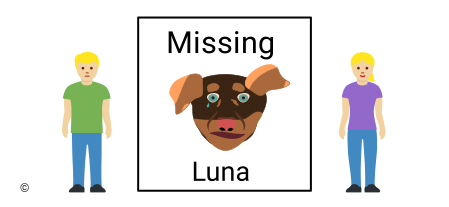
Tadeo and Magdalena live in a third-floor apartment. They decide start their search in the underground parking structure, which is a common place that Luna goes to. She particularly likes the third floor down of the parking structure, Subbasement 3.
a How many floors do they go down to reach Subbasement 3?
{"type":"text","form":{"type":"math","options":{"comparison":"1","nofractofloat":false,"keypad":{"simple":true,"useShortLog":false,"variables":[],"constants":[]},"rendered":false},"text":" "},"formTextBefore":null,"formTextAfter":"floors","answer":{"text":["5"]}}
b Luna was not in Subbasement 3, so the siblings started working their way back up. They found her on the first floor below ground level, Subbasement 1. How many floors did they go up before coming across Luna?
{"type":"text","form":{"type":"math","options":{"comparison":"1","nofractofloat":false,"keypad":{"simple":true,"useShortLog":false,"variables":[],"constants":[]},"rendered":false},"text":" "},"formTextBefore":null,"formTextAfter":"floors","answer":{"text":["2"]}}
Hint
b Write Luna's location as an integer. Subtract this integer from the integer that represents where Tadeo and Magdalena are on the Subbasement 3 floor. Apply the absolute value to the result to get the distance.
Solution
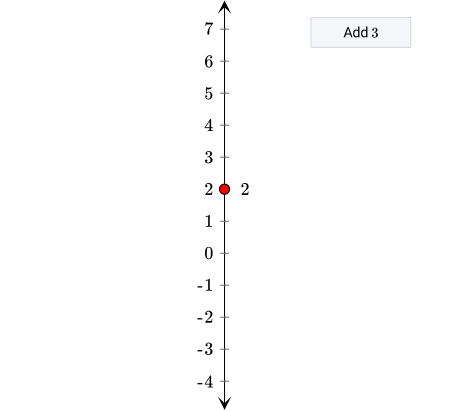
a Since the siblings live on the third floor, they go down 2 floors to reach the ground floor. If the ground floor is represented by 0 on the number line, the family apartment floor will be represented by 2 on the line.
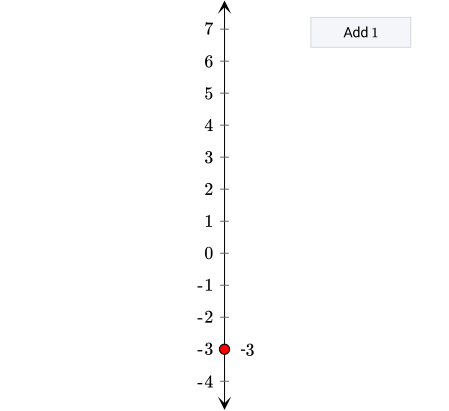
b Recall that Subbasement 3 is represented by the number -3. Luna is on the first floor of the underground parking structure, one floor below ground. This position is -1. Subtracting Luna's position from Subbasement 3 will give how many floors the siblings must go up in order to find Luna.
Pop Quiz
Share
Report error
Finding the Sum or Subtraction of Random Integers
Find the given sum or difference of integer numbers. Consider that adding a negative number is the same as subtracting its opposite. In contrast, subtracting a negative integer is the same as adding its opposite.

Closure
Share
Report error
Who Wins the Board Game That Comes in the Mystery Box?
In this lesson, how to add and subtract integer numbers was explained. Use this information to find the positions of Tadeo's and Magdalena's pieces on the curious board game that came in the mystery box they bought. Begin by looking at the board game.

In this game, players start at 0 and take turns rolling a die 🎲 to move forward or backward based on the outcome of the roll. The rules for each of these outcomes are shown in the table.
| Outcome | Action |
|---|---|
| 1 | Move 1 step forward |
| 2 | Move 2 steps backward |
| 3 | Move 3 steps forward |
| 4 | Move 4 steps backward |
| 5 | Move 5 steps backward |
| 6 | Move 6 steps forward |
The first player to reach 36 is the winner.
a Magdalena rolls the die three times and gets 3, 5, and 1, respectively. What is the final position of her game piece on the board?
{"type":"text","form":{"type":"math","options":{"comparison":"1","nofractofloat":false,"keypad":{"simple":true,"useShortLog":false,"variables":[],"constants":[]},"rendered":false},"text":" "},"formTextBefore":null,"formTextAfter":null,"answer":{"text":["-1"]}}
b Tadeo got 1, 1, and 4 in his three rolls. What is the final position of his game piece on the board?
{"type":"text","form":{"type":"math","options":{"comparison":"1","nofractofloat":false,"keypad":{"simple":true,"useShortLog":false,"variables":[],"constants":[]},"rendered":false},"text":" "},"formTextBefore":null,"formTextAfter":null,"answer":{"text":["-2"]}}
Hint
a Magdalena's game piece's final position on the board is the sum of the three integers representing the actions for her rolls. Use the opposite numbers to simplify calculations. Then, perform the calculations from left to right on a number line.
b Follow the same steps as in Part A.
Solution
a Begin by representing each number Magdalena rolled as an integer value. If the action of to a given outcome is to move forward 3 steps, for example, this would be represented by the positive integer 3. On the other hand, if the action is to move backward 5 steps, it would be represented as -5.
| Outcome | Action | Integer |
|---|---|---|
| 3 | Move 3 steps forward | 3 |
| 5 | Move 5 steps backward | -5 |
| 1 | Move 1 step forward | 1 |
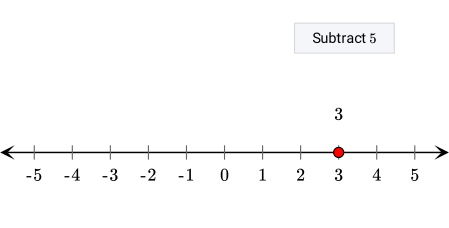
b Follow a similar process to find the position of Tadeo's game piece. First, represent each of his rolls as an integer value.
| Outcome | Action | Integer |
|---|---|---|
| 1 | Move 1 step forward | 1 |
| 1 | Move 1 step forward | 1 |
| 4 | Move 4 steps backward | -4 |
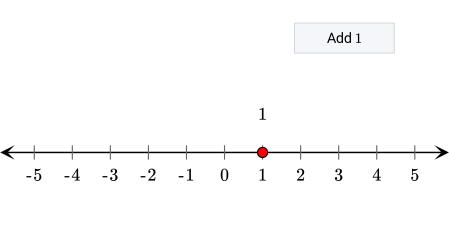
Add and Subtract Integers
Exercise 3.1
Davontay is trying to solve a magic square where only three numbers are provided.
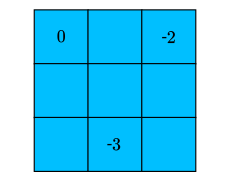
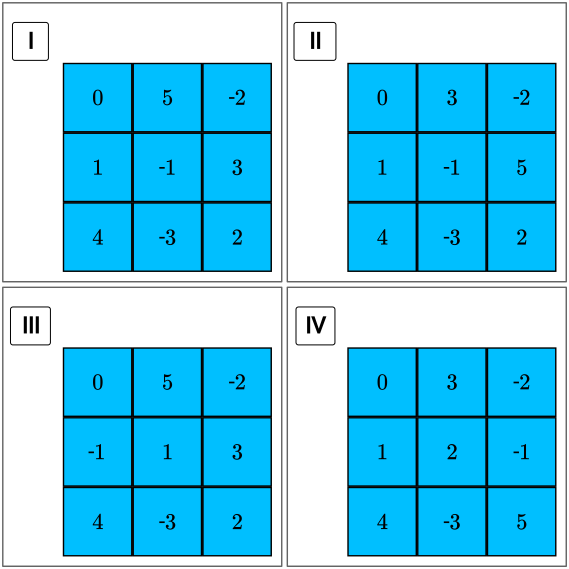
In this game, players arrange numbers to make the rows, columns, and diagonals add up to the same sum. This sum is called the magic sum. If the magic sum of Davontay square is 3 and he can only use integers between -3 and 5 once, which of the following represents the solution to the magic square?
{"type":"choice","form":{"alts":["I","II","III","IV"],"noSort":true},"formTextBefore":"","formTextAfter":"","answer":2}
security
report
code
security
report
code
We know that the sum for each row and each column is 3. Note that in the first row, we have 0 and -2. We can add these two numbers to see how much is needed to get to 3. 0 + ( -2) We have the addition of a negative integer to another integer. We must change the addition sign to a subtraction sign and -2 to its opposite 2. 0 + ( -2) ⇕ 0 - 2=-2 We must discover how much we add to -2 to get 3. We start counting from -2 on a number line until we reach 3.
We need to add 5 to -2 to get 3. We can write this number in the magic square to complete the first row.
We can now follow a similar process to find the missing number in the second column. Let's first add 5 and -3. 5 + ( -3) ⇕ 5 - 3=2 The number 2 is only 1 unit behind 3. This means the missing number in this column is 1.
Now, note that the diagonal formed with the top-left square and the bottom-right square has only one missing number. The sum of 0 and 1 is 1, two units behind 3. We can complete this diagonal by filling the bottom-left square with the number 2.
Next, in the rightest column, we have the sum of -2 and 2, which is 0 because they are opposite. We need three units to reach 3. This is the number that completes this column.
Let's now find the missing number in the bottom left square. However, we must guarantee that both the diagonal across this square and the row add to 3. Let's find the sum of this diagonal and this row. -2+1=-1 -3+2=-1 Both sums equal -1. This means that we need four units to get to 0. We can complete the bottom-left square with 4.
The only number available to complete the magic square is -1. Let's ensure that the corresponding row and column of the missing cell add to 3 when filling it with the number -1. 0+4+(-1)=3 -1+1+3=3 The magic square is now completed.
This graph matches option III.
security
report
code
Add and Subtract Integers
Recommended exercises
To get personalized recommended exercises, please login first.
Loading content
≤
>
■2
■▢
e▢
7
8
9
×
÷■1
=
=
√▢
▢√
∫▢▢
4
5
6
+
−
≤
<
log
ln
log▢
1
2
3
()
∣
sin
cos
tan
0
.
π
x
y
Loading content