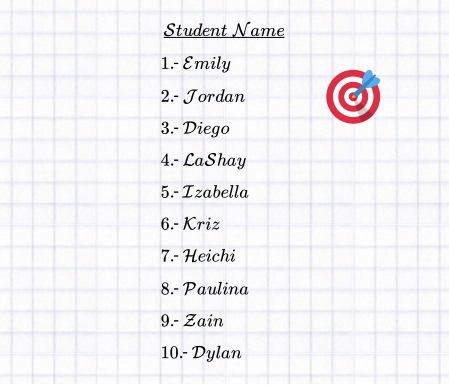
Begin by describing each method. What happen if we include some bias on both methods?
See solution.
Practice makes perfect
Our friend claims that using a random number table to pick a person at random is not as fair as throwing a dart at the list of names. To compare both methods, let's suppose that there is a list of 10 students and we want to select one of them. First, we will describe how each method is conducted.
Using a Random Number Table
The first step is taking a line from a random number table.
18 820 78 162 93 591 57 295 29 623 71 626 77 986Then, we will group the line from the table into two digit-numbers.
18 82 07 81 62 93 59 15 72
95 29 62 37 16 26 77 98 6
We need to take the first number less than 10 from the two-digit numbers, which is 07. The seventh student on the list will be the chosen one.
Throwing a Dart
In this method, we only take the dart and throw it at the list.
Conclusions
We have described both methods. Now, let's compare them and suppose that we make some decisions based on our wishes when we conduct both methods.
Random Number Generator: If we choose one line of the number list based on our feelings, we do not have control over them because they will be split in the next step. Additionally, we do not know which one will be the first number less than 10.
Throwing a Dart: We can decide if we want to throw the dart higher, lower, or in the middle.
With this information we can conclude that even if we include some bias in the random number generator method, we do not control the result. However, the throw will be affected because we have some control over the throw, which is what our friend is not taking into account.