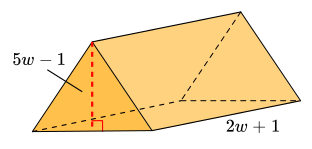
Consider the given with a triangular base.
The is 10w^3+23w^2+5w-2, where its height is 2w+1 and the height of the triangular base is 5w-1. We will calculate the length of the base of the . To do so, let's first find an expression for the of the triangular base B by using the formula for the volume of a prism.
V=BhLet's substitute V= 10w^3+23w^2+5w-2 and h= 2w+1 into the formula and solve it for B.
V=Bh
10w^3+23w^2+5w-2=B( 2w+1)
10w^3+23w^2+5w-2/2w+1=B
B=10w^3+23w^2+5w-2/2w+1
We will use to calculate the B. All the terms of the dividend must be present and the must be in . Since there are no missing terms and our polynomial is in descending order, we do not need to rewrite the polynomial. Let's divide!
l r 2w+1 & |l 10w^3+23w^2+5w-2
r 5w^2 r 2w+1 & |l 10w^3+23w^2+5w-2
r 5w^2 rl 2w+1 & |l 10w^3+23w^2+5w-2 & 10w^3+5w^2
r 5w^2 r 2w+1 & |l 18w^2+5w-2
r 5w^2+9w r 2w+1 & |l 18w^2+5w-2
r5w^2+ 9w rl 2w+1 & |l 18w^2+5w-2 & 18w^2+9w
r 5w^2+9w r 2w+1 & |l - 4w-2
r 5w^2+9w-2 r 2w+1 & |l - 4w-2
r5w^2+9w - 2 rl 2w+1 & |l - 4w-2 & - 4w-2
r 5w^2+9w-2 r 2w+1 & |l 0
The quotient is 5w^2+9w-2. This is the area of the triangle B. We will find the measure of the base of the triangle. To do this, let's use the formula for the area of a triangle.
B=1/2bh
Let's now substitute B= 5w^2+9w-2 and h= 5w-1 into the formula and solve it for b.
B=1/2bh
5w^2+9w-2=1/2b( 5w-1)
2(5w^2+9w-2)=b(5w-1)
10w^2+18w-4=b(5w-1)
10w^2+18w-4/5w-1=b
b=10w^2+18w-4/5w-1
We will again use polynomial long division to calculate the quotient b. Notice that there are no missing terms in the dividend and our dividend is in descending degree order. Therefore, we do not need to rewrite it. Let's divide!
l r 5w-1 & |l 10w^2+18w-4
r 2w r 5w-1 & |l 10w^2+18w-4
r 2w rl 5w-1 & |l 10w^2+18w-4 & 10w^2-2w
r 2w r 5w-1 & |l 20w-4
r 2w+4 r 5w-1 & |l 20w-4
r2w+ 4 rl 5w-1 & |l 20w-4 & 20w-4
r 2w+4 r 5w-1 & |l 0
The quotient is 2w+4. This is the measure of the base of the triangle.
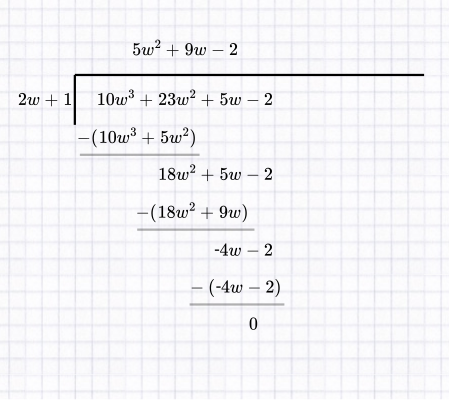
When we are doing long division by hand, it looks a bit different than how we have it in this solution. Here is how yours should look when you are writing it in your notebook. Let's start with the of 10w^3+23w^2+5w-2 by 2w+1.
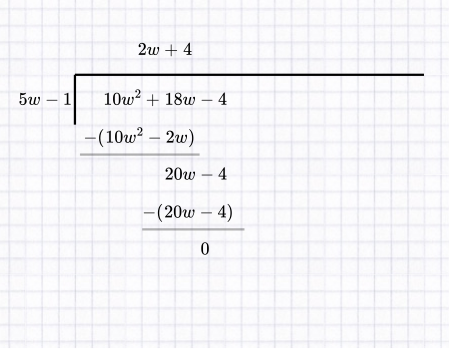
Let's now show how to divide 10w^2+18w-4 by 5w-1 by hand.