{{ tocSubheader }}
{{ 'ml-label-loading-course' | message }}
An error ocurred, try again later!
Chapter {{ article.chapter.number }}
{{ article.number }}.
{{ article.displayTitle }}
{{ article.intro.summary }}
Show less Show more expand_more Lesson Settings & Tools
| | {{ 'ml-lesson-number-slides' | message : article.intro.bblockCount }} |
| | {{ 'ml-lesson-number-exercises' | message : article.intro.exerciseCount }} |
| | {{ 'ml-lesson-time-estimation' | message }} |
This lesson aims to show how to represent the solutions to linear inequalities on a coordinate plane.
Catch-Up and Review
Here are a few recommended readings before getting started with this lesson.
Challenge
How Would the Graph Change?
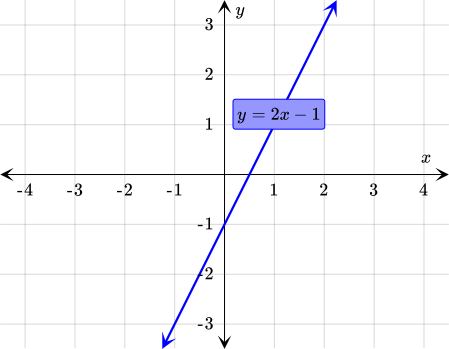
When graphing a linear equation, the resulting graph is a line.
Discussion
Linear Inequality
A linear inequality is an inequality that represents a linear relationship involving one or more variables. Therefore, the exponent of all variables is 1. As with any other inequality, linear inequalities can be strict or non-strict.
| Strict Linear Inequalities | Non-Strict Linear Inequalities |
|---|---|
| -13>-2x+4y | 7x−y≥21 |
| -9y<17+x | 9x+3y≤6 |
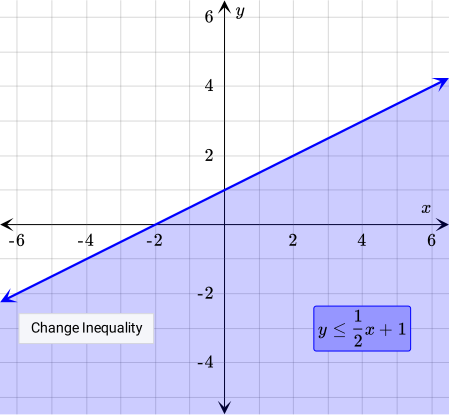
Linear inequalities are similar to linear equations. The difference is that, while the solutions to linear equations are represented by all the points that lie on a line, the solution set to a linear inequality is represented by the points on a region containing one half of the coordinate plane.
Determining if a Point Is a Solution of an Inequality
If a point is a solution to an inequality, then substituting its coordinates in the inequality makes a true statement. As an example, consider the following inequality.y≤3x+7
The points (0,0) and (1,11) will be tested. To verify whether these points are solutions, their coordinates will be substituted into the inequality. | Point | Substitute | Simplify |
|---|---|---|
| (0,0) | 0≤3(0)+7 | 0≤7 ✓ |
| (1,11) | 11≤3(1)+7 | 11≤10 × |
Pop Quiz
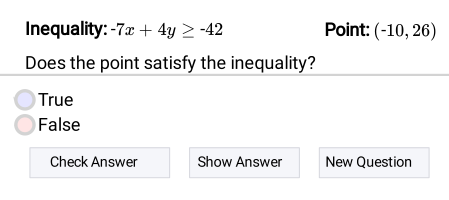
Does the Point Satisfy the Inequality?
Verify whether the point satisfies the given linear inequality.
Discussion
Graphing a Linear Inequality
Graphing a linear inequality is similar to graphing a linear equation in slope-intercept form. However, instead of a line, the graph of a linear inequality is a region of the coordinate plane. Consider the following linear inequality.
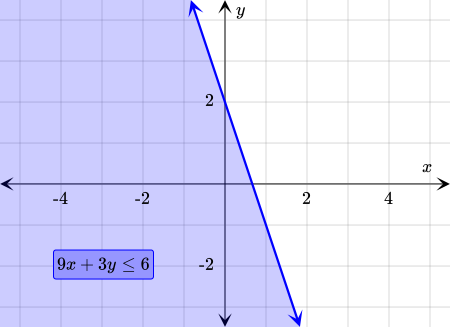
9x+3y≤6
To draw its solution set, the procedure begins by writing the inequality in slope-intercept form. This way, the equation for the boundary line can be obtained. Then, this boundary line is graphed in the coordinate plane. Finally, the region that contains the solutions is shaded.
1
Write the Inequality in Slope-Intercept Form
expand_more To find the boundary line of the region, start by writing the inequality similar to a linear equation in slope-intercept form. This is done solving the inequality for one of the variables, most commonly y.
Then, the inequality in slope-intercept form can be written as follows.
9x+3y≤6
▼
Write in slope-intercept form
SubIneq
LHS−9x≤RHS−9x
3y≤-9x+6
DivIneq
LHS/3≤RHS/3
y≤3-9x+6
WriteSumFrac
Write as a sum of fractions
y≤3-9x+36
MoveNegNumToFrac
Put minus sign in front of fraction
y≤-39x+36
MovePartNumRight
ca⋅b=ca⋅b
y≤-39x+36
CalcQuot
Calculate quotient
y≤-3x+2
y≤-3x+2
2
Graph the Boundary Line
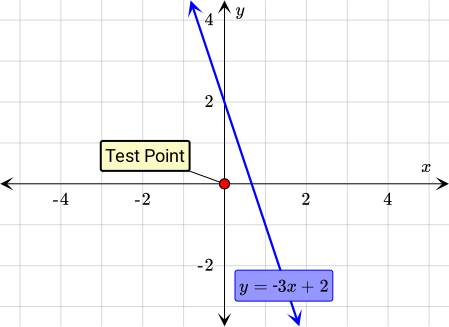
expand_more The boundary line of the inequality is obtained by replacing the inequality symbol with an equals sign.
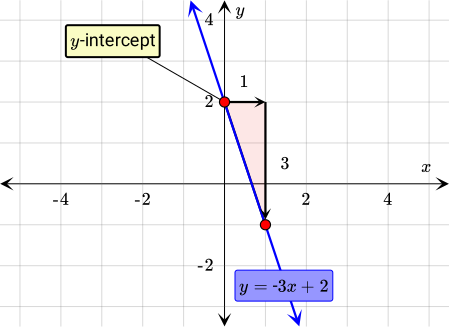
Inequalityy≤-3x+2Boundary Liney=-3x+2
If the inequality is strict, the points on the line are not solutions to the inequality. Therefore, the line is dashed. Conversely, if the inequality is not strict, the points on the line are solutions to the inequality. In this case, the line is solid. | Symbol | Meaning | Type | Boundary Line |
|---|---|---|---|
| < | Less than | Strict | Dashed |
| > | Greater than | Strict | Dashed |
| ≤ | Less than or equal to | Non-strict | Solid |
| ≥ | Greater than or equal to | Non-strict | Solid |
Therefore, in the given example, the line is solid. The boundary line can be graphed using y-intercept and slope.
3
Test a Point
expand_more The region of the coordinate plane either to the left or to the right of the boundary line contains the solution set. To determine the correct region, substitute an arbitrary test point not on the boundary line into the inequality. It is common to use (0,0).
Since 0≤2 is a true statement, the point (0,0) is a solution to the inequality.
4
Shade the Correct Region
expand_more If the test point is a solution to the inequality, the region that contains it must be shaded. Otherwise, the opposite region must be shaded.
In this case, the test point (0,0) is a solution to the inequality. The region containing (0,0) lies to the left of the boundary line. This is the region that must be shaded.
Example
Clothes for a Skiing Trip
Stoked to go on a ski trip to the Rocky Mountains, Heichi has saved as much money as he could to buy equipment. After buying most of the equipment, he is left with $1250 to buy jackets and pants.

At his favorite ski shop, each jacket costs $150 and each pair of pants costs $200.
a Write an inequality that describes the number of jackets and pairs of pants that Heichi can buy.
b Graph the inequality.
Answer
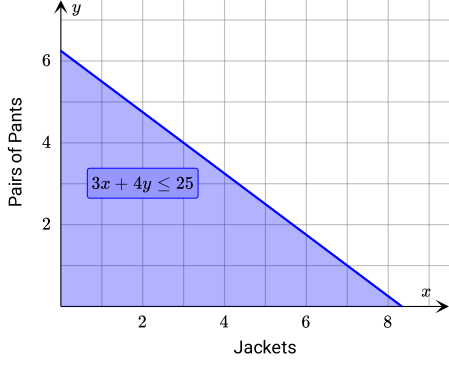
a 3x+4y≤25
b
Hint
a Use variables to represent the number of items bought.
b Write the linear inequality in slope-intercept form.
Solution
a To write an inequality that describes the number of jackets and pairs of pants that Heichi can buy, variables need to be assigned to each item.
Number of Jackets:Number of Pairs of Pants: x y
The total amount of money spent on these items is obtained by adding the product of each variable and the price of the item.
Money Spent: 150x+200y
It is given that the the total amount of money that Heichi can spend is $1250. Therefore, Heichi can spend no morethan $1250.
No morecan be written with the less than or equal to symbol.
150x+200y≤1250
This linear inequality can be simplified by dividing both sides of the equation by 50.
b To graph linear inequalities, they should be first rewritten in slope-intercept form. This can be done by solving the inequality for y.
Next, the boundary line will be graphed. Because the inequality is non-strict, the line will be solid. Also, since the quantities of interest are the number of items bought, the only relevant quadrant is the first quadrant, where the positive values lie. 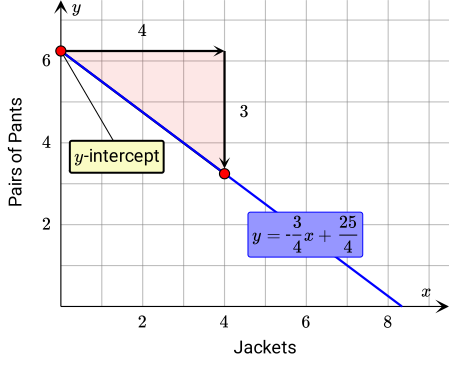 Now, the point (0,0) will be tested to determine the region that should be shaded. To do so, the point's coordinates will be substituted into the inequality.
Since the test point satisfies the inequality, the region that contains the point should be shaded.
Now, the point (0,0) will be tested to determine the region that should be shaded. To do so, the point's coordinates will be substituted into the inequality.
Since the test point satisfies the inequality, the region that contains the point should be shaded. 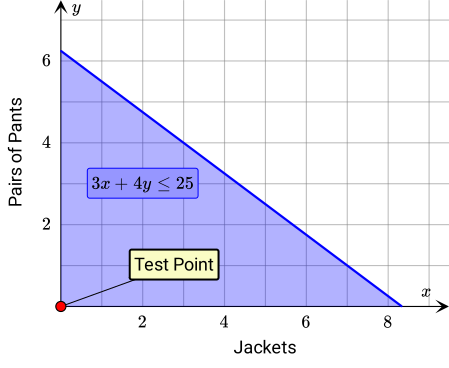
3x+4y≤25
▼
Write in slope-intercept form
SubIneq
LHS−3x≤RHS−3x
4y≤-3x+25
DivIneq
LHS/4≤RHS/4
y≤4-3x+25
WriteSumFrac
Write as a sum of fractions
y≤4-3x+425
MoveNegNumToFrac
Put minus sign in front of fraction
y≤-43x+425
MovePartNumRight
ca⋅b=ca⋅b
y≤-43x+425
Example
Algebraic and Graphic Methods to Solve an Inequality
Heichi needs to finish the last of his homework so he can hit the slopes. He is considering the following linear inequality.
 Now the region to be shaded will be found by testing the point (0,0) in the inequality.
Since the test point satisfies the inequality, the shaded region is the region that contains the point.
Now the region to be shaded will be found by testing the point (0,0) in the inequality.
Since the test point satisfies the inequality, the shaded region is the region that contains the point. 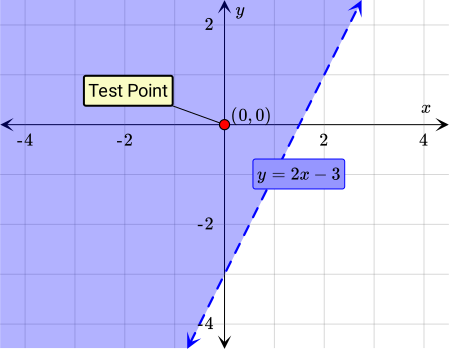
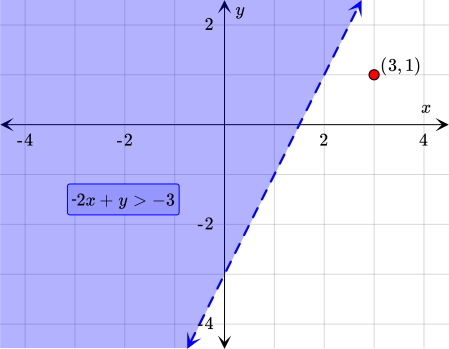
-2x+y>-3
He wonders whether the point (3,1) is a solution to the inequality. He needs to solve the problem algebraically, then test the point graphically. a How can Heichi solve this problem algebraically?
b How can he solve this problem graphically?
Answer
a See solution.
b See solution.
Hint
a Substitute the coordinates of the given point into the inequality.
b Graph the inequality first.
Solution
a To solve this problem algebraically, the given point will be substituted into the inequality. If the point satisfies the inequality, then it is a solution.
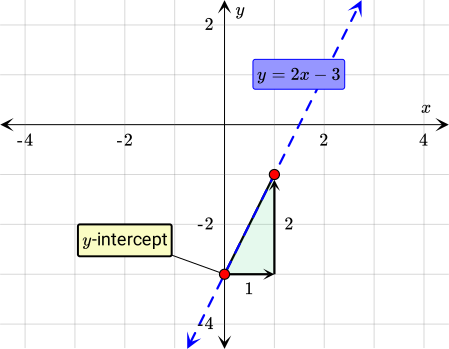
b To graphically test whether the given point is a solution to the linear inequality, the inequality will be graphed. To do so, it will be written in slope-intercept form.
-2x+y>-3 ⇔ y>2x−3
The boundary line is obtained by replacing the inequality symbol with an equals sign.
Inequalityy>2x−3Boundary Liney=2x−3
Since the inequality is strict, the line is dashed. Now the given point can be tested. To do so, verify if the point lies in the shaded region.
Since the point lies outside the shaded region, the point is not a solution to the inequality.
Discussion
Writing a Linear Inequality
Writing a linear inequality given a graph is similar to writing a linear equation given a graph. Two extra things must be considered.
- Whether the line is solid or dashed
- Shaded region
Consider the following graph.
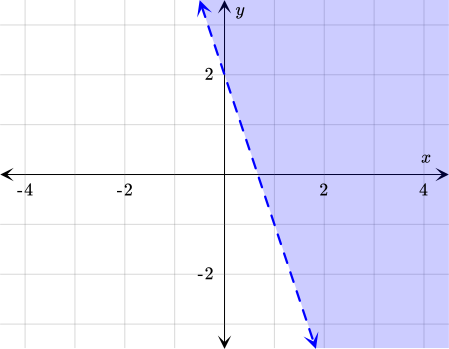
1
Writing the Linear Equation
expand_more To write the linear equation of the boundary line, the slope and y-intercept should be identified. It is easier to do so if the shaded region is ignored.
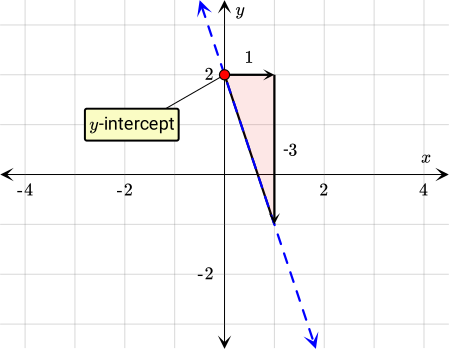
m=1-3⇔m=-3
Having found the slope and the y-intercept, the linear equation can be written in slope-intercept form.
y=-3x+2
2
Strict or Non-Strict?
expand_more To identify whether the inequality is strict or non-strict, the line should be considered. If it is dashed, the inequality is strict. Otherwise, the inequality is non-strict. Consider the boundary line of the given inequality.
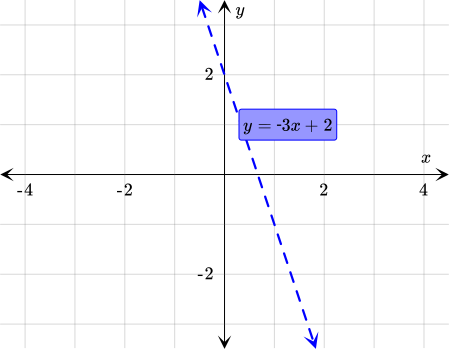
The graph has a dashed line. Therefore, the inequality is strict. This means that the inequality sign is either < or >.
3
Inequality Sign
expand_more To determine the sign of the inequality, a point located in the shaded region but not on the boundary line should be tested. For simplicity, the point (1,1) will be used.
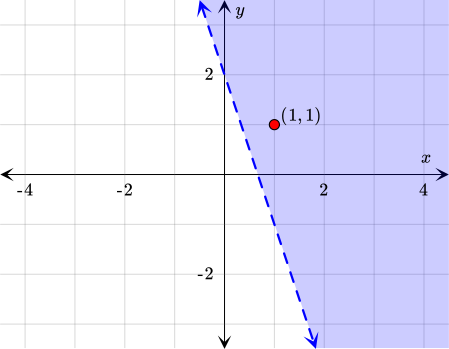
y ? -3x+2
SubstituteII
x=1, y=1
1 ? -3(1)+2
IdPropMult
Identity Property of Multiplication
1 ? -3+2
AddTerms
Add terms
1>-1
y>-3x+2
Example
Writing the Linear Inequality From a Graph
Consider the following graph of a linear inequality represented on a coordinate plane.
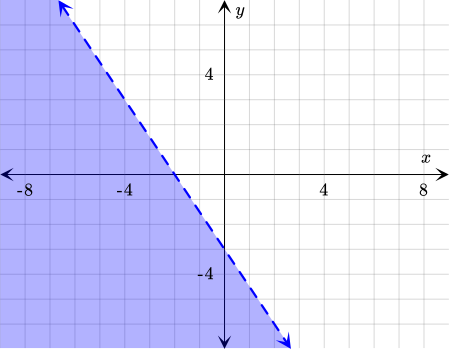
{"type":"text","form":{"type":"math","options":{"comparison":"1","nofractofloat":false,"keypad":{"simple":false,"useShortLog":false,"variables":["x","y"],"constants":[]},"rendered":false},"text":"<span class=\"katex\"><span class=\"katex-html\" aria-hidden=\"true\"><\/span><\/span>"},"formTextBefore":null,"formTextAfter":null,"answer":{"text":["y<-1.5x-3","y<-3\/2x-3","y<-\\dfrac{3}{2}x-3"]}}
Hint
Start by writing the equation of the boundary line.
Solution
To write a linear inequality from a graph, the first step is writing the equation the boundary line. To do so, the slope and the y-intercept will be found.
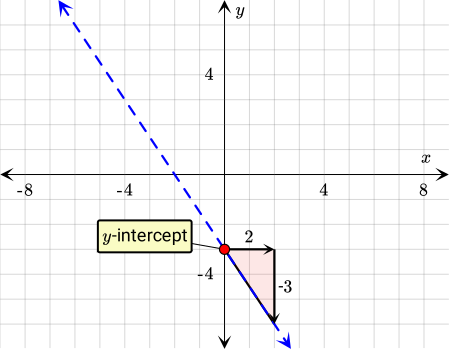
y=-1.5x+(-3) ⇔ y=-1.5x−3
Since the boundary line is dashed, the inequality is strict. To determine the inequality symbol, a point in the shaded region but not on the boundary line will tested. Looking at the graph, it can be seen that the point (-3,-2) lies in the shaded region. 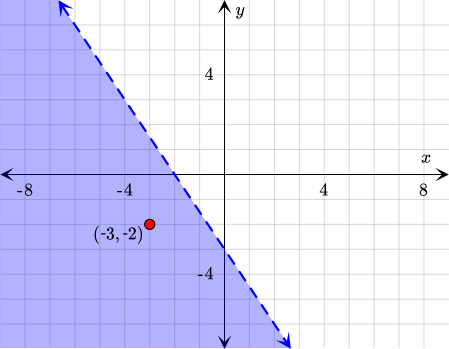
y ? -1.5x−3
SubstituteII
x=-3, y=-2
-2 ? -1.5(-3)−3
MultNegNegOnePar
-a(-b)=a⋅b
-2 ? 4.5−3
SubTerm
Subtract term
-2<1.5
y<-1.5x−3
Closure
Graphing Two Inequalities
This lesson will be finished by finding the solution set of two linear inequalities. Consider the following inequalities.
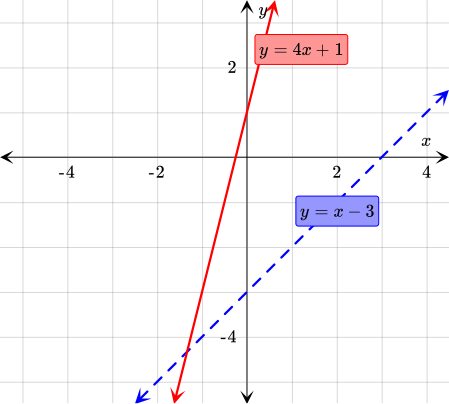
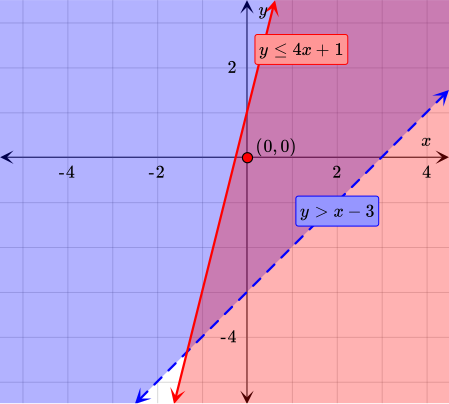
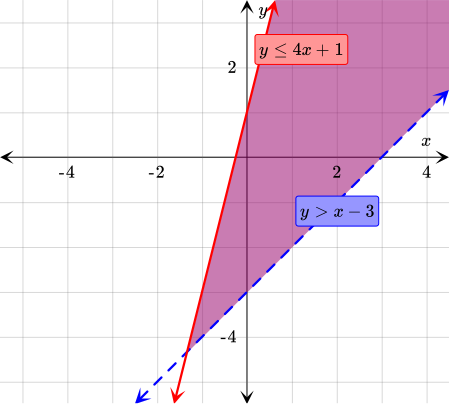 A single inequality divides the coordinate plane in two regions, and one of those regions is the solution set of the inequality. Meanwhile, two inequalities can divide the coordinate plane in up to four regions, and sometimes there is no overlapping solutions for both inequalities at the same time.
{y>x−3y≤4x+1
To graph the solution set of these two inequalities, it is important to identify and graph both boundary lines. Note that the inequalities are already written in slope-intercept form. The slope and the y-intercept can be used to graph these lines. Also, the boundary line of the strict inequality is dashed, while the boundary line of the non-strict inequality is solid. Next, the the point (0,0) is substituted in each inequality to see if these are satisfied.
| Inequality | Substitute | Simplify |
|---|---|---|
| y>x−3 | 0>?0−3 | 0>-3 ✓ |
| y≤4x+1 | 0≤?4(0)+1 | 0≤1 ✓ |
The coordinates of the point satisfy both inequalities.
- Since (0,0) is above the line y=x−3, the entire region above this line should be shaded.
- Since (0,0) is below the line y=4x+1, the entire region below this line should be shaded.
This information can be shown in the graph.
Finally, the overlapping region is the solution set for both inequalities. This means that the points in this region satisfy both inequalities at the same time.
Loading content