1. Definitions of Geometric Objects
+ Customize lesson
0
0
Sign In
Understanding basic geometric objects is essential for building stronger reasoning in geometry. This lesson explores how angles, circles, parallel lines, perpendicular lines, and line segments are defined using both their characteristics and transformations. It also shows how these objects can be described, named, measured, and connected to real-world models, such as railroad tracks. By learning these foundational definitions, students can better analyze diagrams, recognize geometric relationships, and use precise mathematical language.
| Student Learning Objectives: |
|---|
|
| | 19 Theory slides |
| | 8 Exercises - Grade E - A |
| | Each lesson is meant to take 1-2 classroom sessions |
Tearrik's baby accidentally knocked some boxes off the shelf. Now, the objects are cluttered all over the floor.

When having two distinct rays on the same plane, there are various ways of positioning them. If it were to be the case that both rays have the same starting point, the geometric figure has its own name, an angle.
An angle is formed by two rays that share a common endpoint. The common endpoint is the vertex, and the rays are the sides of the angle.

The sides of this angle are BA and BC and its vertex is B. The region between the sides is the interior of the angle, while the region outside is its exterior. There are different ways to name an angle. Each name begins with the symbol ∠.
| Naming Method | Explanation | Example |
|---|---|---|
| Using the vertex | Use the vertex letter when only one angle is located at that vertex. | ∠ B |
| Using three points | Use one point on each side and the vertex. The vertex must appear in the middle. | ∠ABC or ∠CBA |
| Using a number or a Greek letter | Use the number or letter written inside the angle. | ∠ 1 or ∠ α |
Consider angle ∠ PQR. What type of movement could be applied to QP such that it lies exactly on QR?

An angle is a figure formed by a ray and its image after being rotated around its endpoint.
At a geometry forum, one question made by the audience was to say what an angle is. The only ones who answered this question were Heichi and his friends.
Emily said an angle is the set of points formed by two different rays with a common point.
Kevin said an angle is the set of points formed by two different rays with the same endpoint.
Analyze each definition, indicate whether it is mathematically correct, and point out the flaws, if any.
Heichi's answer has a major flaw. It includes incorrect cases, for instance, when the rays do not intersect.
Emily's answer has the flaw of not being precise. It includes incorrect cases, for instance, two intersecting rays with different endpoints.
Kevin's answer is correct and the most classical definition.
Consider all possible positions for two different rays in a plane.
Notice that it is not said whether the common point is the endpoint of both rays.
For two rays, having the same endpoint is the same as sharing the same starting point.
Heichi's answer has a major flaw. He did not mention any relationship between the rays other than being different. Then, his definition includes the following four cases.

Among these cases, only the fourth one corresponds to an angle. Consequently, Heichi's definition is not precise since it includes incorrect cases.
As with Heichi, Emily's answer has the flaw of not being precise. Besides the fourth and correct case, her answer includes the second and third cases, which are not correct.
Kevin's answer is correct. Although he said that both rays have the same endpoint, this is equivalent to say that both rays share the same starting point.
Consider two points A and B on a plane such that their distance is 2. Apart from B, are there more points on the plane whose distance to A is also 2?

The answer is yes. There are infinitely many, and the set of all these points is called a circle.
A circle is the set of all the points in a plane that are equidistant from a given point. There are a few particularly notable features of a circle.
The following circle can be referred to as ⊙ O, or circle O,
since it is centered at O.

Let C_1 be a circle centered at point P with a radius of 3 centimeters. Pick any point on this circle and label it as Q.
Does P belong to C_1?
Consider ⊙ Q such that it has a radius of 3 centimeters. What is the relationship between P and this circle?
No
Point P belongs to the circle centered at point Q with a radius of 3 centimeters.
A circle is the set of all points that are equidistant from a given point.
Consider the distance between P and Q.
By definition, a circle is the set of all points that are equidistant from a given point. In this case, C_1 is the set of points whose distance to P is 3 centimeters.

Since point P is not 3 centimeters apart from itself, it does not belong to C_1.
By definition, the circle centered at Q with a radius of 3 centimeters is the set of all points whose distance to Q is 3 centimeters. Since Q belongs to C_1, its distance to P is 3 centimeters. In consequence, point P belongs to the circle centered at Q.

When two lines are drawn in a plane, there are two possible options — they intersect each other or they do not intersect at all. Move the points A and B to investigate the name given to the lines when they do not intersect. Is there only one way to position A and B such that AB and l do not intersect?

Consider a pair of parallel lines. Is it possible to translate one line such that it lies exactly on the other? Try moving line l onto line m.

Two lines are parallel when one of the lines is the image of the other under a translation.
Last week, Kevin and his friends learned about parallel lines. Today, the teacher asked them to define, without using their notes, what does it mean for two distinct lines to be parallel.
Emily said two distinct lines are parallel when they do not meet.
Heichi said two distinct lines are parallel when they do not intersect each other and are coplanar.
Analyze each definition and indicate whether it is mathematically correct. Point out the flaws, if any.
Kevin's answer has two flaws. First, it does not cover the case when one of the lines is vertical, and therefore has no slope. Secondly, it refers to the slope of a line, which is not essential for the formal definition.
Emily's answer is not precise and includes the case of non-coplanar lines, which is incorrect. This can be fixed by adding that the lines are coplanar.
Heichi's answer is correct and the most classical definition.
What is the slope of a vertical line? Is the slope strictly needed when talking about parallel lines?
Think about two non-coplanar lines that do not intersect. Are they necessarily parallel?
Remember the two conditions for two lines to be parallel.
Once again, Kevin gave a definition in terms of the slope of a line. This is a flaw since it only applies to lines having a slope. This definition does not tell whether or not a pair of vertical lines are parallel or whether or not a vertical line is parallel to a non-vertical line.
Vertical lines have no slope.
Consequently, Kevin's definition fails to cover all possible cases. However, this flaw can be corrected by adding the following premise.
All vertical lines are parallel and no vertical line is parallel to a non-vertical line.
The second flaw in Kevin's definition is that it refers to auxiliary information — the slope of a line. Whereas it is true that two non-vertical lines are parallel when they have the same slope, it is possible to define parallel lines without referencing the slope.
Emily's answer seems correct, however, she did not say whether the lines are coplanar or not. Without this condition, two lines might not intersect each other nor be parallel. Such is the case for skew lines.

Consequently, Emily's definition is not precise and therefore includes incorrect cases. Her statement can be fixed by adding that the lines are coplanar.
Notice that Heichi's answer is the same as Emily's answer, but he included that the lines are coplanar. Therefore, Heichi's definition is correct and would be considered the most classical definition.
Whenever two coplanar lines intersect at a single point, they form four angles. By moving points A and B, investigate the measure of the four angles that make the lines l and AB perpendicular. Is there only one line perpendicular to l?

Two coplanar lines — lines that are on the same plane — that intersect at a right angle are said to be perpendicular lines. The symbol ⊥
is used to algebraically denote that two lines are perpendicular. In the diagram, lines m and l are perpendicular.

Notice that even knowing only one angle measure, it is possible to know if two lines are perpendicular. Consider a pair of perpendicular lines l and m. Is there a way to map line l onto line m by applying a rotation about the movable point C? Try it out!

Two lines are perpendicular when one of the lines is the image of the other under a rotation of 90^(∘) around the intersection point.
Three students were asked to write down what it means for two distinct lines to be perpendicular. Analyze each of their answers and indicate whether they are mathematically correct. Point out the flaws, if any.
Kevin wrote, two distinct lines are perpendicular when the product of their slopes is -1.

Heichi answered, two distinct lines are perpendicular when they form four angles of equal measure.

Emily wrote, two distinct lines are perpendicular when they intersect at a 90^(∘) angle.

Kevin's answer has two flaws. First, it does not cover the case when one of the lines is vertical, and therefore has no slope. Secondly, it refers to the slope of a line, which is not essential for the formal definition.
Heichi's answer is correct. However, it requires finding four angle measures when knowing only one is enough.
Emily's answer is correct and the most classical definition.
What is the slope of a vertical line? When talking about perpendicular lines, is it essential to mention the slope?
The four angles formed by two intersecting lines make a complete turn of 360^(∘). Are the four angle measures strictly needed?
A 90^(∘) angle is the same as a right angle.
Kevin's answer has two flaws. First, it only applies to lines that have a slope. Since vertical lines have no slope, Kevin's answer does not tell whether a vertical line can be perpendicular to another line. Then, his definition fails to cover all possible cases. Adding the following premise would correct this flaw.
Vertical lines are perpendicular to horizontal lines.
Secondly, Kevin's answer refers to auxiliary information — the slope of a line. While it is true that two non-vertical lines are perpendicular when the product of their slopes is -1, it is possible to define perpendicular lines without referencing the slope.
Consider two lines that intersect and form four angles of equal measure.

Since a complete turn is 360^(∘), each angle must have a measure of 3604=90^(∘). That is, the lines form four right angles, and consequently, Heichi's answer is correct. However, his answer has a minor flaw. It requires finding four angle measures when only one is enough.
Since a 90^(∘) angle is the same as a right angle, two lines are indeed perpendicular when they intersect at a 90^(∘) angle. Therefore, Emily's answer is correct and the most classical definition. Notice that, in contrast to Heichi's answer, she only mentioned one angle measure.
One last geometric object to be considered is the section or part of a line between any two of its points.
A segment, or line segment, is the part of a line that consists of two distinct points, called endpoints, and all the points between them. Unlike a line, a segment does not extend infinitely, so it is drawn without arrowheads.

segment ABor
segment BA.Its length is written AB or BA.
In the final of a math Olympics, two students from different schools had to define what a line segment is.
Mark, from South High School, said a line segment is the intersection of two different rays that are on the same line but have opposite directions.
Analyze each answer and indicate whether it is mathematically correct or not. Which school should win the Olympics?
LaShay's answer is correct and the most classical definition.
Mark's answer is not precise. It includes cases where the intersection is not a segment. For instance, when the rays are opposite rays or when the rays do not intersect at all.
Remember that a segment has a length and in consequence, it must be bounded.
Consider all possible positions for two rays that lie on the same line but have opposite directions.
LaShay's answer is correct and is the classical definition of line segment.
Mark's answer has a major flaw. It does not specify a particular position for the rays. Therefore, it includes the three following cases.


Since the first and second cases do not represent a line segment, Mark's definition is not correct. It seems like Mark did not consider the first two cases. In consequence, Jefferson High should win the Olympics.
Consider a pair of parallel lines l_1 and l_2 and a line m which is perpendicular to both lines. No matter where the line m is placed, the distance between the two points of intersection is always the same as the distance between the lines.


What is the max number of points of intersection we can get if we draw four coplanar lines, each with a different slope?
Let's begin by drawing two distinct lines such that they are not parallel. Then, they must intersect each other at one point.
We can continue by drawing a third line in our diagram. Let's draw this additional line so that it intersects each of the existing lines once.
Notice that the three coplanar lines have a total of three points of intersection. Now, we can add a fourth line and make it intersect each of the other lines once.
Examining the four coplanar lines, we can see that they intersect 6 times. As each line intersects all other lines once, 6 is the highest number points of intersection we can have.
In the diagram, there is a segment l. Also, there are three segments each representing a counterclockwise rotation of l using P as the center of rotation.
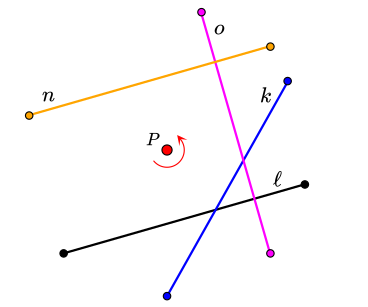
Which of the three segments, k, o and n, corresponds to a 45^(∘), 90^(∘), and a 180^(∘) rotation.
When we rotate a segment, any 90^(∘) rotation will place the rotated segment perpendicular to the original segment. Similarly, a 180^(∘) rotation places the segment parallel to the original segment.
As we can see, segment o has been rotated 90^(∘) and segment n has been rotated 180^(∘) about P. This means segment k must have rotated 45^(∘). line k &→ 45^(∘) rotation line o &→ 90^(∘) rotation line n &→ 180^(∘) rotation

