A ratio is a comparative relation between two quantities.
4:10
Practice makes perfect
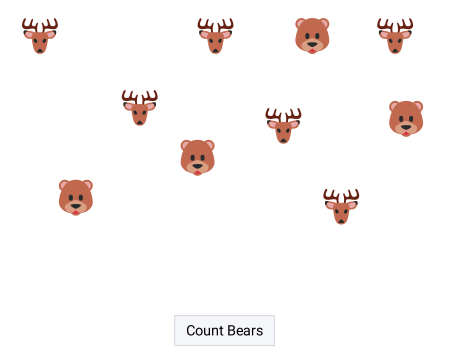
We want to find the ratio of bears to animals. Let's start by counting the number of bears and the total number of animals in the given diagram!
We can see in the diagram that there are 4 bears and 10 total animals. Now, recall that a ratio is a comparison of two quantities by division. This means that to find the ratio of bears to total animals, we divide the number of bears, 4, by the total number of animals, 10. Let's do it!
4/10 l← Number of bears ← Number of animals
The ratio of bears to total animals is 410, which can be also written as 4 to 10 or 4:10. We know that a ratio of ab means that for every a units of one quantity, there are b units of another quantity. Therefore, the ratio of 46 means that for every 4 bears, there are 10 animals.
Extra
Simplify the Ratio
To simplify the ratio, we will divide the numerator and the denominator by their greatest common factor (GCF). The first step in finding a GCF is to express each number as a product of its prime factors. Let's do it!
Given Number
Prime Factorization
Common Prime Factors
4
2* 2
2
10
5* 2
2
The only common prime factor for the given values is 2, so 2 is the GCF of 4 and 10. We can simplify our ratio by dividing the numerator and denominator by 2.
The ratio of bears to total animals is 25, which can be also written as 2 to 5 or 2:5. Recall that the ratio 25 also means that for every 2 bears, there are 5 total animals.