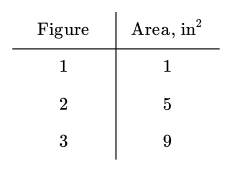
We have been given three figures. We want to know if their areas form an arithmetic sequence. If they do we want to write a function that represents the sequence and we want to find the area of the 30th figure. Let's do it!
Is It Arithmetic?
We are told that the area of each small square is 1 square inch. We can add the areas of the small squares in each figure to find the total areas.
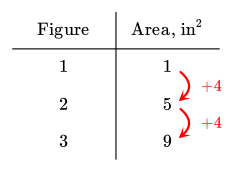
For an arithmetic sequence, the difference between consecutive terms is constant. Let's determine if this is true for our sequence.
Since four squares have been added each time, the area of each figure is 4 larger than the previous one. Therefore, the difference between consecutive terms is constant and we have an arithmetic sequence.
Writing the Function
The common difference d of the sequence is 4. The area of the first figure gives us that the first term a_1 is 1. We can substitute these values into the equation for an arithmetic sequence.
a_n= a_1+(n-1) d
⇓
a_n= 1+(n-1) 4
Let's simplify this function a little bit and rewrite it into a function notation, as requested.