
Cumulative Assessment
Sign In
Reflection: in the x-axis.
Translation: (a,b) → (a+4,b)
| Corresponding sides | Corresponding angles |
|---|---|
| XZ ≅ JL | ∠ X ≅ ∠ J |
| XY ≅ JK | ∠ Y ≅ ∠ K |
| YZ ≅ KL | ∠ Z ≅ ∠ L |
| Point | (a,b) | (a,- b) |
|---|---|---|
| J | (- 3,2) | (- 3,- 2) |
| K | (- 2,4) | (- 2,- 4) |
| L | (0,2) | (0,- 2) |
Now we can graph the image of △ JKL after reflecting it in the x-axis.
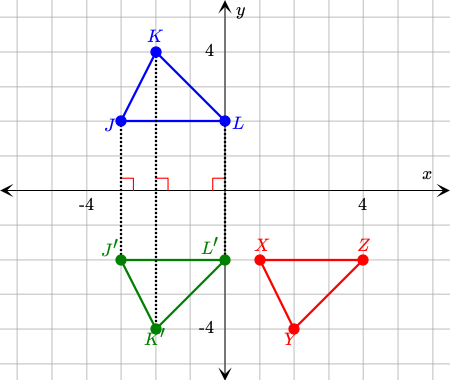
The coordinates of △ J'K'L' has the same vertical position as △ XYZ. Therefore, we only have to translate △ J'K'L' horizontally by 4 units to the right: preimage (a,b) → image (a+4,b) By performing this translation, we can map the triangles to each other.
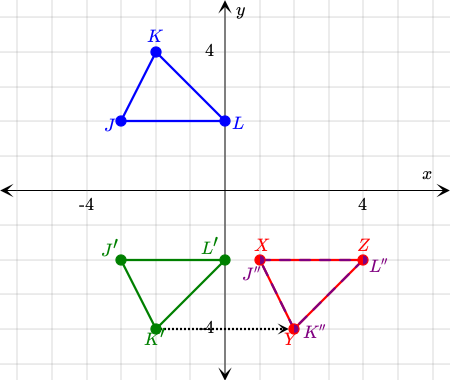
The composition of transformations that maps △ JKL to △ XYZ is: Reflection:& in the $x-$axis. Translation:& (a,b) → (a+4,b)
&Corresponding sides &&Corresponding angles &XZ ≅ JL && ∠ X ≅ ∠ J &XY ≅ JK && ∠ Y ≅ ∠ K &YZ ≅ KL && ∠ Z ≅ ∠ L