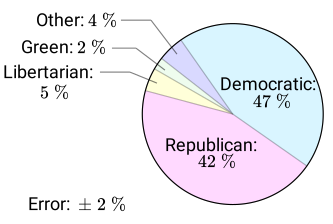
Looking at the graph, we can see that 42 % voted Republican and 2 % voted Green Party. However, taking the margin of error into account, these numbers could either be 2 % lower or 2 % greater.
&Republican
&Minimum: 40 % - 2 % =38 %
&Maximum: 40 % + 2 % =42 % [1em]
&Green Party
&Minimum: 2 % - 2 % =0 %
&Maximum: 2 % + 2 % =4 % [1em]
b The difference between the reported percent and the minimum and maximum percents is -2 and 2, respectively. In both cases the absolute value of these differences is 2.
|-2|= 2=|2|
Using the reported percents as our midpoints, we can write the following absolute value equations to describe the result of the survey for the Republican and Green Party candidate.
Republican:& |x- 42|= 2
Green Party:& |x- 2|= 2
Those equations tell us that the actual results could be 2 more or 2 less than their respective midpoints.
c As we already determined, 44 % falls within the margin of error for the Republican candidate.
Republican Margin: 42 ± 2 %
The only other candidate with votes that come close to 44 % is the Democratic candidate. Let's calculate the minimum percent of votes the Democratic candidate could receive.
47 %- 2 %=45 %.
Since the minimum percent of votes the Democratic candidate could receive is greater than 44 %, the candidate who received 44 % must be Republican.