{{ tocSubheader }}
{{ 'ml-label-loading-course' | message }}
An error ocurred, try again later!
Chapter {{ article.chapter.number }}
{{ article.number }}.
{{ article.displayTitle }}
{{ article.intro.summary }}
Show less Show more expand_more Lesson Settings & Tools
| | {{ 'ml-lesson-number-slides' | message : article.intro.bblockCount }} |
| | {{ 'ml-lesson-number-exercises' | message : article.intro.exerciseCount }} |
| | {{ 'ml-lesson-time-estimation' | message }} |
Angles are present everywhere. For example, when a person makes a peace sign ✌🏼 with their hand, the middle finger and index finger form an angle. Bricklayers 👷🏽♂️ always use angles at work. Different angles are formed at the intersections of roads. This lesson will focus on the essential concept of angles.
Catch-Up and Review
Here are a few recommended readings before getting started with this lesson.
Explore
Notebooks Open!
Think about a spiral notebook 📒. When it is opened, the two covers form an angle. As the cover is rotated, the angle measure changes.
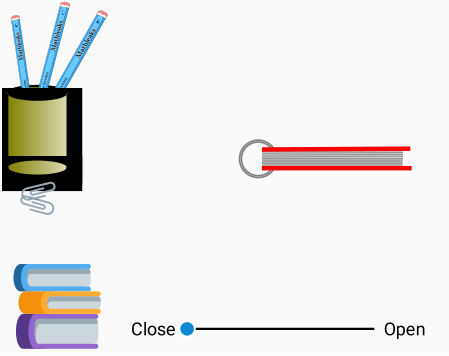 If angles were classified by their measures, what names might they get?
Discussion
Angles
An angle is a plane figure formed by two rays that have the same starting point. This common point is called the vertex of the angle and the rays are the sides of the angle.
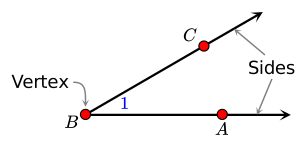
There are different ways to denote an angle and all involve the symbol ∠
in front of the name. One way is to name an angle by its vertex alone. Alternatively, it can be named by using all three points that make up the angle. In this case, the vertex is always in the middle of the name. Additionally, angles within a diagram can be denoted with numbers or lowercase Greek letters.
| Using the Vertex | Using the Vertex and One Point on Each Ray | Using a Number | Using Greek Letters |
|---|---|---|---|
| ∠B | ∠ABC or ∠CBA | ∠1 | ∠α or ∠β or ∠θ |
The measure of an angle, denoted by m∠, is the number of degrees between the rays. It is found by applying the Protractor Postulate.
Interior and Exterior of an Angle
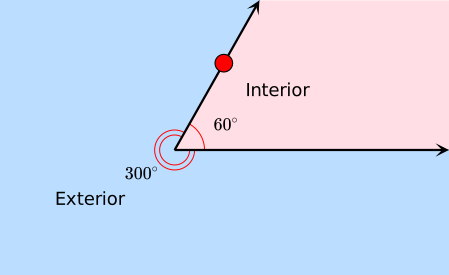
An angle divides the plane into two parts.
- The region between the sides, or
interior
of the angle - The region outside the sides, or
exterior
of the angle
Discussion
Classifying an Angle From Its Measure
The measure of an angle can range from 0∘ to 360∘ or from 0 to 2π radians, a unit of measure that will be studied in the future. Angles can be classified according to their measures into six different types.
Concept
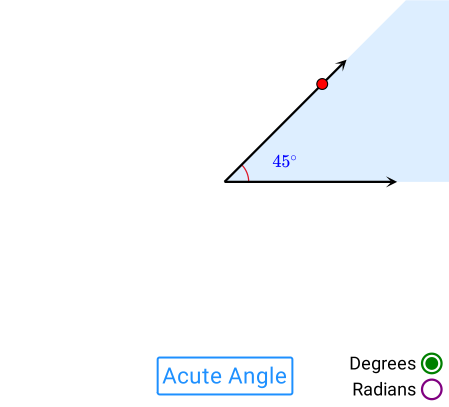
Acute Angle
An acute angle is an angle whose measure is greater than 0∘ but less than 90∘.
Discussion
Angles With a Measure of 90∘
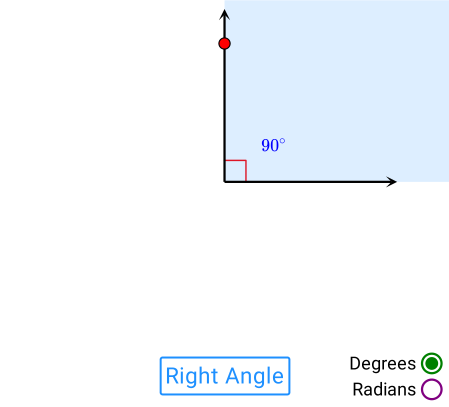
Discussion
Angles With a Measure Ranging From 90∘ to 180∘
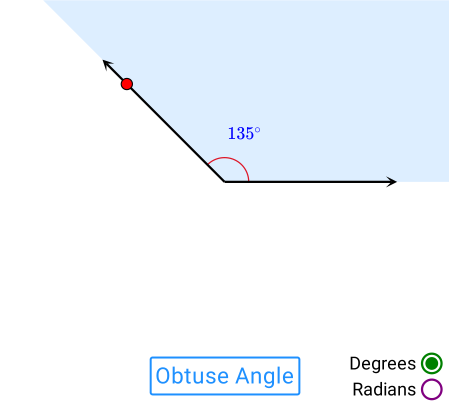
Discussion
Angles With a Measure of 180∘
As with right angles, the following type of angle involves only those angles whose measure is exactly 180∘.
Concept
Straight Angle
A straight angle is an angle whose measure is exactly 180∘.
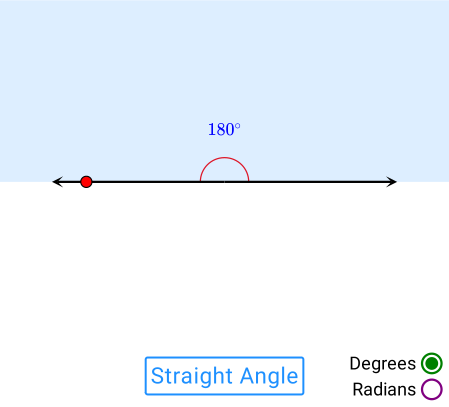
Discussion
Angles With a Measure Greater Than 180∘
The fifth type of angle includes angles whose measure is greater than 180∘ but less than 360∘. This is the largest range of measures.
Concept
Reflexive Angle
A reflexive angle is an angle whose measure is greater than 180∘ but less than 360∘. An alternative name for this type of angle is reflex angle.
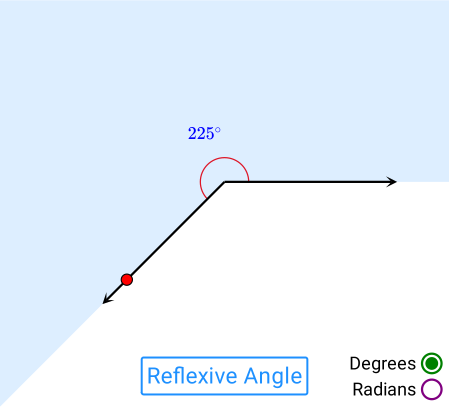
Discussion
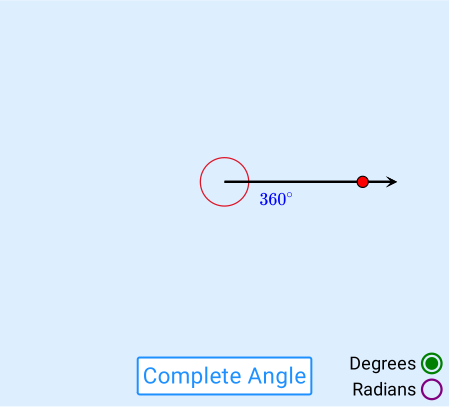
Angles With a Measure of 360∘
Pop Quiz
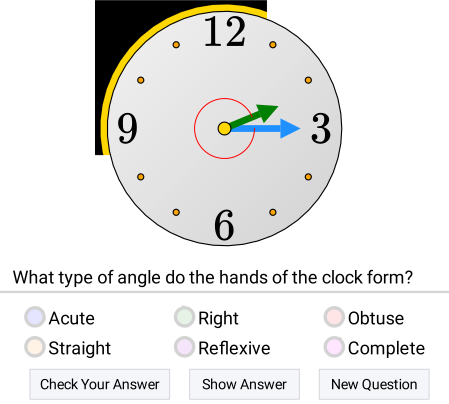
Angles on a Clock Face
As time passes, the hands of a clock form different angles. Classify the indicated angle by estimating its measure.
Discussion
Angles With the Same Measure
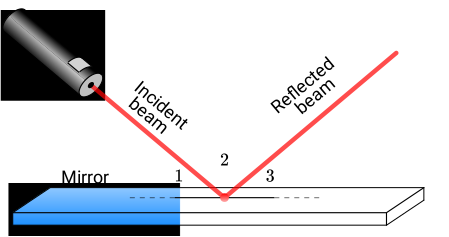
When a laser is pointed at a mirror, the light beam is reflected in such a way that the angle between the incident beam and the mirror measures the same as the angle between the reflected beam and the mirror.
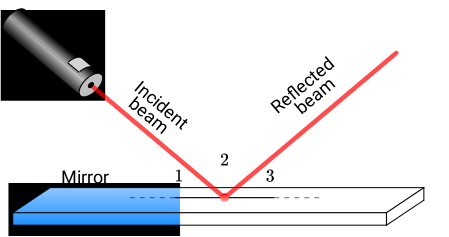
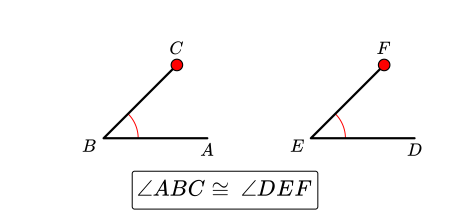
In the diagram, ∠1 and ∠3 have the same measure. Angles with the same measure have a special name.
Concept
Congruent Angles
Discussion
Classifying Angle Pairs Based on Their Position
Angles can also be classified based on their position relative to other angles.
Concept
Adjacent Angles
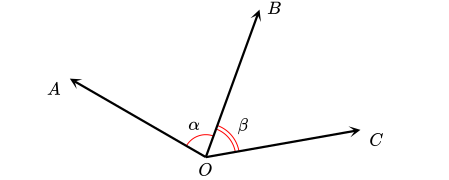
Going back to the diagram of the laser and the mirror, notice that the point where the beam hits the mirror is the vertex of three angles.
Discussion
Vertical Angles
Two angles are vertical angles if they are opposite angles formed by the intersection of two lines or line segments. In the diagram, vertical angles are marked with the same number of angle markers.
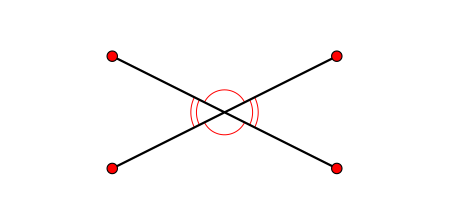
Vertical angles are always congruent.
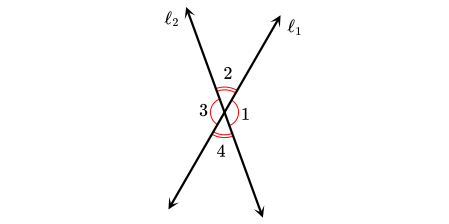
Based on the characteristics of the diagram, the following relations hold true.
∠1≅∠3
∠2≅∠4
Example
Naming Pairs of Angles
In the diagram, lines AD and CE intersect at point X, and B is a point on the interior of ∠AXC.
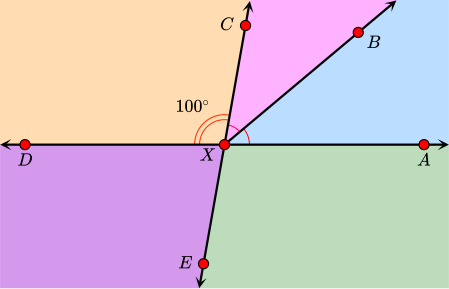
a Name a pair of congruent angles, a pair of adjacent angles, and a pair of vertical angles, if there are any.
b Is there any relation between ∠BXC and ∠DXE?
c What is the measure of ∠EXA?
Answer
a
| Congruent Angles | Adjacent Angles | Vertical Angles |
|---|---|---|
| ∠AXB and ∠BXC ∠CXD and ∠EXA ∠DXE and ∠AXC |
∠AXB and ∠BXC ∠BXC and ∠CXD ∠CXD and ∠DXE ∠DXE and ∠EXA ∠EXA and ∠AXB |
∠CXD and ∠EXA ∠DXE and ∠AXC |
b There is no relation between ∠BXC and ∠DXE.
c m∠EXA=100∘
Hint
b Remove the unnecessary parts of the diagram to have a better look.
c Use the fact that ∠CXD measures 100∘.
Solution
a Start by identifying whether there are congruent angles, or angles with the same measure. In the diagram, only one angle measure is shown. However, congruent angles are also denoted with the same number of angle markers.
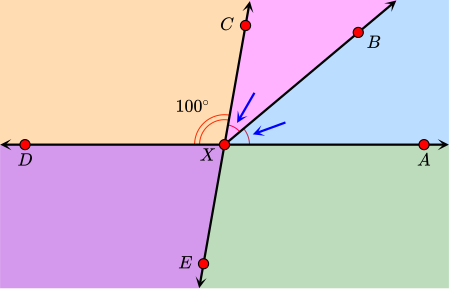
Since ∠AXB and ∠BXC have the same number of markers, the angles are congruent.
| Congruent Angles |
|---|
| ∠AXB and ∠BXC |
Next, focus on identifying adjacent angles. Adjacent angles have the same vertex, share one side, and they do not overlap. These three conditions are met by ∠DXE and ∠EXA.
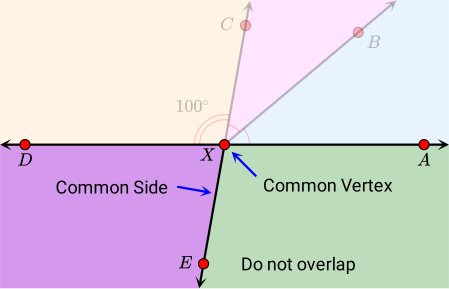
In the diagram there are five pairs of adjacent angles.
| Adjacent Angles |
|---|
| ∠AXB and ∠BXC |
| ∠BXC and ∠CXD |
| ∠CXD and ∠DXE |
| ∠DXE and ∠EXA |
| ∠EXA and ∠AXB |
Finally, look for vertical angles. Vertical angles are opposite angles formed when two lines or line segments intersect. Since lines AD and CE intersect at X, they form two pairs of vertical angles. To make it easier to see, ignore the unnecessary parts of the diagram and focus on just these two lines.
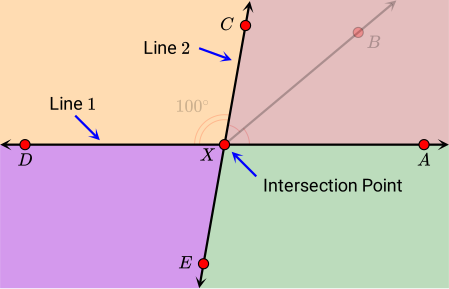
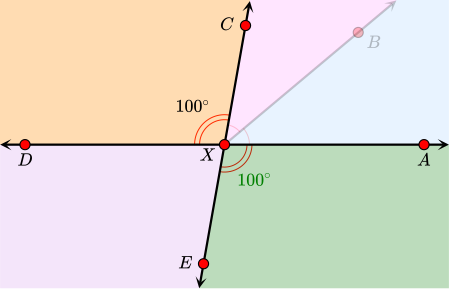
From the diagram, ∠CXD and ∠EXA are vertical angles, as are ∠DXE and ∠AXC.
| Vertical Angles |
|---|
| ∠CXD and ∠EXA |
| ∠DXE and ∠AXC |
Because vertical angles are always congruent, the last pairs of angles are also congruent angles. All the information obtained from the diagram is summarized in the following table.
| Congruent Angles | Adjacent Angles | Vertical Angles |
|---|---|---|
| ∠AXB and ∠BXC ∠CXD and ∠EXA ∠DXE and ∠AXC |
∠AXB and ∠BXC ∠BXC and ∠CXD ∠CXD and ∠DXE ∠DXE and ∠EXA ∠EXA and ∠AXB |
∠CXD and ∠EXA ∠DXE and ∠AXC |
b To check whether ∠BXC and ∠DXE are related, ignore the irrelevant parts for a moment.
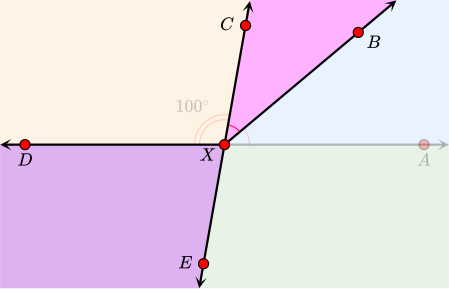
The angles have the same vertex but they do not have a common side. Therefore, they are not adjacent angles. Notice that ∠DXE has no angle marker and its measure seems to be greater than the measure of ∠BXC. Therefore, the angles are not congruent.
| ∠BXC and ∠DXE | ||
|---|---|---|
| Adjacent | Congruent | Vertical |
| × | × | ? |
Lastly, note that E, X, and C lie on the same line but D, X, and B do not. Therefore, ∠BXC and ∠DXE are not vertical angles. As such, there is no relation between these angles.
| ∠BXC and ∠DXE | ||
|---|---|---|
| Adjacent | Congruent | Vertical |
| × | × | × |
c From Part A, ∠EXA and ∠CXD are vertical angles, which also means they are congruent. This means that they have the same measure. Since the measure of ∠CXD is 100∘, the measure of ∠EXA is also 100∘.
Discussion
Angle Relationships Based on Measures
In addition to adjacent, vertical, and congruent angles, pairs of angles can be classified in three more ways based on the sum of their measures.
Concept
Complementary Angles
Two angles are complementary angles when the sum of their measures is 90∘.
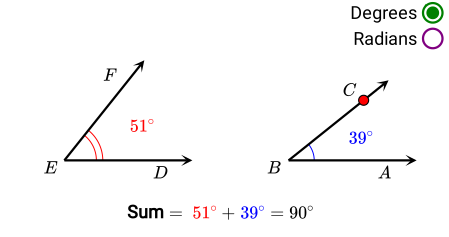 In the diagram, ∠B and ∠E are complementary because the sum of their measures is equal to 90∘.
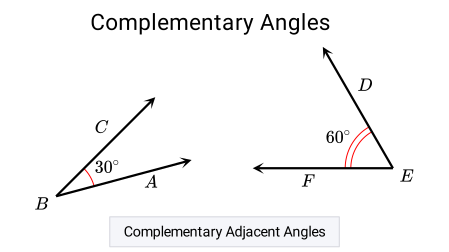
m∠B+m∠E=90∘
Notice that if two angles are complementary, they are by necessity acute angles. Also, if two complementary angles are adjacent, the angle formed by the not common sides is a right angle.
Example
Angle Formed by the Clock Hands
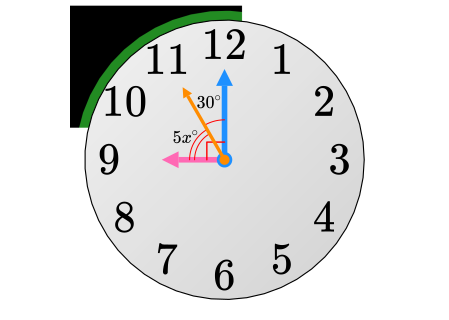
When the clock shows 09:00 and 55 seconds, the angle between the minute hand and the second hand is 30∘, while the angle between the minute hand and the hour hand is 90∘.
{"type":"text","form":{"type":"math","options":{"comparison":"1","nofractofloat":false,"keypad":{"simple":true,"useShortLog":false,"variables":[],"constants":[]},"rendered":false},"text":"<span class=\"katex\"><span class=\"katex-html\" aria-hidden=\"true\"><\/span><\/span>"},"formTextBefore":"<span class=\"katex\"><span class=\"katex-html\" aria-hidden=\"true\"><span class=\"base\"><span class=\"strut\" style=\"height:0.43056em;vertical-align:0em;\"><\/span><span class=\"mord mathdefault\">x<\/span><span class=\"mspace\" style=\"margin-right:0.2777777777777778em;\"><\/span><span class=\"mrel\">=<\/span><\/span><\/span><\/span>","formTextAfter":null,"answer":{"text":["12"]}}
Hint
The angle formed by the minute hand and the second hand is complementary to the angle formed by the second hand and the hour hand.
Solution
Start by marking a few points on the diagram to make it easy to reference its parts.
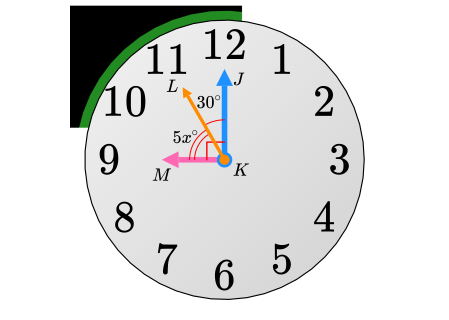
m∠JKL+m∠LKM=90∘
From the diagram, m∠JKL=30∘ and m∠LKM=5x∘. Substitute these values into the equation and solve for x.
Discussion
Supplementary Angles
Two angles are supplementary angles when the sum of their measures is 180∘.
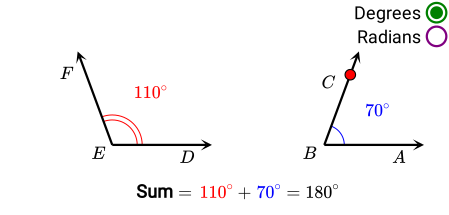 In the diagram, ∠B and ∠E are supplementary because the sum of their measures equals 180∘.
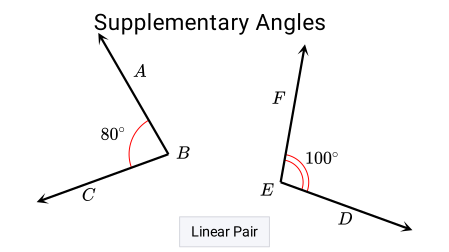
m∠B+m∠E=180∘
If two angles are supplementary, either both are right angles or one is acute and the other obtuse. When two supplementary angles are adjacent, they are called a linear pair or straight angle pair. Notice that a linear pair forms a straight angle.
Example
Computer Screen Tilt
Some studies recommend tilting the computer screen 💻 slightly backwards between 10∘ and 20∘ for better posture and range of vision.
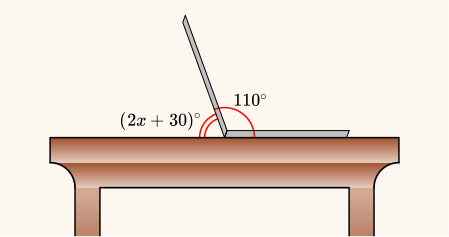
{"type":"text","form":{"type":"math","options":{"comparison":"1","nofractofloat":false,"keypad":{"simple":true,"useShortLog":false,"variables":[],"constants":[]},"rendered":false},"text":"<span class=\"katex\"><span class=\"katex-html\" aria-hidden=\"true\"><\/span><\/span>"},"formTextBefore":"<span class=\"katex\"><span class=\"katex-html\" aria-hidden=\"true\"><span class=\"base\"><span class=\"strut\" style=\"height:0.43056em;vertical-align:0em;\"><\/span><span class=\"mord mathdefault\">x<\/span><span class=\"mspace\" style=\"margin-right:0.2777777777777778em;\"><\/span><span class=\"mrel\">=<\/span><\/span><\/span><\/span>","formTextAfter":null,"answer":{"text":["20"]}}
Hint
The computer screen forms two supplementary angles with the table.
Solution
Notice that the computer screen forms two angles with the table and that these two angles together form a straight angle. This means that the angles are supplementary.
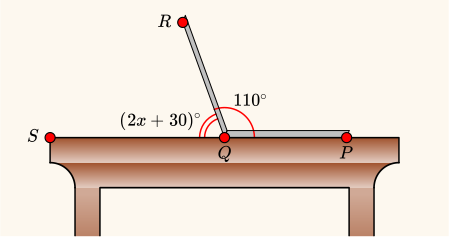
m∠PQR+m∠RQS=180∘
From the diagram, m∠PQR=110∘ and m∠RQS=(2x+30)∘. Substitute these measures into the equation and solve for x.
Discussion
Explementary Angles
Two angles are explementary angles, also called conjugate angles, when the sum of their measures is 360∘.
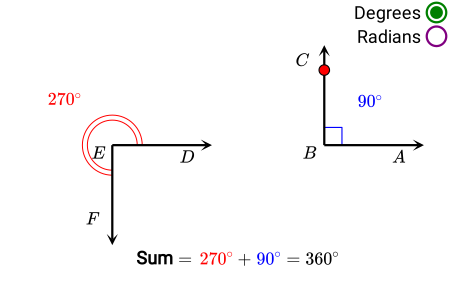 In the diagram, ∠B and ∠E are explementary because the sum of their measures is 360∘.
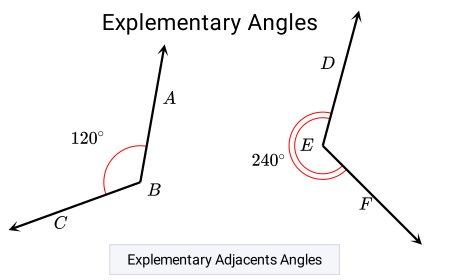
m∠B+m∠E=360∘
If two angles are explementary, either both are straight angles or one is a reflexive angle while the other can be acute, right, or obtuse. Notice that if two explementary angles are adjacent, they form a complete angle.
Example
Blind Spot Angle
When a human focuses their eyes 👀 on a point in front of them, their range of binocular vision is approximately 120∘.
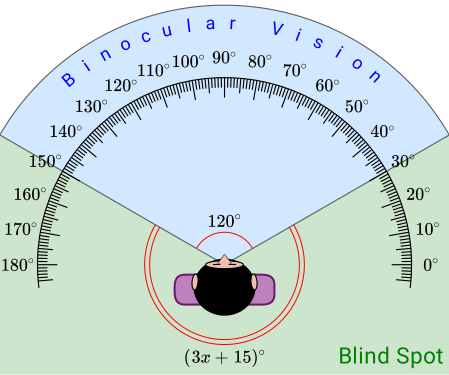
{"type":"text","form":{"type":"math","options":{"comparison":"1","nofractofloat":false,"keypad":{"simple":true,"useShortLog":false,"variables":[],"constants":[]},"rendered":false},"text":"<span class=\"katex\"><span class=\"katex-html\" aria-hidden=\"true\"><\/span><\/span>"},"formTextBefore":"<span class=\"katex\"><span class=\"katex-html\" aria-hidden=\"true\"><span class=\"base\"><span class=\"strut\" style=\"height:0.43056em;vertical-align:0em;\"><\/span><span class=\"mord mathdefault\">x<\/span><span class=\"mspace\" style=\"margin-right:0.2777777777777778em;\"><\/span><span class=\"mrel\">=<\/span><\/span><\/span><\/span>","formTextAfter":null,"answer":{"text":["75"]}}
Hint
The binocular vision angle and the blind spot angle are explementary angles.
Solution
For simplicity, mark some points in the given diagram.
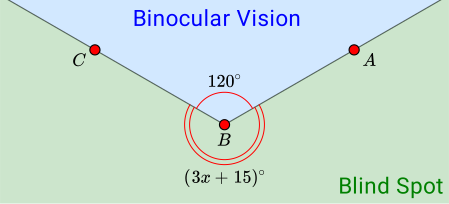
m∠ABC+m∠CBA=360∘
From the diagram, the binocular vision angle measures 120∘ and the blind spot angle measures (3x+15)∘. Substitute 120 for m∠ABC and (3x+15)∘ for m∠CBA and solve the equation for x.
If x=75, it can be also found that the blind spot angle measures 240∘.
Pop Quiz
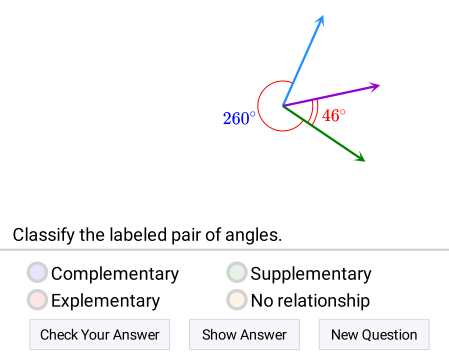
Classifying Pairs of Angles
Classify each given pair of angles as complementary, supplementary, or explementary angles, or if they have no relationship.
Pop Quiz
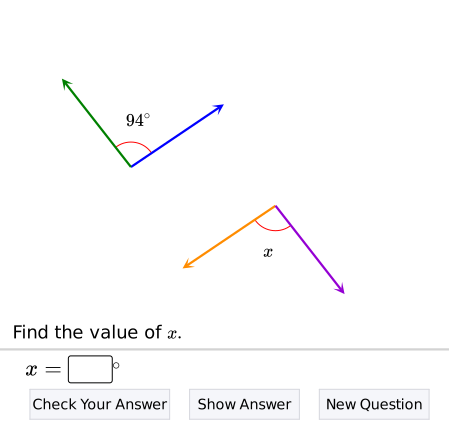
Finding Angle Measures
For each of the given diagrams, find the value of x.
Discussion
Non-Intersecting Lines
Suppose two lines are drawn on a sheet of paper 📄. If the lines were to extend beyond the edges of the paper, there are only two possible cases for the lines: they either cross or they do not. When the lines do not intersect, they are called parallel lines.
Concept
Parallel Lines
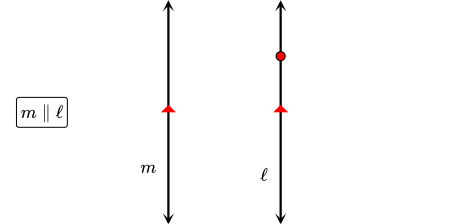
Two coplanar lines — lines that are on the same plane — that do not intersect are said to be parallel lines. In a diagram, triangular hatch marks are drawn on lines to denote that they are parallel. The symbol ∥
is used to algebraically denote that two lines are parallel. In the diagram, lines m and ℓ are parallel.
Discussion
Special Case of Intersecting Lines
If two lines intersect each other and the angle between them is a right angle, the lines are called perpendicular lines.
Concept
Perpendicular Lines
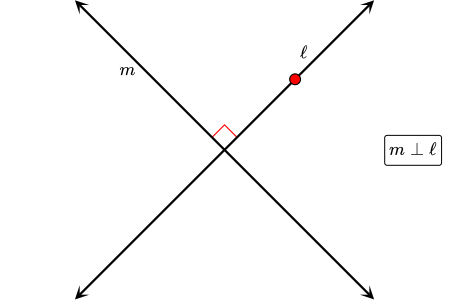
Two coplanar lines — lines that are on the same plane — that intersect at a right angle are said to be perpendicular lines. The symbol ⊥
is used to algebraically denote that two lines are perpendicular. In the diagram, lines m and ℓ are perpendicular.
Pop Quiz
Classifying Pairs of Lines
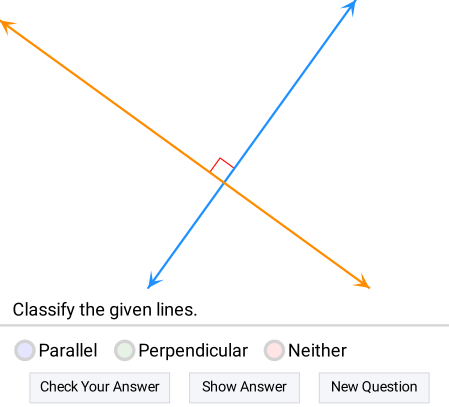
For each pair of lines given, determine whether they are parallel, perpendicular, or neither. Remember, parallel lines are denoted with triangular hatch marks.
Closure
Drawing Three Lines
When three lines are drawn on a piece of paper 📄 and one of the lines cuts the other two, the paper is divided into six different regions. Additionally, eight angles are formed — four at each intersection point.
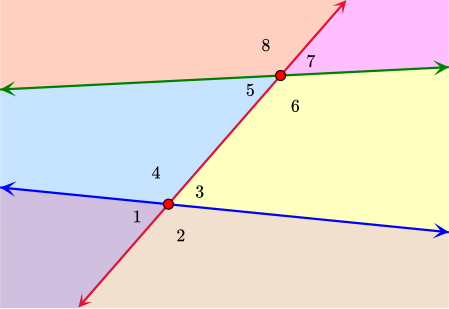 At each intersection point there are two pairs of vertical angles and four pairs of supplementary angles.
But this is not all! The angles formed at one intersection point can also be related to the angles formed at the other intersection point. These relationships will be explored later in the course.
| Vertical Angles | Supplementary Angles |
|---|---|
| ∠1 and ∠3 ∠2 and ∠4 |
∠1 and ∠2, ∠2 and ∠3 ∠3 and ∠4, ∠4 and ∠1 |
| ∠5 and ∠7 ∠8 and ∠9 |
∠5 and ∠6, ∠6 and ∠7 ∠7 and ∠8, ∠8 and ∠5 |
Loading content