4. Triangles
+ Customize lesson
0
0
Sign In
Triangles are foundational geometric shapes that appear in various mathematical and practical contexts. Understanding their properties and classifications enables deeper insight into geometry. Different types of triangles, such as acute, right, and obtuse, are categorized based on angles, while equilateral, isosceles, and scalene triangles are distinguished by their sides. The Triangle Inequality Theorem plays a critical role in determining possible side lengths and ensuring a valid triangle. Exploring these concepts enhances problem-solving skills and supports applications in fields like construction, design, and engineering. Mastery of triangle properties also serves as a stepping stone to more advanced topics in trigonometry and geometry.
Show less Show more expand_more| Student Learning Objectives: |
|---|
|
| | 18 Theory slides |
| | 11 Exercises - Grade E - A |
| | Each lesson is meant to take 1-2 classroom sessions |
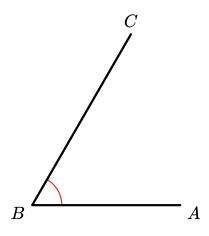
Consider three segments AB, BC and AC that form three angles. Click and drag point C to change the shape of the figure.
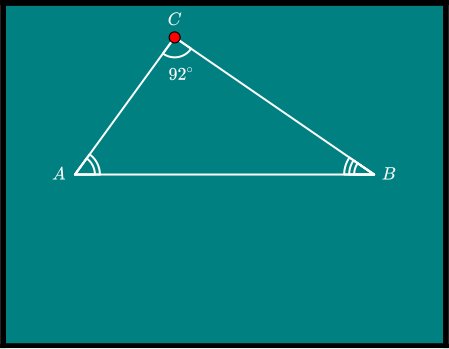
Dylan and Zosia love to solve riddles and decided to have a competition to see who can solve them faster. In one riddle, they have to form a triangle with three matchsticks that are 4, 4.5, and 8.8 centimeters long.
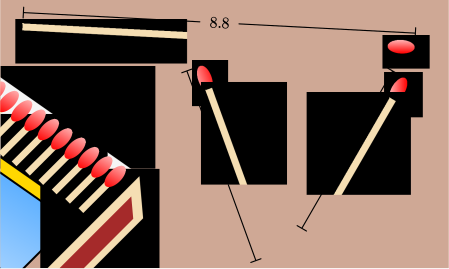
Dylan says that such a triangle cannot be formed, while Zosia says it can. Who is right?
The second type of triangle groups all those triangles that have one right angle.
A right triangle is a triangle that has one right angle. The side opposite the right angle is always the longest and is known as the hypotenuse. The other sides are commonly called legs. Notice that in a right triangle, the legs are perpendicular to each other.

The next type of triangle includes those triangles that have one obtuse angle.
An obtuse triangle is a triangle that has one obtuse angle. In other words, one of the angles measures more than 90^(∘).

The last classification of triangles according to the measure of their angles consists of those triangles that have three angles of the same measure.
An equiangular triangle is a triangle in which the three angles have the same measure. In other words, the three angles are congruent. In fact, the three angles measure 60^(∘) each.

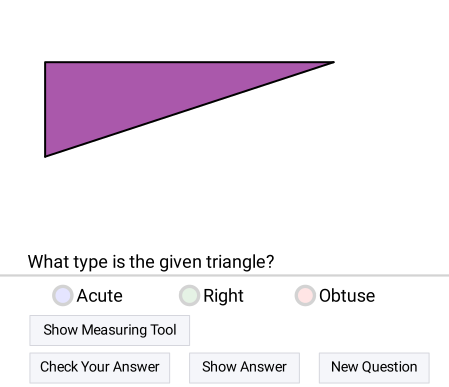
Classify the given triangle according to its angle measures as an acute, right, or obtuse triangle.
The same way two angles with the same measure are called congruent angles, there is a special term for two segments that have the same length.
In addition to their angle measures, triangles can also be classified by comparing the lengths of their three sides. There are three different types. The first includes those triangles in which all three sides have the same length.
An equilateral triangle is a triangle in which the three sides have the same length. In other words, the three sides are congruent.

The second way of classifying a triangle according to its side lengths includes all the triangles in which only two sides have the same length.
An isosceles triangle is a triangle that has exactly two sides of the same length. In other words, it has two congruent sides. The congruent sides are called legs while the third side is called the base. The angle between the legs is called the vertex angle and the other two angles are called base angles.

The last classification of triangles based on their side lengths is when the three sides have different lengths.
A scalene triangle is a triangle in which all three sides have different lengths. In other words, it has no congruent sides.

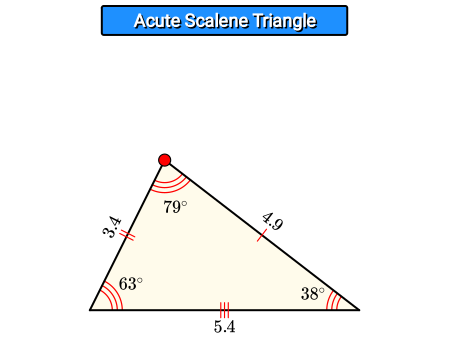
Classify the given triangle according to its side lengths as an equilateral, isosceles, or scalene triangle.

In any triangle, the sum of the lengths of any two sides is greater than the length of the third side.

AB + BC > AC BC + AC > AB AC + AB > BC
At lunch, Ali challenged Dylan and Zosia to build a triangle with the objects they had on hand. He offered a free dessert to whoever did it successfully.

Since Zosia brought Chinese food and a soft drink, she decided to use the two chopsticks and the straw to build her triangle. The straw is 18 centimeters long and the chopsticks are each 24 centimeters long.

For his part, Dylan decided to use a pen, a short pencil, and a small crayon from his backpack. The pen, pencil, and crayon are 15, 9, and 5 centimeters long, respectively.

Who will get the free dessert?
Start by writing the lengths of the objects that Zosia chose.
| Object | Length (cm) |
|---|---|
| Straw | 18 |
| Chopstick 1 | 24 |
| Chopstick 2 | 24 |
Now, calculate the sums of the lengths of the possible pairs of objects and check if they are greater than the length of the third object.
| Pair of Objects | Sum of Lengths | Object 3 | Comparison |
|---|---|---|---|
| Straw and Chopstick 1 | 18+24=42 | Chopstick 2 | 42 > 24 ✓ |
| Straw and Chopstick 2 | 18+24=42 | Chopstick 1 | 42 > 24 ✓ |
| Chopstick 1 and Chopstick 2 | 24+24=48 | Straw | 48 > 18 ✓ |
As shown, the sum of the lengths of any two objects is always greater than the length of the third object. Therefore, Zosia can form a triangle with the objects she chose, so she will get a free dessert!

Notice that the triangle has two sides of the same length, which means that Zozia built an isosceles triangle.
Dylan can build a triangle with the objects he chose only if their lengths meet the Triangle Inequality Theorem. Follow the same process to see if he can earn a free dessert. Begin by writing the lengths of the objects.
| Object | Length (cm) |
|---|---|
| Pen | 15 |
| Pencil | 9 |
| Crayon | 5 |
Next, calculate the sums of the lengths of the possible pairs of objects and verify if they are greater than the length of the third object.
| Pair of Objects | Sum of Lengths | Object 3 | Comparison |
|---|---|---|---|
| Pen and Pencil | 15+9=24 | Crayon | 24 > 5 ✓ |
| Pen and Crayon | 15+5=20 | Pencil | 20 > 9 ✓ |
| Pencil and Crayon | 9+5=14 | Pen | 14 > 15 * |
The sum of the lengths of the pencil and the crayon in the last row of the table is not greater than the length of the pen, which means that the object's lengths do not meet the Triangle Inequality Theorem. Dylan cannot build a triangle with the objects he chose, so he will not get a free dessert. Bummer!

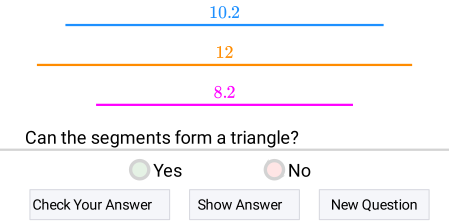
Determine whether the given segments can form a triangle.
At the beginning of the lesson, Dylan and Zosia were challenged to form a triangle using three matchsticks. However, they came to opposite conclusions. Dylan claimed that no triangle could be formed with the given matches, while Zosia said that a triangle could be formed.
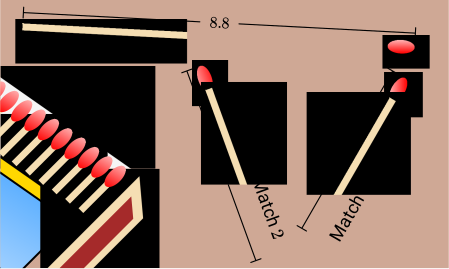
The riddle can be solved with the information given in this lesson. The three matches can form a triangle if they satisfy the Triangle Inequality Theorem. In other words, check whether the sum of the lengths of any pair of matches is greater than the length of the third match.
| Pair of Matches | Sum of Lengths | Third Match | Comparison |
|---|---|---|---|
| Match 1 & Match 2 | 8.8+4.5=13.3 | 4.0 | 13.3 > 4.0 ✓ |
| Match 1 & Match 3 | 8.8+4.0=12 | 4.5 | 12 > 4.5 ✓ |
| Match 2 & Match 3 | 4.5+4.0=8.5 | 8.8 | 8.5 > 8.8 * |
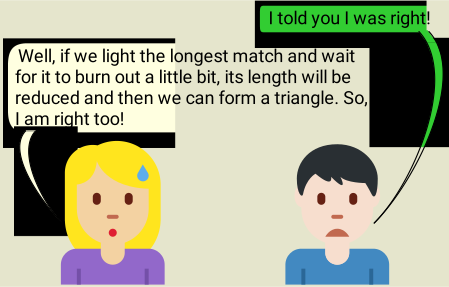
As shown, the sum of the lengths of the two shorter matches is not greater than the length of the longest match. Therefore, the given matchsticks cannot form a triangle. Dylan was right!
Before moving forward, keep in mind that a triangle can be classified simultaneously by angle measures and side lengths.
Diego and Paulina will go to the baseball stadium after school. They will follow different paths. Paulina will follow the path that passes by the hospital. The streets that connect the school, the hospital, and the stadium form a triangle.

If Diego and Paulina walk at the same pace and do not stop along the way, who will get to the stadium first?
Diego and Paulina walk at the same pace and do not stop along the way, so whoever has chosen the shortest path will arrive first.
The streets that connect the school, the hospital, and the baseball stadium form a triangle. This means that the lengths of the sides of this triangle satisfy the Triangle Inequality Theorem and so, three inequalities can be written. SH + HB &> SB [0.4em] HB + SB &> SH [0.4em] SB + SH &> HB The first inequality tells us that the path from the school to the stadium that passes by the hospital is longer than the path that directly connects the school and the stadium. We can conclude that Diego will arrive first.