The explicit formula of an arithmetic sequence combines the information provided by the two equations of the recursive form into a single equation.
Recursive:& A(n)=A(n-1)+ d;
& A(1)= A_1 [0.8em]
Explicit:& A(n)= A(1)+(n-1) dIn these formulas, d is the common difference and A(1) is the first term.
Looking at the given recursive formula, we can identify the common difference d and the value of the first term A_1.
A(n)=A(n-1)+ 12; A(1)= 12
We can see that 12 is the common difference and the first term is also 12. Now we have enough information to form an explicit formula for this sequence.
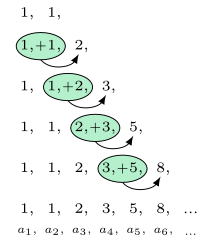
One particularly well-known sequence that is defined recursively is the Fibonacci sequence, in which each term is the sum of the two previous terms. It is a well-known sequence whose first few terms are 1,1,2,3,5,8 ... As shown, the first two terms are 1 and 1 and each subsequent term will be the sum of the previous two terms.
For every term after the second term, the sequence can be expressed by the following recursive rule.
&a_1 = 1
&a_2 = 1
&a_n = a_(n - 1) + a_(n - 2).
This means that, in order to determine the fourth term of the sequence, a_4, one must have the terms a_3 and a_2.
a_4 = a_3 + a_2=2+1=3.
The sequence is named after the Italian mathematician Leonardo Fibonacci, who used it to describe how pairs of rabbits increases as they multiply under certain conditions. Sometimes, the first two numbers are defined as a_1=0 and a_2=1. This, however, does not change the sequence in any way other than by increasing the index of every term by one compared to the previously mentioned definition.